How to Calculate Battery Capacity and Runtime for Industrial Applications

If you’ve ever had a critical system go dark mid-shift — a forklift stranded in an aisle, a sensor array dropping offline during a production run — you already know the cost of getting battery sizing wrong. In industrial environments, that cost isn’t just inconvenience. It’s downtime, and downtime has a dollar figure attached to every minute.
Getting battery capacity and runtime right the first time requires more than reading a spec sheet. It requires understanding how your load actually behaves, how your environment affects chemistry performance, and how to build in the margins that keep operations running when conditions aren’t ideal.
Understanding the Core Metrics: Capacity vs. Runtime
Battery capacity and battery runtime are related but distinct concepts, and conflating them is one of the most common sources of sizing errors in industrial projects.
Capacity (measured in ampere-hours, or Ah) describes how much charge a battery can store. A 100 Ah battery can theoretically deliver 100 amps for one hour, or 10 amps for ten hours — at least in theory.
Runtime is how long that battery will actually power your specific load under your specific conditions. Runtime depends on capacity, yes, but also on discharge rate, temperature, battery age, depth of discharge limits, and the efficiency of your power conversion hardware.
The gap between the two is where industrial projects run into trouble.
Step 1 — Determine Your Load Profile
Before any math happens, you need an accurate picture of what the battery is actually powering. Industrial loads are rarely simple or constant.
Start by listing every electrical load in the system:
- Continuous loads: Motors running at steady state, HVAC units, lighting circuits, control panels
- Intermittent loads: Solenoids, actuators, conveyors that cycle on and off
- Surge or inrush loads: Motor startups, compressors, pumps — equipment that draws 3–7× its rated current for a fraction of a second at startup
For each load, note its rated wattage or amperage and its estimated duty cycle — the percentage of time it’s actually drawing power during operation.
Example load profile for an industrial UPS application:
| Load | Watts | Duty Cycle | Average Draw |
| PLC and controls | 150 W | 100% | 150 W |
| Communication equipment | 80 W | 100% | 80 W |
| Indicator lighting | 40 W | 60% | 24 W |
| Emergency ventilation | 500 W | 20% | 100 W |
| Total average load | 354 W |
This average load figure is what you’ll carry into your runtime calculation. If you’re working in amps rather than watts, divide by your system voltage (typically 12V, 24V, 48V, or 120V DC for industrial systems).
Step 2 — Convert to Amp-Hours
The fundamental runtime formula is straightforward:
Runtime (hours) = Battery Capacity (Ah) ÷ Load Current (A)
Working from the example above at a 48V system:
- Average load = 354 W
- Load current = 354 W ÷ 48 V = 375 A
- With a 200 Ah battery bank: Runtime = 200 ÷ 7.375 = ~27 hours
That’s the theoretical number. Now comes the part most sizing guides skip.
Step 3 — Apply Real-World Correction Factors
Raw Ah math assumes ideal conditions. Industrial environments are not ideal. You need to derate your calculated runtime — or, equivalently, upsize your battery bank — to account for several factors.
The Peukert Effect
Battery capacity isn’t fixed. It shrinks as discharge rate increases. This relationship, described by Peukert’s Law, is especially significant for lead-acid chemistries.
A 200 Ah lead-acid battery discharged at its 20-hour rate (C/20, or 10 A) may deliver its full 200 Ah. Discharge the same battery at 100 A and you might only get 140–160 Ah before voltage collapses. Lithium chemistries are far less affected — one of the practical reasons lithium-iron phosphate (LiFePO4) has gained traction in industrial applications.
As a rule of thumb for lead-acid at moderate discharge rates: apply a Peukert derating of 10–20% if your discharge rate is faster than C/10.
Temperature
Battery capacity drops significantly in cold environments. Lead-acid batteries lose roughly 1% of capacity for every degree Celsius below 25°C (77°F). At 0°C, you may have 75–80% of rated capacity. At –20°C, you could be down to 50% or less.
Lithium chemistries handle cold better but have their own thresholds and charge restrictions at low temperatures.
Cold temperature correction factor:
| Temperature | Lead-Acid Derating |
| 25°C (77°F) | 100% (baseline) |
| 10°C (50°F) | ~85% |
| 0°C (32°F) | ~75% |
| –10°C (14°F) | ~65% |
| –20°C (–4°F) | ~50% |
If your equipment operates outdoors in northern climates or in refrigerated warehouses, this factor alone can cut your runtime in half.
Depth of Discharge (DoD) Limits
Running a battery to zero is a fast path to premature failure. Different chemistries tolerate different discharge depths:
- Flooded lead-acid: Limit to 50% DoD for reasonable cycle life
- AGM/VRLA: 50–60% DoD recommended
- Lithium (LiFePO4): 80–90% DoD with minimal cycle life impact
If you’re using lead-acid and limiting to 50% DoD, your usable capacity is half the nameplate rating. A 200 Ah battery only gives you 100 Ah to work with.
Aging and State of Health
A new battery performs at or near its rated capacity. After 500 cycles, a lead-acid battery may be at 80% capacity. After 1,000 cycles, you might be looking at 60% or less. Industrial battery banks should be sized for end-of-life performance, not new-battery performance, unless replacement is factored into the maintenance schedule at predictable intervals.
A 20% aging buffer is a common industry starting point.
System Efficiency Losses
Inverters, charge controllers, and cabling all introduce losses. A 95%-efficient inverter wastes 5% of every watt-hour passing through it. Don’t forget to account for these when calculating how much capacity your loads actually consume from the battery.
Step 4 — Build Your Sizing Formula
Bringing the correction factors together:
Required Capacity (Ah) = [Load (W) × Runtime (h)] ÷ [Voltage × DoD × Temperature Factor × Efficiency × Aging Factor]
Using the earlier example, targeting 8 hours of runtime on a 48V system with AGM batteries in a 10°C environment:
- Load = 354 W
- Runtime target = 8 hours
- Voltage = 48 V
- DoD limit = 0.55
- Temperature factor = 0.85
- System efficiency = 0.93
- Aging buffer = 0.80
Required Ah = (354 × 8) ÷ (48 × 0.55 × 0.85 × 0.93 × 0.80)
Required Ah = 2,832 ÷ (48 × 0.3489)
Required Ah = 2,832 ÷ 16.75 = ~169 Ah
So you’d specify a 200 Ah battery bank (the next standard size up), not the 100 Ah bank that the raw theoretical math might have suggested.
Step 5 — Choose the Right Battery Chemistry
Sizing and chemistry selection are inseparable. The same runtime requirement carries very different cost, weight, footprint, and maintenance implications depending on what you put in the cabinet.
Lead-Acid (Flooded or AGM) Still the workhorse of industrial backup power. Lower upfront cost, mature technology, wide temperature tolerance for charging (with proper management). Downsides: heavy, limited DoD, sensitive to discharge rate, requires periodic replacement. Best fit for stationary applications where weight and footprint aren’t constrained.
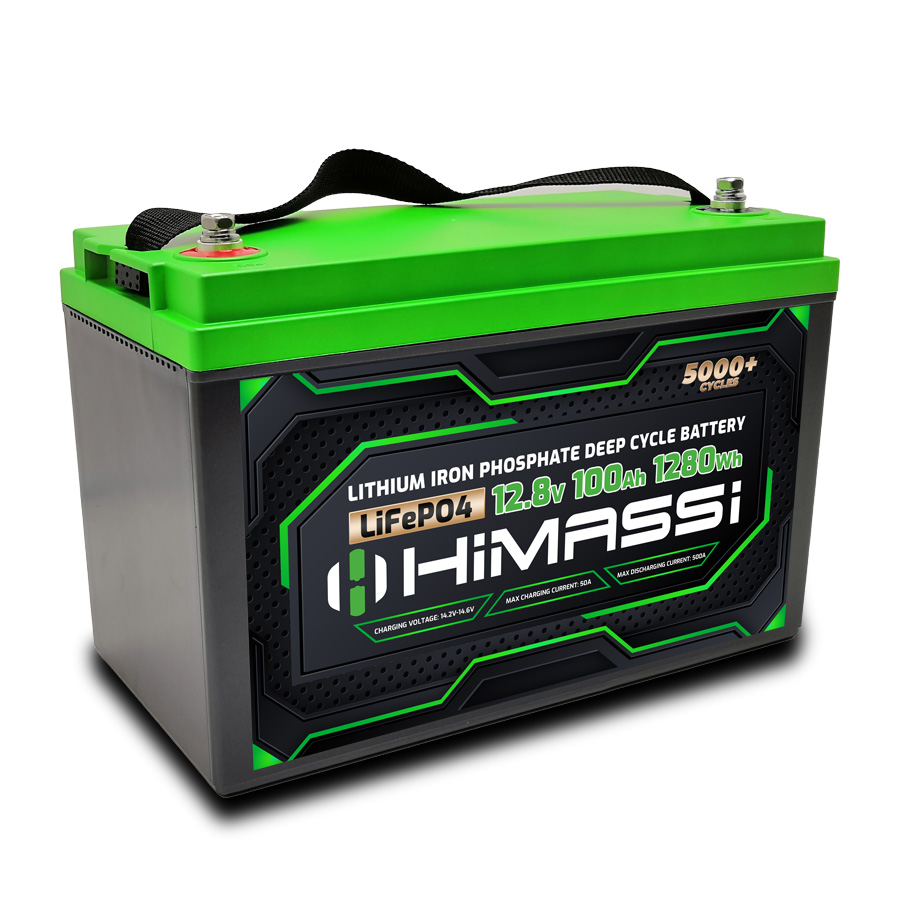
Lithium Iron Phosphate (LiFePO4) Higher upfront cost, but superior cycle life (2,000–5,000+ cycles vs. 300–800 for lead-acid), deeper usable DoD, flat discharge curve, lighter weight. Increasingly cost-competitive over a 10-year ownership horizon. Best fit for mobile industrial equipment, high-cycle applications, or where space and weight matter.
Nickel-Based (NiMH, NiCd) NiCd in particular has a long history in industrial and aviation applications due to its tolerance for extreme temperatures and deep cycling. Environmental regulations around cadmium have limited its use in new installations, but it remains relevant in certain regulated environments.
Common Sizing Mistakes in Industrial Projects
Sizing to average load, ignoring peaks. Inrush currents from motor startups can trip battery management systems or collapse voltage to sensitive electronics. Size your battery bank and BMS for peak demand, not just average.
Ignoring cable losses. In a 48V system, even modest cable resistance matters. A 0.5V drop across cabling at 50 A represents a meaningful efficiency loss that compounds with distance.
Using manufacturer capacity at ideal conditions. Nameplate ratings are tested at 25°C, C/20 discharge rate, and 100% DoD in many cases. Your field conditions will not match those.
Forgetting self-discharge in standby applications. A battery bank sitting in standby for months without a maintenance charge will self-discharge. Lead-acid loses 3–5% per month at room temperature. Factor this into UPS and emergency backup designs.
Skipping load measurement and estimating instead. Current clamps and data loggers are inexpensive relative to the cost of a misspecified battery bank. Measure before you size.
Monitoring and Verification in the Field
Sizing is a starting point, not a guarantee. Actual runtime should be verified during commissioning with a controlled load test, and battery health should be monitored on an ongoing basis through:
- Voltage under load— A battery showing voltage collapse at moderate loads is nearing end of life
- Internal resistance measurement— Rising internal resistance is a reliable early indicator of degradation
- Capacity testing— Periodic full discharge/recharge cycles to verify usable capacity against the baseline
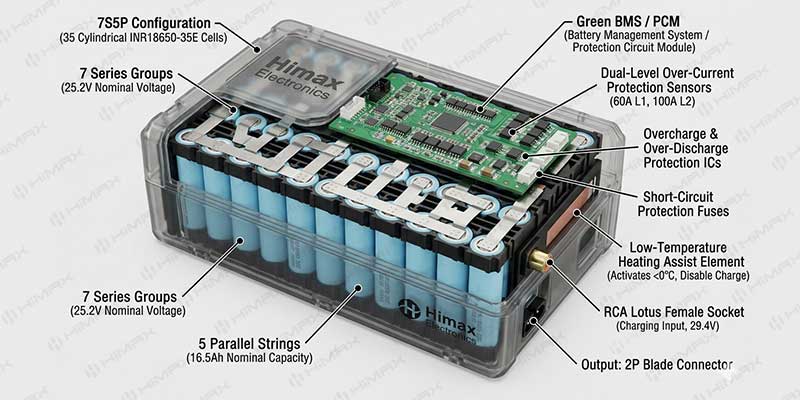
Battery management systems (BMS) in modern lithium installations handle much of this automatically and can feed data into SCADA or asset management platforms for fleet-level visibility.
Putting It All Together
Battery sizing for industrial applications is part science, part engineering judgment. The formulas are straightforward once you have accurate load data, but the correction factors — temperature, aging, discharge rate, depth of discharge limits, efficiency losses — are where the real engineering happens.
The difference between a system that runs reliably for years and one that fails during the worst possible moment often comes down to whether someone took the time to work through these factors honestly, rather than relying on a quick back-of-envelope calculation and hoping for the best.
Build in the margins. Test before deployment. Monitor in service. That’s the short version of what every experienced industrial battery engineer will tell you.