Why Clear Communication of Technical Specifications is Crucial for Custom Battery Solutions
As industries continue to develop smarter and more advanced products, battery requirements are becoming increasingly specialized. Whether the application is a medical device, an industrial robot, an AGV, a solar energy storage system, or underwater monitoring equipment, every product requires a battery that matches its specific operating conditions. A standard battery is often unable to meet these unique demands. This is why custom battery solutions have become the preferred choice for many manufacturers.
At **HIMAX ELECTRONICS**, we understand that every battery project begins with understanding the customer’s actual needs. A custom battery is not simply a combination of cells. It is a complete power solution designed according to the equipment’s electrical, mechanical, and environmental requirements. The more complete and accurate the technical information provided at the beginning of the project, the more efficiently our engineering team can design a battery that delivers reliable performance, long service life, and maximum safety. Clear communication during the early design stage reduces development time, avoids unnecessary revisions, and helps ensure the final battery performs exactly as expected.
Confirming Basic Electrical Specifications
The first step in any custom battery project is confirming the battery’s fundamental electrical specifications. These parameters determine whether the battery can provide stable power throughout the equipment’s operating cycle.
The most important specifications include:
* Rated voltage
* Battery capacity (Ah or Wh)
* Continuous working current
* Peak discharge current
Voltage determines whether the battery is compatible with the device’s electrical system. Capacity determines how long the equipment can operate before recharging. Continuous current indicates the normal operating load, while peak current represents the highest current required during startup or heavy-load operation.
For example, some industrial equipment may require only a moderate operating current but need several times that current for a few seconds during motor startup. If this requirement is not communicated in advance, the battery may experience voltage drops, trigger BMS protection, or fail to power the equipment properly.
Providing complete electrical specifications allows engineers to select the most suitable cell type, determine the correct series and parallel configuration, and design a battery that delivers stable and reliable performance.
Defining the Physical Structure
Electrical performance is only one part of a successful battery design. The battery must also fit perfectly inside the customer’s equipment.
Important mechanical information includes:
* Battery dimensions
* Maximum allowable size
* Shape requirements
* Wire length
* Connector type
* Terminal position
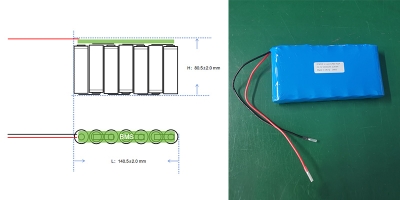
Even a small difference in dimensions may prevent the battery from fitting into the product housing. Likewise, using the wrong connector or incorrect cable length may require additional modifications during assembly, increasing production cost and delaying the project.
When customers provide detailed drawings, 3D models, or installation photos, our engineers can verify every structural detail before production begins. This minimizes design risks and helps ensure smooth integration with the final equipment.
Selecting the Right Battery Management System (BMS)
The Battery Management System (BMS) is one of the most important components of any lithium battery pack. It continuously monitors battery operation and protects the cells from unsafe conditions.
A properly designed BMS typically provides protection against:
* Overcharge
* Over-discharge
* Overcurrent
* Short circuit
Depending on the application, additional functions such as overtemperature, cell balancing, fault diagnostics, and communication interfaces may also be required.
Different applications require different BMS designs. For example, a battery used in medical equipment may require highly stable voltage output and enhanced monitoring functions, while an energy storage battery may prioritize balancing efficiency and long cycle life.
By understanding the customer’s operating conditions, HIMAX ELECTRONICS can select or customize a BMS that delivers the appropriate level of protection, reliability, and performance.
Understanding the Final Application
Knowing where and how the battery will be used is just as important as knowing its electrical specifications.
Different industries place different demands on battery performance. A battery for an autonomous mobile robot operates under very different conditions than one used in emergency backup power or portable testing equipment.
Understanding the application helps engineers determine important design factors such as:
* Suitable cell chemistry
* Required cycle life
* Charging method
* Safety level
* Mechanical protection
* Environmental resistance
For example, batteries used in outdoor equipment may require stronger mechanical protection and better resistance to moisture and dust. Equipment operating continuously in industrial environments may require cells with excellent cycle life and stable high-current performance.
Providing application details enables engineers to recommend the most suitable battery solution rather than simply meeting minimum specifications.
Communicating Special Functional Requirements Early
Many projects require functions beyond standard battery specifications. These special requirements should be discussed as early as possible because they often affect the overall battery design.
Common customized features include:
High- and Low-Temperature Performance
Some equipment operates in extremely hot or cold environments. Batteries may require special cells, heating systems, insulation materials, or optimized charging strategies to maintain reliable performance across a wide temperature range.
Waterproof and Dustproof Design
Outdoor equipment, marine applications, and underwater monitoring systems often require waterproof battery packs with specific IP ratings. Achieving these protection levels requires appropriate enclosure design, sealing materials, connector selection, and manufacturing processes.
Communication Functions
Modern smart devices increasingly require batteries to communicate with external systems.
Common communication interfaces include:
* CAN Bus
* RS485
* UART
* SMBus
These interfaces allow users to monitor battery voltage, current, temperature, State of Charge (SOC), and fault information in real time.
Bluetooth Monitoring
Bluetooth functionality enables users to check battery status through a mobile application without opening the equipment. This feature is becoming increasingly popular in energy storage systems, recreational vehicles, marine batteries, and industrial equipment.
Physical Switches and User Controls
Some applications require power switches, reset buttons, charging indicators, or LED status displays. These features improve operational convenience and simplify maintenance.
Discussing these special requirements at the beginning of the project allows engineers to incorporate them into the initial design, reducing development time and avoiding costly redesigns later.
Why Early Communication Saves Time and Cost
Many project delays are caused not by manufacturing problems but by incomplete technical information during the design stage.
When important specifications are confirmed early, engineers can:
* Recommend the most suitable battery solution
* Complete the design more efficiently
* Reduce engineering revisions
* Avoid repeated sample modifications
* Improve production efficiency
* Shorten overall project lead time
This collaborative process benefits both the customer and the manufacturer. Instead of correcting problems after prototypes are produced, potential issues are identified and resolved before production begins.
One practical example is a recent waterproof high-rate battery developed for underwater monitoring equipment. The customer clearly provided requirements for battery dimensions, operating current, waterproof level, and installation method at the start of the project. Based on these specifications, the engineering team designed a customized battery pack that fit perfectly inside the equipment while delivering stable high-current output and reliable operation in harsh underwater environments. Because all key requirements were confirmed early, the project progressed smoothly with minimal design revisions and achieved a faster time to market.
Building Better Custom Battery Solutions Together
A successful custom battery project is built on cooperation. While engineers contribute technical expertise, customers provide valuable information about their equipment and operating conditions. Combining these two perspectives leads to better battery performance, improved safety, and a more efficient development process.
Providing complete technical information from the beginning enables engineers to select appropriate cells, optimize battery structure, configure the correct BMS, and integrate all required features into one reliable solution. This approach not only improves product quality but also reduces development risks and overall project costs.
In conclusion, every successful custom battery solution begins with effective communication. At **HIMAX ELECTRONICS**, we are committed to working closely with customers to develop battery solutions that match their exact application requirements. By confirming key specifications—including voltage, capacity, discharge current, dimensions, connectors, BMS configuration, and any special requirements such as temperature resistance, communication protocols, Bluetooth monitoring, or waterproof protection—we can design battery packs