Golf Cart Battery Upgrade: Is LiFePO4 Worth It in 2026?
| Caleb · Battery Engineer — BMS & Protection Systems
Focused on battery management systems and protection design, Caleb develops PCM/BMS solutions with overcharge, over-discharge, thermal, and short-circuit protection to enhance safety and operational stability across applications. |
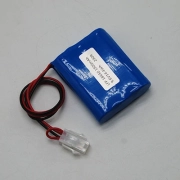
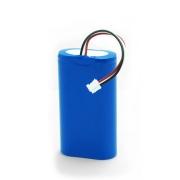
Lead acid has powered golf carts for decades — and for a long time, the case against switching was simple: lithium costs more up front. That calculation has shifted. With LiFePO4 cycle life now exceeding 2,000 full charges, golf course operators and fleet buyers are asking a different question: not whether to switch, but when and what to specify. This guide answers both, using the Himax 51.2V 50Ah LiFePO4 pack as the working reference.
| KEY TAKEAWAYS
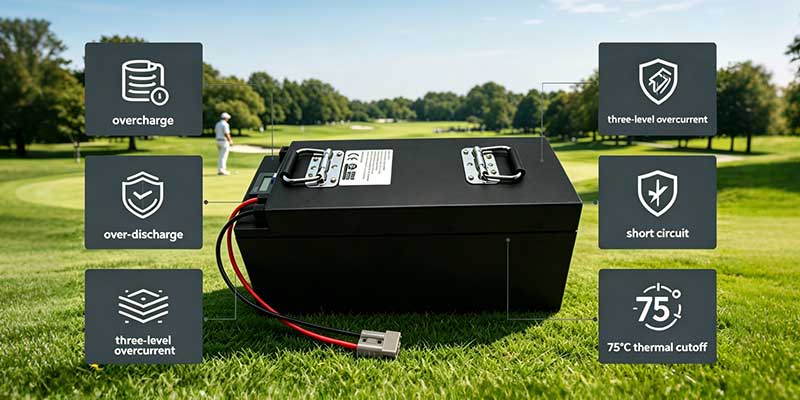
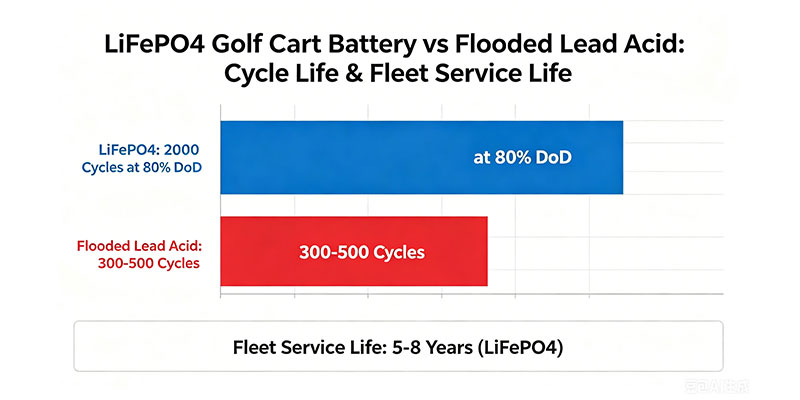
› LiFePO4 chemistry is the correct choice for golf carts: thermally stable, non-toxic, and inherently safer than NMC or lead acid under abuse conditions. › 51.2V nominal (16S LiFePO4) is a direct drop-in replacement for 48V lead-acid systems — no motor controller changes required in most carts. › 2,000-cycle rated life at 80% depth of discharge translates to 5–8 years of daily fleet use, versus 300–500 cycles for flooded lead acid. › The BMS in this pack provides six protection layers: overcharge, over-discharge, overcurrent (three thresholds), short circuit, and thermal cutoff at 75°C NTC. › 2,560Wh of usable energy delivers 35–50km of real-world range per charge for a standard golf cart — depending on terrain, load, and ambient temperature. › Maintenance cost savings from eliminating water top-ups, equalization charges, and early replacement typically offset the higher purchase price within 2–3 years. |
Why Is LiFePO4 the Right Chemistry for Golf Carts?
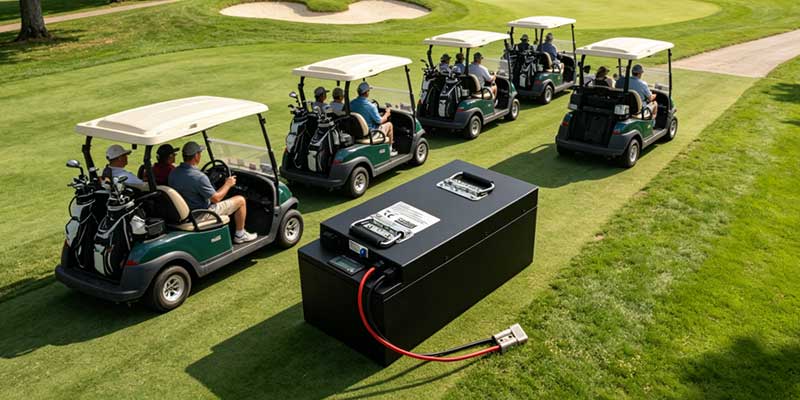
| LiFePO4 (lithium iron phosphate) is the safest lithium chemistry for vehicle applications. Its thermal stability means it does not enter runaway when overcharged or punctured — a critical advantage for carts used in close proximity to people on golf courses, resorts, and campuses. |
Thermal stability compared with other lithium chemistries
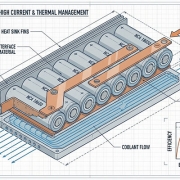
NMC and NCA lithium cells release oxygen when thermally stressed, which feeds combustion. LiFePO4 cells do not — the phosphate-oxygen bond is significantly stronger and does not break down at temperatures a golf cart battery might realistically encounter. The Himax pack’s BMS adds a 75°C NTC thermal cutoff as a second protection layer, but the underlying cell chemistry is the primary safety feature.
Why 51.2V (16S) works with 48V golf cart systems
A 16S LiFePO4 pack has a nominal voltage of 51.2V (3.2V × 16 cells) and a full-charge voltage of 57.6V (3.6V × 16). Most 48V golf cart motor controllers are rated to operate across 40–60V — which means this pack is electrically compatible without controller replacement. The nominal voltage is close enough to 48V that torque and speed characteristics remain familiar to drivers, while the higher peak voltage delivers noticeably better hill-climbing performance.
What the 2,000-cycle rating means in a fleet context
The Himax 51.2V 50Ah pack is rated for 2,000 cycles to 70% remaining capacity at standard depth of discharge. In a golf course context where a cart is discharged and recharged once per day, this translates to roughly 5.5 years before the pack drops below 70% of original capacity. Most fleet operators find the pack remains serviceable for 7–8 years. Flooded lead acid at a similar depth of discharge rarely exceeds 300–500 cycles — one-sixth the life.
What Are the Full Specifications of the Himax 51.2V 50Ah Pack?
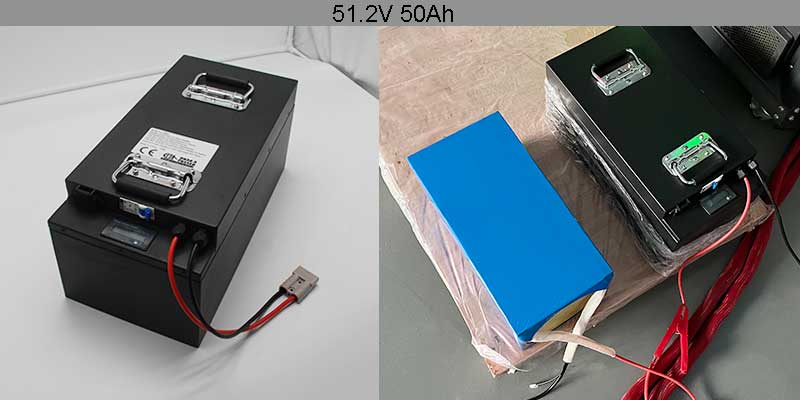
| Model 512-50BP is a 16S1P LiFePO4 pack using LF28148115 cells, delivering 51.2V nominal, 50Ah minimum capacity, 2,560Wh of energy, and a 40A maximum continuous discharge current. The BMS provides six-layer protection with cell-level balancing at 3.5V ± 0.025V. |
| Model
512-50BP Himax reference |
Nominal voltage
51.2V 16S LiFePO4 configuration |
Capacity (min)
50Ah 0.2C discharge to 40V |
Energy
2,560Wh Usable per charge |
| Charge voltage
57.6V CC/CV method |
Std. charge current
5A 12-hour standard charge |
Max charge current
10A Fast charge option |
Std. discharge current
10A Normal operating load |
| Max continuous discharge
40A 2,048W at nominal V |
Cycle life
2,000 cycles ≥70% capacity retained |
Discharge cut-off
40V BMS hard cutoff |
Internal impedance
≤ 35mΩ Pack level |
| Dimensions
400×220×180mm (±3mm) L × W × H |
Output wire
AWG10, 304.8mm 3135 specification |
Charge connector
Pinzi Head Dedicated charge port |
Discharge connector
SC50 High-current rated |
| Charge temp range
0°C to 45°C Do not charge below 0°C |
Discharge temp range
-20°C to 60°C Wide operating window |
Storage temperature
-10°C to 45°C Long-term storage |
Warranty
2 years From shipment date |
BMS protection parameters — what Caleb’s team specifies
The protection circuit is built around the SH367005BAB IC (×4) with LGSE10R046B and LR046N10SM2 MOSFETs (×12). The table below covers every protection threshold as shipped:
| Protection function | Threshold / setting | Delay / reset |
| Overcharge detect | 3.75V ± 0.025V per cell | Delay: 0.5–1.5s | Reset: 3.55V |
| Over-discharge detect | 2.2V ± 0.08V per cell | Delay: 0.5–1.5s | Reset: 2.7V |
| Overcurrent (charge) | 80A ± 16A | Delay: 0.5–1.5s |
| Overcurrent (discharge) level 1 | 160A ± 32A | Delay: 0.5–1.5s |
| Overcurrent (discharge) level 2 | 320A ± 64A | Delay: 50–150ms (fast trip) |
| Short circuit | External short detection | Reset: release load |
| Cell balancing | Balances at 3.5V ± 0.025V | Balance current: 36 ± 10mA |
| Thermal cutoff (NTC) | 75°C surface trigger | Automatic protection |
How Far Will a Golf Cart Lithium Battery Take a Golf Cart on a Single Charge?
With 2,560Wh of usable energy, a standard 4-seat golf cart drawing 30-50A on average will cover 35-55km per charge on flat terrain. However, hilly courses, full passenger loads, and cold weather reduce that figure. Therefore, correct depth-of-discharge management significantly extends pack life.
Flat Golf Course – Standard 4-Seat Cart
For example, a typical 4-seat cart on flat terrain draws approximately 15-25A at cruise speed. At 20A average draw and 51.2V nominal, power consumption is roughly 1,024W. As a result, the 2,560Wh pack delivers about 2.5 hours of continuous drive time — equivalent to 48-56km at 20-22km/h cart speed. Moreover, most 18-hole courses require only 12-16km per round. Consequently, one charge comfortably covers 3-4 full rounds.
Average draw: 15-25A | Range (flat): 48-56km | Rounds per charge: 3-4 (18-hole)
Hilly Resort or Country Club Course
In contrast, steep elevation changes increase motor draw significantly. For instance, peak climbing current can reach 35-40A on a 15% grade. Thus, the average draw over a hilly course rises to 30-38A, cutting range to 30-40km. Nevertheless, the 40A maximum continuous discharge rating of this pack handles sustained climbing loads without triggering BMS overcurrent protection.
Average draw: 30-38A | Range (hilly): 30-40km | Peak climb current: ≤40A (within spec)
Resort Shuttle and Campus Transport – Higher Loads
Similarly, 6-seat utility carts carrying luggage or equipment draw 30-45A continuously. At 40A / 51.2V, peak power is approximately 2,048W. As a result, range at this load is 25-35km — still sufficient for a full resort property loop with buffer. Additionally, the SC50 discharge connector is rated for sustained high-current draw without contact heating at these levels.
Continuous draw: 30-45A | Range: 25-35km | Peak power: 2,048W at 40A
Cold-Weather Operation
Finally, the pack’s discharge temperature range runs to -20°C, but cold significantly affects usable capacity. For example, the specification data shows ≥60% capacity retention at -10°C after standard charge at 20°C. Therefore, operators in cold climates should expect 65-75% of warm-weather range on very cold days. Importantly, they should not charge below 0°C — the BMS will prevent charging in that range to protect cell integrity.
LiFePO4 vs. Lead Acid vs. Other Lithium: Which Battery Wins for Golf Carts?
| LiFePO4 wins on cycle life, weight, maintenance, and total cost of ownership for any fleet operated more than 250 days per year. Lead acid retains an advantage only on purchase price and charger compatibility in legacy fleets with no budget for infrastructure updates. |
| Type | Cycle life | Weight (equiv.) | Maintenance | Safety | TCO (5 yr) |
| LiFePO4 51.2V ★ | 2,000+ cycles | ~55% lighter | None | Excellent | Lowest |
| Flooded lead acid | 300–500 cycles | Baseline | Weekly water top-up, equalization | Fair | Highest |
| AGM lead acid | 400–600 cycles | Slightly lighter | Occasional equalization | Good | High |
| NMC lithium | 500–1,000 cycles | ~60% lighter | None | Moderate | Medium |
| NiMH (older tech) | 500–800 cycles | ~30% lighter | Low | Good | Medium-high |
What Are the Most Expensive Mistakes Golf Cart Battery Buyers Make?
The costliest mistakes in golf cart battery procurement are not choosing the wrong chemistry. Instead, they are specifying the wrong voltage tier, ignoring charge temperature limits, or assuming all LiFePO4 packs have equivalent BMS protection. Therefore, each of these errors shortens pack life or creates safety exposure.
Mistake 1: Charging Below 0°C
First, LiFePO4 cells form lithium plating on the anode when charged in sub-zero temperatures. For this reason, the Himax BMS blocks charging below 0°C. However, if an operator overrides this protection — or uses a non-LiFePO4 charger — permanent capacity loss results. Consequently, this is the single most common cause of premature pack failure in cold-climate fleet deployments.
Mistake 2: Using a 48V Lead Acid Charger on a 51.2V LiFePO4 Pack
Similarly, a 48V lead acid charger terminates at approximately 58.4V. Nevertheless, this is close to, but not the same as, the 57.6V CC/CV profile required for this pack. As a result, voltage differences of this magnitude accelerate cell aging and can trigger overcharge protection on individual cells before the pack is full. Thus, always use a charger designed for 16S LiFePO4 chemistry.
Mistake 3: Discharging Consistently to Cut-Off Voltage
In addition, running any lithium pack to its BMS cut-off voltage for every cycle is the fastest way to shorten life. Specifically, the 2,000-cycle rating applies at 80% depth of discharge. However, discharging to 100% DoD consistently reduces cycle life to approximately 800–1,000 cycles. Therefore, fleet operators should configure their charging schedule so carts are plugged in after each round — not after two or three.
Mistake 4: Ignoring the BMS Protection Tier When Sourcing Cheaper Alternatives
Moreover, not all LiFePO4 packs include three-tier overcurrent protection and thermal cutoff. For example, a pack with only basic overcharge and over-discharge protection is a lower-cost product. Nonetheless, it carries meaningfully higher risk in a fleet environment. Hence, verify the full BMS specification — IC model, MOSFET count, and NTC thermal trigger — before purchasing based on price.
Mistake 5: Neglecting Storage SoC During Off-Season
Finally, golf courses in seasonal climates may store carts for 3–6 months. In fact, LiFePO4 cells stored at full charge for extended periods degrade faster than cells stored at 30–50% SoC. For this reason, the Himax pack ships at 30–70% SoC. Accordingly, charge to 50% before long-term storage and recharge every 3 months to prevent deep self-discharge.
Frequently Asked Questions
| The questions below are the ones procurement managers and golf course fleet operators most commonly ask when evaluating a 51.2V LiFePO4 upgrade. Each answer is written to stand alone as a complete, citable response. |
Is 51.2V LiFePO4 compatible with my existing 48V golf cart?
In most cases, yes. A 16S LiFePO4 pack operates between 40V (discharge cutoff) and 57.6V (full charge), which falls within the operating range of the majority of 48V golf cart motor controllers. Verify your controller’s voltage tolerance in its documentation — look for a stated range of 40–58V or similar. If your cart has a hard 48V nominal controller, consult the manufacturer before installing a 51.2V pack.
How long does a full charge take?
At the standard 5A charge current using a 57.6V/5A charger, a full charge from empty takes approximately 10–12 hours — suitable for overnight charging. At the maximum 10A charge current with a compatible fast charger, charge time drops to approximately 5–6 hours. Do not use chargers above 10A; the BMS will trigger overcurrent protection and the charge will not complete.
How many rounds of golf can this battery power per charge?
On a flat 18-hole course, each round requires approximately 12–16km of cart travel. At the conservative range estimate of 35km per charge (hilly terrain, full load), this pack covers 2–3 full rounds. On flat terrain with light loads, 4–5 rounds per charge is achievable. For busy tournament days with continuous cart use, a two-pack rotation with overnight charging on both is the recommended fleet configuration.
What certifications does this pack carry?
The Himax 51.2V 50Ah pack is compiled under GB/T18287-2013, UL1642, and CE61960 technology standards. Mechanical performance testing includes crush, drop (1 meter onto concrete), and vibration (XYZ axes) with no fire, explosion, or leakage. Cell safety testing covers overcharge, over-discharge, short circuit, and heating scenarios. Certification documentation is available on request for procurement records.
What maintenance does a LiFePO4 golf cart battery actually require?
Essentially none, compared with flooded lead acid. There is no water to top up, no equalization charging required, and no terminal corrosion to clean. The only maintenance task is monitoring the BMS indicator (if fitted) for fault codes, and ensuring the pack is stored at 50% SoC during off-seasons longer than 3 months. Quarterly recharging during storage is recommended to prevent deep self-discharge.
What is the warranty and what does it cover?
The pack carries a two-year warranty from the date of shipment. Himax guarantees replacement for defects proven to result from the manufacturing process. Damage from customer abuse, incorrect chargers, charging below 0°C, or mechanical impact is not covered. For OEM fleet purchases, extended warranty terms can be negotiated — contact Himax directly.
Why Do Golf Cart Fleet Operators Source from Himax Electronics?
| Himax designs and manufactures LiFePO4 battery packs end-to-end — from cell sourcing through BMS development to final assembly and QC. For golf course fleets and OEM buyers, this means a single accountable supplier for cells, protection electronics, and pack-level performance guarantees. |
- BMS designed in-house, not sourced as a commodity. Caleb’s team develops PCM/BMS solutions with application-specific protection thresholds — including the three-tier overcurrent protection and NTC thermal trigger in this pack. The IC and MOSFET selection is verified against real golf cart load profiles, not generic datasheets.
- LiFePO4 cell quality verified at batch level. The LF28148115 cells in this pack are tested for capacity, impedance, and safety performance at intake. Cell authenticity and batch records are available for OEM procurement audit.
- Configurable pack dimensions and connectors. The standard 400×220×180mm form factor fits most golf cart battery compartments. Connector type, wire length, and output configuration can be adjusted for OEM builds with a revised drawing.
- Fleet-scale production with stable supply. Golf course procurement often involves 20–100+ units per order. Himax maintains production capacity for volume OEM orders with consistent cell sourcing and BMS batch testing.
- Two-year warranty with documented QC backing. Every pack undergoes pre-shipment voltage, impedance, and BMS function checks. Warranty claims are supported by production batch records — not just a warranty card.
| Ready to upgrade your golf cart fleet to LiFePO4?
Tell us your cart model, fleet size, and charging infrastructure. We’ll respond with a compatible configuration and volume pricing within one business day. |