Breaking the Temperature Barrier: Himax Wide-Temperature Ni-MH Battery Achieves Stable Charge/Discharge Across the Full -40°C to 70°C Range

Published by Himax Electronics • July 2026
In industrial equipment, vehicle-mounted systems, outdoor security installations, energy storage backup, and extreme-environment applications ranging from polar expeditions to high-heat industrial enclosures, a battery’s ability to perform across temperature extremes directly determines the reliability and service life of the entire system.
Standard Ni-MH batteries operate in a narrow window: 0°C to 50°C. Below that floor, capacity falls off sharply, high-current discharge becomes impossible, and equipment fails to start. Above the ceiling, charging efficiency drops, internal pressure rises, capacity degrades faster, and leakage becomes a risk.
To address the industry’s long-standing “freezes in the cold, fails in the heat” problem, the Himax Electronics R&D team overhauled the Ni-MH battery system across four dimensions — materials, electrolyte formulation, conductivity architecture, and sealing process. The result: our new-generation wide-temperature Ni-MH 50A 2200mAh and 43SC 2500mAh cells deliver stable charge and discharge across a full -40°C to 70°C range, pushing well beyond what the industry has previously achieved.
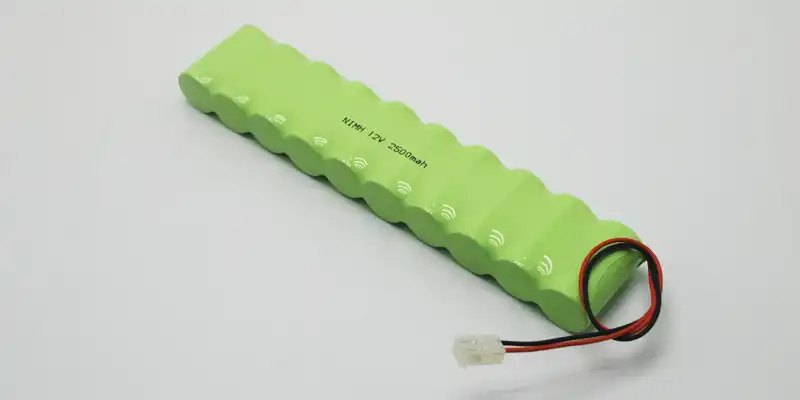
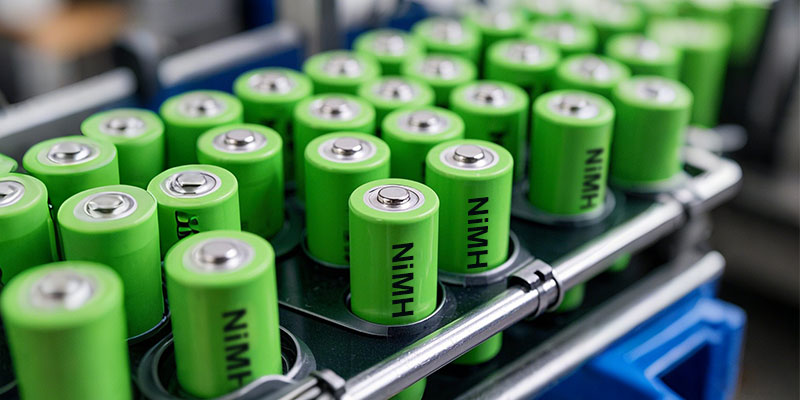
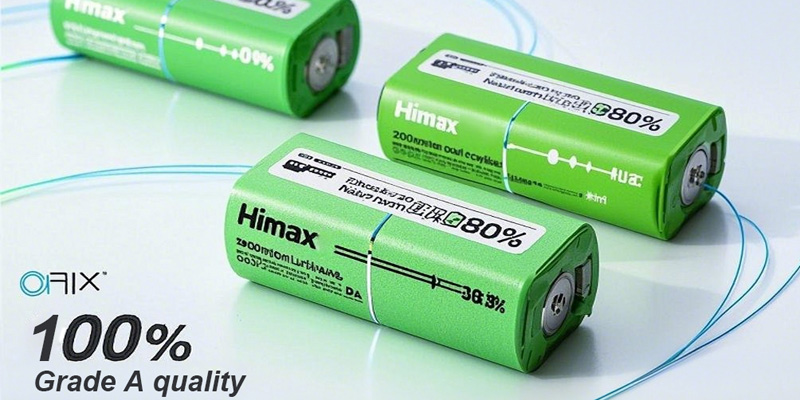
Himax 43SC 2500mAh Ni-MH wide-temperature battery pack (10S1P, 12V nominal) — rated from -40°C to 70°C
I. Why Wide-Temperature Technology Is Needed: The Industry’s Pain Points
Conventional Ni-MH cells on the market today carry a well-documented temperature weakness:
Low-Temperature Pain Points (Below 0°C)
Electrolyte activity drops, hydrogen desorption from the storage alloy is impeded, and internal resistance climbs steeply. At -10°C, capacity falls to roughly 60% of rated and can only be drawn at low current. At -30°C, normal discharge is essentially impossible. Outdoor equipment and high-altitude installations in cold climates regularly experience power cutoffs and startup failures.
High-Temperature Pain Points (Above 50°C)
Charging polarization increases significantly, internal pressure builds, and charge acceptance deteriorates. Sustained high-temperature operation accelerates aging of the electrode structure, sharply shortening cycle life. Swelling, leakage, and permanent capacity loss become real failure risks.
The Longevity Trade-Off
Batteries engineered for extreme temperature performance have historically paid for it with shorter service life — a compromise that has forced system designers to choose between temperature range and durability.
II. Himax’s Core Technical Breakthroughs: A Full-Range Adaptation System
Rather than tweaking individual parameters, Himax rebuilt the Ni-MH system from four foundational directions: negative electrode alloy, electrolyte system, conductivity architecture, and sealing process.
Modified Hydrogen-Storage Alloy (Negative Electrode)
We optimized the alloy composition to improve hydrogen desorption efficiency at low temperatures, reducing polarization resistance in extreme cold and restoring electrochemical activity. Simultaneously, we enhanced the alloy’s structural stability at high temperatures, suppressing the particle pulverization that causes capacity fade over time.
Wide-Temperature Electrolyte Formulation
We developed a solvent system with a lower freeze point and higher thermal ceiling than conventional KOH-based electrolytes. The formulation maintains adequate ionic conductivity at -40°C while preserving chemical stability at 70°C — expanding the usable electrochemical window across the full operating range.
High-Conductivity Composite Architecture
Electrode plates were made thinner to increase active surface area, and positive current tabs were widened. These changes reduce internal resistance across all temperatures, enabling high current delivery in extreme cold without voltage collapse and clean charge acceptance in extreme heat.
Deep-Groove High-Temperature Sealing
We adopted a deep-groove rolling crimp process that optimizes the sealing contact geometry and compression force. This prevents leakage and case deformation under sustained high-temperature charging — directly addressing the swelling and electrolyte migration that standard cells experience in enclosed hot environments.
Together, these four upgrades deliver stable operation from -40°C to 70°C with substantially improved IEC cycle life — clearing the industry’s conventional temperature limits by a significant margin.
III. Test Data: Multi-Dimensional Validation Across the Full Temperature Range
To validate performance under extreme conditions, Himax conducted a comprehensive series of standardized temperature-chamber charge/discharge tests simulating arctic cold, high-heat operation, diurnal temperature swings, and outdoor sun exposure. The results below are based on a 10S1P pack built from 43SC 2500mAh cells (12V nominal).
Test 1: Low-Temperature High-Rate Performance at -20°C, 2C Discharge
After stabilizing at -20°C in a temperature chamber, the pack was charged to full capacity and then discharged at 2C:
- No sleep mode, no cutoff — normal startup and continuous charge/discharge achieved
- Capacity retention exceeded 80% at full 2C current, sufficient to run equipment at full rated power in sub-zero conditions
This directly solves the field problem where equipment either fails to start or runs at reduced power in low-temperature environments.
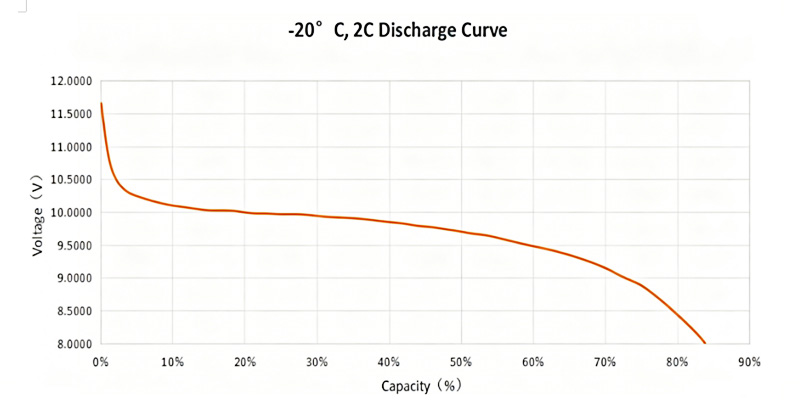
Figure 1: -20°C, 2C discharge curve — Himax wide-temperature Ni-MH pack (10S1P, 43SC 2500mAh). Capacity retention >80%.
Test 2: Extreme Cold Performance at -40°C, 0.2C Discharge
After full stabilization at -40°C, the pack was subjected to standard charge/discharge testing:
- No sleep mode, no cutoff — the battery started and operated normally
- Capacity retention exceeded 70%, with stable continuous current output
This resolves the fundamental field failure of conventional Ni-MH in arctic conditions: “the charge is there but can’t be delivered, and the equipment won’t start.”
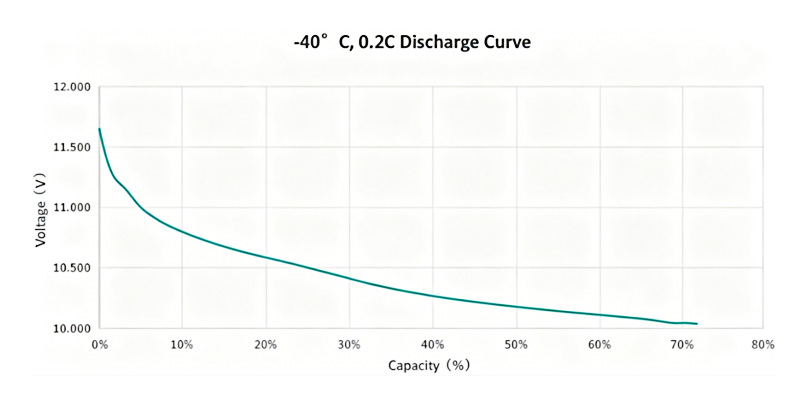
Figure 2: -40°C, 0.2C discharge curve — Himax wide-temperature Ni-MH pack. Capacity retention >70%, voltage remains stable through 70% of discharge.
Test 3: High-Temperature Performance at 70°C, 2C Discharge
After stabilization at 70°C, the pack was charged and discharged at 2C:
- Capacity retention approached 70% under high-rate discharge at extreme heat
- Charge acceptance was stable: no overcharge events, no thermal runaway risk
- No leakage, no abnormal internal pressure rise
This addresses the challenge of simultaneously handling both temperature extremes — the same pack that survives -40°C also handles 70°C without modification.
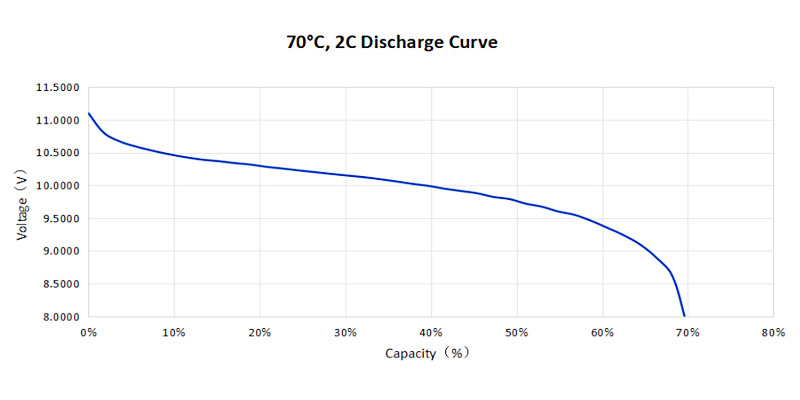
Figure 3: 70°C, 2C discharge curve — Himax wide-temperature Ni-MH pack. Capacity retention ~70%, no thermal events, no leakage.
Test 4: IEC Cycle Life (IEC 61951-2:2017, Section 7.5.1.2)
Tested under the IEC standard protocol:
- Stable charge acceptance throughout: no overcharge, no thermal runaway
- No leakage, no abnormal internal pressure
- Capacity at 1,000 cycles remained above 63%, with a gradual and controlled decline curve — substantially outperforming standard cells
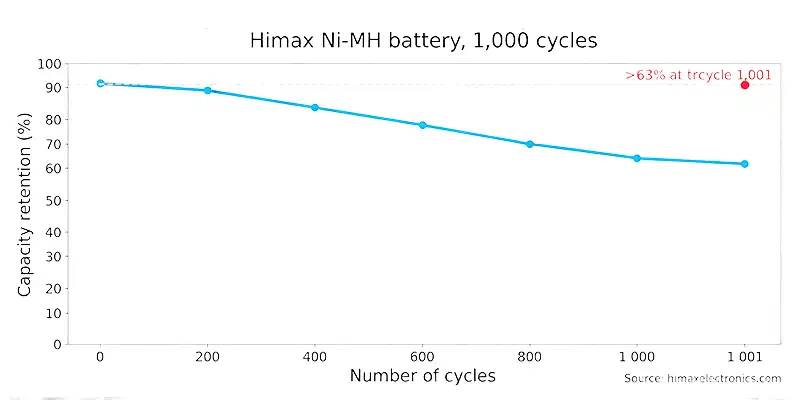
Figure 4: IEC 61951-2 standard cycle life curve — Himax Ni-MH battery, 1,000 cycles. Capacity retention >63% at cycle 1,001.
Test 5: Thermal Shock Cycling Reliability
Across multiple high-low temperature alternating shock test cycles, the cells demonstrated consistent impedance, stable voltage plateau, and minimal internal resistance drift. At the pack level, cell-to-cell voltage uniformity and capacity consistency were well maintained — making this chemistry well suited to outdoor unattended equipment, vehicle backup systems, and industrial control applications where thermal swings are a daily reality.
IV. Key Product Advantages of the Wide-Temperature Ni-MH Series
- Full-range temperature coverage: -40°C to 70°C — suitable for every climate zone and all-season outdoor operation
- No cold-weather shutdown: operates normally in arctic conditions; eliminates the winter startup failures common in northern and high-altitude deployments
- High-heat durability: handles vehicle underhood temperatures, outdoor sun exposure, and sealed industrial enclosures without performance loss
- Superior safety profile: Ni-MH chemistry is non-flammable and incapable of thermal runaway; combined with Himax’s wide-temperature process, extreme-environment stability far exceeds lithium-based alternatives
- Excellent cell-to-cell consistency: stable impedance across the full temperature range keeps pack-level voltage spread tight and extends system service life
V. Target Application Scenarios
The wide-temperature Ni-MH series is designed for demanding-environment equipment across a broad range of industries:
- Vehicle-mounted backup power, T-BOX, and automotive security backup batteries
- Outdoor IoT devices, wireless sensor nodes, and meteorological monitoring equipment
- Industrial control systems and rail transit support equipment in cold-climate regions
- Energy storage backup for high-temperature equipment enclosures and sealed industrial systems
- Military equipment, special-purpose instruments, and field operation power supplies
VI. Technology That Solves the Extreme-Environment Power Problem
| Commodity batteries compete on specs. Industrial batteries compete on environmental reliability. |
Himax’s wide-temperature Ni-MH technology breaks through the limitations that have defined the industry for decades, extending the operating window from the conventional 0°C–50°C to a full -40°C to 70°C range — with lab-verified data to back every claim.
Looking ahead, we will continue advancing the Ni-MH platform and extending wide-temperature performance to additional cell formats, including: 43/44AAA 600mAh, 50A 2500mAh, 50AA 1800mAh and 2000mAh, 60D 8000mAh, and 90F 12000mAh. Each addition broadens the application range for OEM partners working across multiple product lines.
Our ongoing development roadmap targets continued improvement in low-temperature rate capability, high-temperature cycle stability, and full-pack consistency for industrial, automotive, security, and special-purpose power applications.
Request Samples, Datasheets, or a Custom Pack Quote
For sample requests, technical documentation, or custom PACK configurations, contact the Himax Electronics engineering team directly. We work with OEM clients from initial specification through mass production qualification.
| Himax Electronics Co., Ltd.
Website: www.himaxelectronics.com Contact: https://www.himaxelectronics.com/contact/ Products: https://www.himaxelectronics.com/ni-mh-battery/ OEM/ODM: https://www.himaxelectronics.com/oem-odm-battery/ |