The LiFePO4 Battery That’s Changing How Electric Walkers Are Powered
By Shawn | Battery Engineer – Power System Design, Himax Electronics
Case Study · LiFePO4 Power Systems · Medical Mobility
A LiFePO4 battery for electric walker is not just an upgrade — it’s a necessity. Let me be direct with you: lead-acid batteries do not belong in modern electric walkers. They never really did. Therefore, this case study walks through a 25.6V 10Ah LiFePO4 battery pack we recently engineered for an electric walker OEM — and explains, from a power systems engineer’s perspective, exactly why this chemistry and configuration was the only logical answer.
Why a LiFePO4 Battery for Electric Walker Beats Lead-Acid Every Time
An electric walker — or power rollator — carries a person who often depends on it for basic daily mobility. That’s a fundamentally different use case from a power tool or an e-bike. The battery doesn’t just deliver performance; it determines safety, portability, and trust. A device this important deserves a power source engineered with the same care as the frame it’s bolted to.
When this OEM came to us, they were running a lead-acid battery. Their engineers knew it was a weak link. The pack was too heavy, runtime was inconsistent, and the battery offered no way to tell the device — or the user — how much charge remained. They needed something smarter. We built them exactly that. In short, that’s exactly why a high-quality LiFePO4 battery for electric walker makes such a measurable difference.
Full Specification Breakdown
Here’s what we built, and why each parameter was chosen:
| Parameter | Value |
| Chemistry | LiFePO4 (Lithium Iron Phosphate) |
| Configuration | 8S2P (8 series × 2 parallel) |
| Cell Model | 26700 / 5000mAh per cell |
| Nominal Voltage | 25.6V |
| Fully Charged Voltage | 29.2V |
| Capacity | 10Ah |
| Max Discharge Current | 10A (device operating power) |
| Max Charge Current | 5A (solar / adapter compatible) |
| Communication | RS485 with RJ45 waterproof connector |
| Charge Connector | AMASS XT60-F (with dust cap) |
| Wire Spec | 12AWG, UL1015 |
| Charge wire length | 150mm (±20mm) |
| Discharge wire length | 75mm (±20mm) |
| Max Dimensions | L181 × W76 × H165mm (±2mm) |
| Housing | Black ABS — lead-acid form factor replacement |
| Waterproofing | Yes |
| Certifications | Reach, RoHS, MSDS, Air Transport Assessment |
| Target Market | North America |
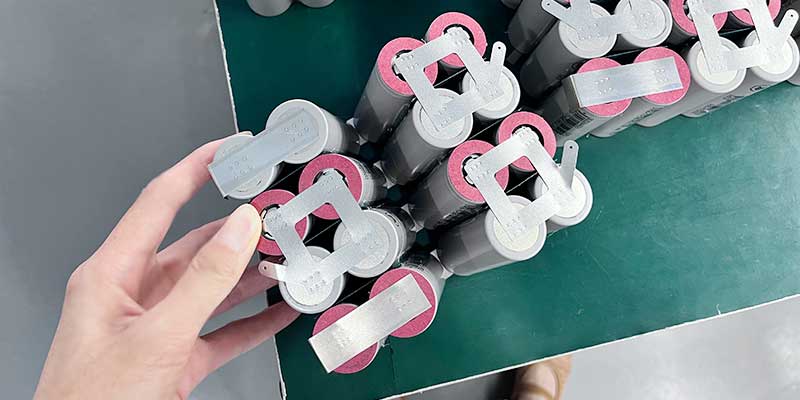
| The 8S2P topology is the key insight here. For example, eight cells in series gives us 25.6V — exactly the voltage profile the walker’s motor controller expects, matching or exceeding the legacy lead-acid pack voltage with far superior stability. Two cells in parallel doubles the capacity to 10Ah without increasing the footprint beyond the original housing envelope. |
The Case Against Lead-Acid in Medical Mobility Devices
I’ve reviewed a lot of battery specs over my career. And when I see a lead-acid pack in a product that a person has to carry, lift, or push daily, I know immediately where the engineering debt is hiding.
| Criteria | LiFePO4 25.6V | Sealed Lead-Acid | NiMH |
| Weight | Light (~1.5 kg) | Heavy (4–6 kg) | Moderate |
| Cycle Life | 2000+ cycles | 300–500 cycles | 500–800 cycles |
| Voltage Sag | Flat / stable | Significant sag | Moderate sag |
| RS485 Support | Yes (smart comms) | No | No |
| Safe indoors | Yes — no acid/gas | Risk of acid/gas | Yes |
| Lifespan | 8–10 years | 2–3 years | 3–5 years |
Obviously, the weight difference alone justifies switching to a LiFePO4 battery for electric walker. A sealed lead-acid battery at 25V and 10Ah weighs roughly 4–6 kg. Our LiFePO4 pack comes in around 1.5 kg. For a user who already has limited mobility, that’s not a minor improvement — it’s a life-quality difference.
Moreover, that’s before we get to cycle life. A lead-acid pack in daily-use conditions typically lasts 300–500 charge cycles. Our 26700 LiFePO4 cells deliver 2,000+ cycles — meaning the battery will likely outlast the walker itself.
RS485 Communication: The Smart Feature Your LiFePO4 Battery for Electric Walker Needs
Most battery engineers focus on voltage, capacity, and current. I do too — but on this project, the RS485 communication interface was what I found genuinely compelling. It’s the kind of feature that separates a commodity battery from a smart power system. Consequently, when you integrate RS485 into a LiFePO4 battery for electric walker, you turn a dumb power source into a smart mobility asset.
What RS485 enables in practice
Real-time state of charge display. The walker’s control panel can show the user exactly how much battery remains — not a guess, not a LED bar that drops suddenly, but accurate, real-time capacity data pulled directly from the BMS over RS485.
In terms of voltage, the system can monitor per-cell group voltage, detect imbalances early, and alert the device firmware before a problem becomes a failure. In a medical mobility context, that’s meaningful.
When it comes to capacity calibration, the RS485 protocol allows the device to adjust displayed capacity based on actual BMS readings rather than estimated state-of-charge curves — more accurate for the end user, fewer support calls for the OEM.
| Design note: The customer specified that the RS485 display must show voltage and capacity accurately, adjusted to the smallest readable unit. We tuned the BMS communication parameters to match their display driver’s polling rate, ensuring the readout is smooth and responsive under normal operating loads. |
BMS Configuration: Designed for Real-World Mobility Use
A walker battery lives a different life than an EV pack or a solar storage unit. It charges once a day (or once every few days). It discharges slowly and steadily — no aggressive peaks. It sits in a warm environment. Above all, it needs to be reliable without any user interaction whatsoever.
The BMS on this pack was configured with exactly that operating profile in mind:
| Protection / Feature | Specification |
| Overcharge cutoff | 25.6V → 29.2V (8S fully charged) |
| Over-discharge cutoff | ≥ 16V (BMS protection threshold) |
| Max continuous discharge | 10A |
| Max charge current | 5A (solar / adapter compatible) |
| Cell balancing | Yes — passive balancing |
| Communication protocol | RS485 (real-time voltage/capacity display) |
| Short circuit protection | Yes |
| Operating temperature | Specified per design |
The 5A charge limit is deliberate — it protects the cells from aggressive solar or fast-charge inputs while remaining fully compatible with standard adapter chargers. The 10A discharge ceiling matches the walker’s maximum motor draw with comfortable headroom, so the BMS never trips under normal use.
“A well-designed BMS for a medical device is one the user never thinks about. It just works — every time, all the time, for years.”
Cell Selection for a LiFePO4 Battery for Electric Walker: Why 26700 Works
The 26700 form factor (26mm diameter, 70mm length) sits between the compact 18650 and the high-capacity 32700. Specifically for this application, it’s the right balance: enough capacity per cell to build a 10Ah pack in just 2P (parallel) rather than needing 4P or more, which keeps the pack compact enough to fit the lead-acid footprint.
At 5,000mAh per cell, two in parallel gives us 10Ah — precisely matching the OEM’s runtime requirement. The 8S topology then stacks eight of these pairs in series, stepping voltage up from 3.2V per cell to 25.6V nominal — the exact voltage the walker controller expects.
LiFePO4 chemistry in the 26700 format also brings excellent thermal stability. Walkers used indoors and outdoors across North American climate ranges need a cell that handles both winter cold storage and summer ambient temperatures without meaningful capacity loss.
Housing & Mechanical Design: A True Lead-Acid Drop-In
One of the harder constraints on this project was the mechanical envelope. The OEM’s chassis was designed for a standard lead-acid battery. Any replacement had to fit the same bolt pattern, connector orientation, and external dimensions — otherwise the customer faced a costly retool of their housing design.
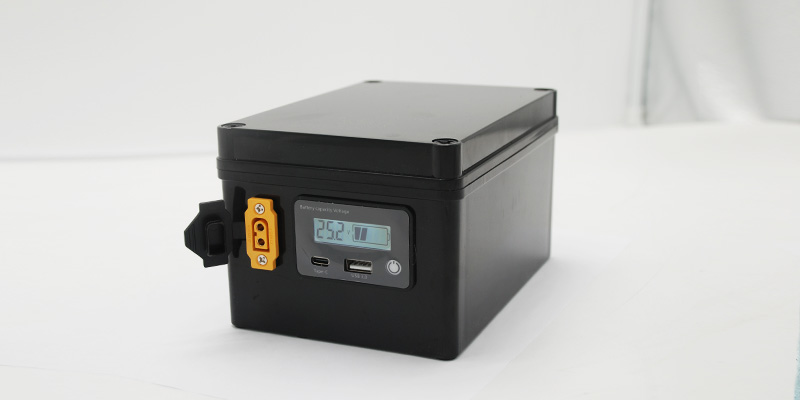
As a result, we engineered the pack to fit within L181 × W76 × H165mm(±2mm) — staying within the original lead-acid housing dimensions. The black ABS enclosure mimics the form factor exactly. The XT60-F charge port and RJ45 RS485 connector are mounted in the same orientation as the customer’s wiring harness, so installation is genuinely plug-and-play.
Waterproofing was included as standard on this build — appropriate for a device that might be used in light rain or cleaned with damp cloths in a healthcare setting.
Certification: Built for the North American Market
Selling a lithium battery pack in North America — particularly in a medical-adjacent application — means documentation isn’t optional. This pack was built to comply with:
- Reach — materials compliance, confirming no restricted substances
- RoHS — restriction of hazardous substances in electronics
- MSDS — material safety data for transport and handling
- Air Transport Assessment — enabling air freight where required
The customer also specified a 5A fuse requirement inside the battery — an additional protection layer that we incorporated into the BMS circuit design rather than adding it as an external component, keeping the form factor intact.
Manufacturing & Quality Process
My role isn’t just design — I’m also involved in the production process. Here’s what this pack’s build flow looked like:
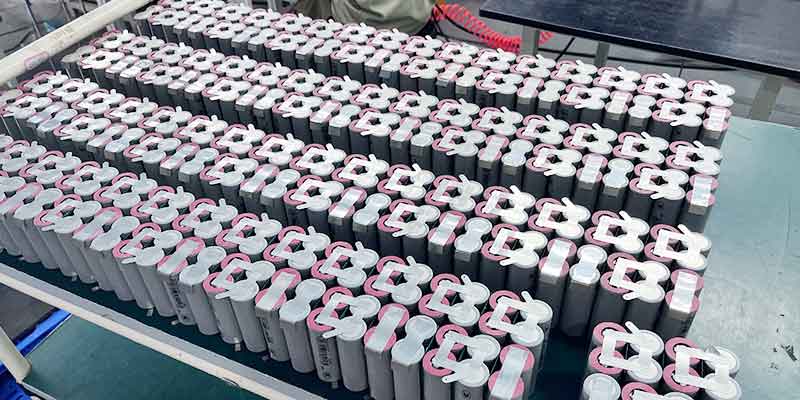
- Cell matching: Every 26700 cell tested for open-circuit voltage and internal resistance. Cells are paired by matching IR values before entering the 2P parallel groups — unmatched cells cause cross-current and degrade faster.
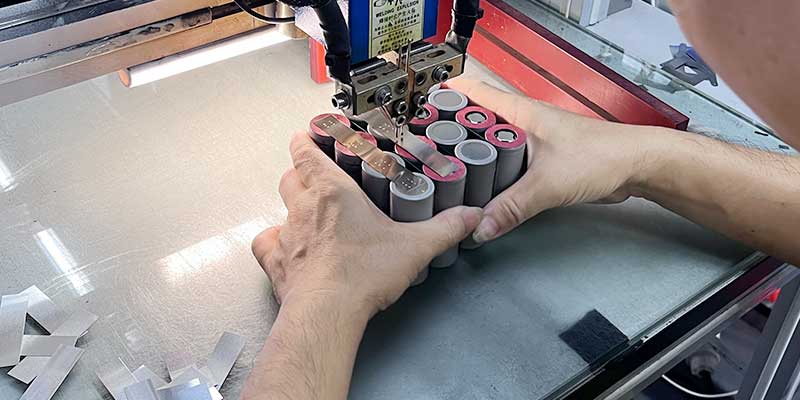
- Nickel strip welding: Cells assembled in the 8S2P topology and spot-welded with nickel strips. Weld points inspected under load — high resistance welds are flagged and reworked before proceeding.
- BMS integration & RS485 tuning: BMS installed and communication parameters programmed to match the customer’s display driver spec. RS485 output verified against their firmware at the agreed polling rate.
- Waterproofing & housing: Pack sealed into the black ABS housing, connectors torqued and tested for IP rating. Wire routing fixed with cable anchors as specified in the customer’s wiring diagram.
- Aging & capacity test: Full charge-discharge cycle logged against rated capacity. Internal resistance measured post-cycle. Any pack below 98% of rated capacity is rejected from the shipment batch.
- Labeling & documentation: Production date printed on cells. Battery serial number label applied per the customer’s label artwork. Reach/RoHS label and QR code applied to battery and inner packaging. MSDS, OQA inspection report, and delivery note included per shipment requirements.
Why This Matters Beyond the Spec Sheet
I work on a lot of battery projects. Industrial, consumer, marine, medical. And I’ll be honest — the ones I find most meaningful are the ones that end up in the hands of people who actually need reliable power to stay mobile and independent.
An electric walker isn’t a luxury product. For many users, it’s a prerequisite for a functional day. Consider what the battery inside it must do: start every morning, last through a full day of use, charge reliably overnight, and repeat that for years — without the user ever thinking about it.
Designing a reliable LiFePO4 battery for electric walker isn’t just about cells — it’s about understanding the user’s daily reality.
That’s the standard we hold ourselves to at Himax. Not just meeting the spec. Engineering to the use case.
Nevertheless, if you’re developing or sourcing batteries for mobility aids… I’d genuinely encourage you to read the comparison table again. The engineering case for a LiFePO4 battery for electric walker is overwhelming. Ultimately, the only remaining question is who builds it right.
Ready to Upgrade Your Mobility Device Battery?
Whether you need a direct lead-acid replacement or a fully custom LiFePO4 pack with RS485 communication, our engineering team at Himax Electronics can take your spec from concept to certified production. Let’s talk about your power requirements.
→ Electric Vehicle & Mobility Battery Solutions
→ See our 25.6V 10Ah LiFePO4 battery for electric walker product page