Why Your UPS Deserves a Better Battery: A Technical Look at the LiFePO4 25.6V 10Ah with External Cell Balancing
By Alden | Battery Engineer – Manufacturing & Quality Control | Himax Electronics | July 2026
I’ve spent more than a decade on the manufacturing floor and in quality testing labs, watching batteries perform — or fail — under real-world demands. When it comes to UPS battery backup applications, the question I get most often from product engineers and procurement managers is always some version of: “What’s the point of upgrading from a sealed AGM if the UPS just sits in a cabinet doing nothing most of the time?”
It’s a fair question. And the honest answer is: the battery you choose determines what happens in the 30 seconds that matter most — when the grid drops and your equipment can’t afford to go dark.
This post digs into why our LiFePO4 25.6V 10Ah deep cycle battery with external cell balancing was engineered specifically for UPS environments, and why more OEM product teams are shifting away from AGM and Ni-Cd for these applications. I’ll walk through the real design decisions, the specs that matter, and the field context behind each one.
The UPS Battery Problem Most Engineers Don’t Talk About
Here’s a scenario that plays out in server rooms, telecom infrastructure closets, and industrial control panels more often than most people realize: a UPS battery that has been sitting at float charge for 18 months reads fine on the display. Then the power goes out, and within three minutes the system shuts down — not because the load was too high, but because three of the eight cells in the battery pack had silently diverged from the others.
Cell voltage divergence is a slow, quiet killer of uninterruptible power supply batteries. It happens because no battery pack — not even a well-made one — comes out of the factory with perfectly matched cells. Over time, small differences in internal resistance, self-discharge rates, and thermal history compound. In a multi-cell series string running at 25.6V, by the time your BMS flags a problem, you may have already lost 20–30% of usable capacity without knowing it.
This is the design problem our engineering team was solving when we developed this particular pack.
What Makes This Battery Different: External Cell Balancing
Most UPS backup batteries in the 24V class use passive balancing: small resistors bleed off energy from high-voltage cells until the pack reaches equilibrium. It works, but it’s wasteful and slow. For a battery that cycles infrequently but stays at float charge for months at a time, passive balancing often can’t keep up with the natural drift.
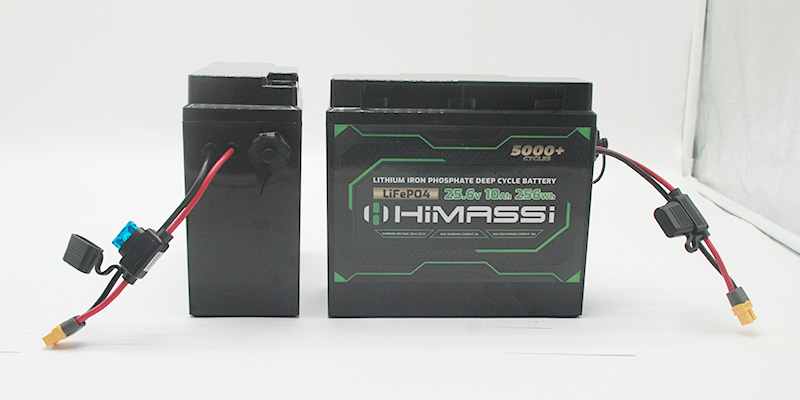
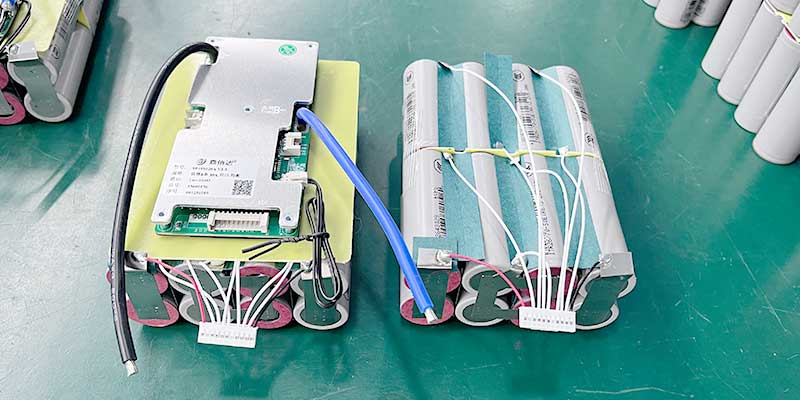
Our 25.6V 10Ah pack takes a different approach. The external balancer connection — routed through an 8-pin MOLEX 5557 connector — allows the BMS to communicate with an active external balancing module that redistributes charge between cells rather than simply burning off the excess. The result is a pack that stays tighter across all eight series cells, even after extended float operation.
| Why External Balancing Matters for UPS Applications:
• Float charge for 12–24 months without active cycling — divergence risk is HIGH • Passive balancing loses energy as heat; active balancing redistributes it • External connector allows easy testing and replacement of balancing hardware • 8-pin MOLEX 5557 interface is industry-standard, widely supported in UPS designs |
Full Technical Specifications
For procurement teams and product engineers, here’s the complete spec sheet for our LiFePO4 25.6V 10Ah deep cycle battery — the same configuration validated for UPS applications:
| Parameter | Specification |
| Chemistry | Lithium Iron Phosphate (LiFePO4) |
| Nominal Voltage | 25.6V |
| Nominal Capacity | 10Ah (256Wh) |
| Cell Configuration | 8S2P (8 series, 2 parallel) |
| Cell Model | 26700-5000 |
| Max Charge Current | 10A |
| Max Continuous Discharge | 10A |
| Peak Discharge Current | 30A (short-duration) |
| Protection Board | 30A BMS with balancing function |
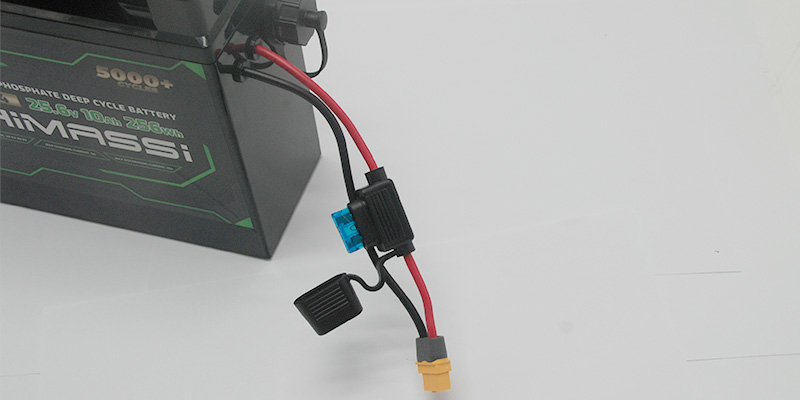
| Balancer Connector | MOLEX 5557 8-pin (pins 1–7 black, pin 8 red) |
| Balancer Wire | 8 × 0.5mm², 150mm ±20mm length |
| Enclosure | Black ABS (lead-acid form factor) |
| Waterproofing | Yes |
| Max Dimensions | 181mm × 76mm × 165mm (L×W×H) |
| Weight | Approx. 2.25 kg |
| Compliance | UN38.3, with MSDS documentation |
Why 25.6V? The Voltage Design Logic
A lot of engineers new to lithium UPS batteries ask why we use 25.6V rather than 24V. The answer comes down to cell chemistry. A single LiFePO4 cell has a nominal voltage of 3.2V. Eight cells in series gives you 25.6V nominal — which drops to around 24V only under high-load discharge conditions. This is intentional.
Standard 24V UPS systems are designed to accept voltage input in a range, typically 21V to 29V depending on the inverter topology. The 25.6V nominal sits comfortably in that window, and the flat discharge curve of LiFePO4 means your UPS inverter sees a stable voltage for the majority of the runtime — not the steep drop you’d see with an aging AGM pack.
From a UPS battery backup system perspective, this matters. Inverters that receive a more stable input voltage maintain cleaner output sine waves, which is important for sensitive equipment like servers, PLCs, and medical devices.
LiFePO4 vs. AGM and Ni-Cd for UPS: Honest Comparison
I want to be straightforward here — AGM batteries are not bad batteries. For certain price-sensitive applications with low cycling requirements, they remain a practical choice. But in UPS scenarios where any of the following are true, the case for switching to LiFePO4 becomes compelling:
- The UPS is deployed in a warm environment (above 25°C ambient) where AGM degradation accelerates significantly
- The battery replacement interval needs to extend beyond 3 years to reduce maintenance cost
- Weight is a factor (LiFePO4 is roughly 50–60% lighter at equivalent capacity)
- The installation location has limited ventilation — AGM can off-gas hydrogen under fault conditions
- The UPS will experience occasional deep discharge cycles, which AGM handles poorly
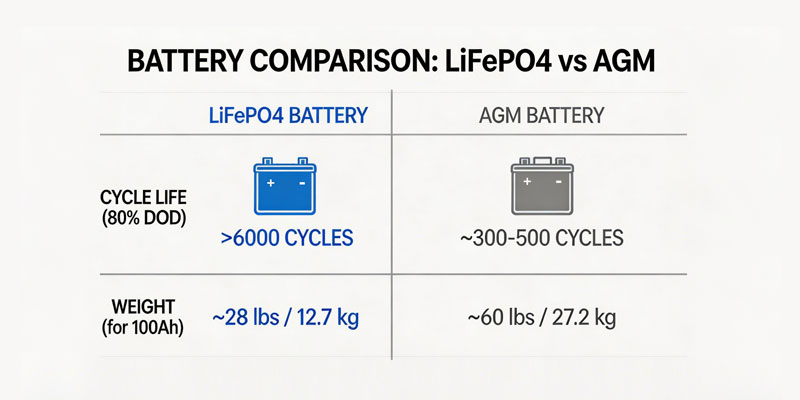
| Metric | LiFePO4 25.6V 10Ah vs. Equivalent AGM |
| Cycle Life | 2,000+ cycles vs. 300–500 cycles |
| Weight | ~2.25 kg vs. ~4.5–5 kg |
| Calendar Life | 8–10 years vs. 3–5 years |
| Self-discharge | ~2% per month vs. 5–8% per month |
| Deep Discharge Tolerance | Safe to 90% DoD vs. ~50% DoD limit |
| Thermal Stability | Excellent vs. Moderate (risk at >40°C) |
| Maintenance | None vs. Periodic terminal check |
| Charging Efficiency | >95% vs. ~70–80% |
You can see more of our UPS-rated battery range at the Himax energy storage and UPS battery page.
The ABS Enclosure: Not Just for Aesthetics
The decision to house this battery in a black ABS shell that mirrors the form factor of a standard lead-acid battery was a deliberate engineering and supply-chain decision, not just a cosmetic one.
Most UPS cabinets are physically designed around the dimensions of sealed lead-acid (SLA) batteries. Switching to a lithium pack that has a completely different profile often means redesigning or modifying the battery tray — which adds time and cost to any OEM’s product update cycle. By matching the external form factor, this pack can be dropped into existing UPS enclosures with minimal or no hardware changes.
The ABS shell also adds meaningful waterproofing (the pack carries IP-compliant sealing), UV resistance for installations near windows or in exposed industrial environments, and enough structural rigidity to protect the cells and BMS during transport — which matters when you’re shipping UN38.3-compliant battery packs internationally.
A Note on the 30A BMS and Its Protection Functions
The onboard 30A protection board provides several layers of active safety management that passive AGM chemistry simply cannot offer:
- Overcharge protection: prevents cells from exceeding 3.65V per cell
- Over-discharge protection: disconnects load if cell voltage drops below ~2.5V
- Overcurrent protection: hardware-level cutoff at 30A surge current
- Short-circuit protection: sub-millisecond response
- Cell balancing output: interfaces with external balancer via MOLEX connector
- Temperature monitoring: passive thermal cutoff under high-temperature conditions
For UPS applications, the overcurrent and short-circuit protections are particularly relevant. During a switchover event, the load presented to the battery can spike significantly depending on the inverter design. A well-specified BMS absorbs that spike without damage or nuisance tripping — and that’s exactly what a 30A protection board with good inrush tolerance is designed to handle.
Compliance and Shipping: UN38.3 and MSDS
For buyers sourcing batteries internationally — which is the reality for most of our OEM and product manufacturer customers — shipping compliance is a practical concern, not just a regulatory checkbox.
Lithium batteries must pass UN38.3 testing (altitude simulation, thermal test, vibration, shock, external short circuit, impact/crush, overcharge, and forced discharge) to be transported by air or sea as commercial cargo. Our 25.6V 10Ah pack is certified under UN38.3 and shipped with complete MSDS documentation. This removes a significant procurement headache for buyers who are integrating our batteries into finished products for global distribution.
If you’re sourcing for a product that will be sold into markets with specific certification requirements, I’d recommend reaching out via our contact page — our team can advise on what documentation your product line may additionally require.
📄 View UN38.3 Test Report
📄 View Material Safety Data Sheet
Environmental Compliance: REACH & RoHS
For OEMs shipping to Europe, two environmental regulations are non-negotiable: REACH and RoHS – and they are not the same.
REACH (EC No. 1907/2006) restricts hundreds of hazardous substances across all manufactured goods. For batteries, this includes limits on cadmium, lead, organotins, phthalates, and more. Compliance is mandatory regardless of product category.
RoHS (2011/65/EU) applies specifically to electrical and electronic equipment. While bare cells may fall outside its scope, battery packs that include a protection circuit or BMS are generally covered – meaning your UPS battery as a complete assembly must meet RoHS limits on 10 restricted substances.
Both regulations must be satisfied independently. Our LiFePO4 25.6V 10Ah pack has been tested and validated against both standards through accredited third-party laboratories.
📄 View REACH Annex XVII Test Report
📄 View RoHS Compliance Test Report
Need these documents for your compliance file? Both reports are available for download above. For custom configurations, we can provide updated declarations upon request.
Where This Battery Is Being Used
While I can’t go into specific customer details, I can share the application categories where we see this exact configuration performing well in the field:
- Rack-mounted UPS systems for server rooms and network closets in the 500VA–2000VA class
- Industrial UPS for PLC and automation systems in manufacturing environments
- Telecom power backup where cabinet space is limited and cycle life is a cost driver
- Medical-grade UPS for non-critical monitoring equipment where weight and maintenance intervals matter
- Commercial building management systems with extended backup time requirements
We also produce lithium backup batteries for smaller applications. If you’re working on something like a mini UPS for Wi-Fi routers or a compact gateway device, we have configurations suited to that end of the power envelope as well.
What to Ask Before You Order
Based on conversations with hundreds of procurement engineers and product managers, these are the questions that separate a successful battery integration from a painful one:
- What is the nominal and peak load current your inverter will draw from the battery?
- What is your UPS inverter’s low-voltage cutoff threshold? (Confirm 25.6V nominal compatibility)
- Does your existing UPS enclosure have a compatible battery tray — or will you need a custom bracket?
- What is your target battery replacement interval, and does your current solution meet it?
- Are there regulatory or certification requirements in your target market that the battery must meet?
- Will the battery be in a temperature-controlled environment, or are there thermal extremes to account for?
I ask these not to complicate the process, but because the answers change which configuration is actually right for your product. In some cases, a different cell count or a different BMS rating will serve you better than the standard spec — and that’s exactly what our engineering team is here to figure out with you.
A Broader Look at LiFePO4 in Powered Products
UPS is one application, but the underlying advantages of LiFePO4 chemistry — stable voltage curve, high cycle life, excellent thermal behavior — show up across a wide range of battery-powered products. If you’re a manufacturer working through whether LiFePO4 is the right chemistry for your product, you might find our breakdown of how LiFePO4 is changing the design of electric walkers a useful frame of reference. The core engineering logic — stable power delivery, low maintenance, and extended service life — applies across verticals.
Ready to Spec This Battery for Your UPS Design?
If you’re evaluating the LiFePO4 25.6V 10Ah with external balancing for a UPS product line or looking for a customized configuration, the product detail page has full spec documentation: 25.6V 10Ah Deep Cycle LiFePO4 Battery — Product Page
For custom requirements — different BMS ratings, enclosure modifications, alternate connector types, or volume pricing — our engineering team reviews each inquiry directly. You can reach us at the Himax contact page and expect a technical response, not a form reply.
And if you want to understand what else we offer in the energy storage and UPS space before reaching out, the full UPS and energy storage battery range is a good starting point.
| About the Author: Alden is a Battery Engineer at Himax Electronics, specializing in
manufacturing process design and quality control for custom lithium battery packs. With extensive field experience across UPS, energy storage, and industrial applications, Alden works directly with OEM partners on battery specification and integration challenges. |