
From Cells to Battery Packs: What Should You Consider When Developing Custom Batteries for Portable Medical Devices?
better understand battery technologies and make informed decisions based on their specific application requirements. All content reflects the official editorial perspective of Himax Electronics and our commitment to providing reliable, flexible, and professional custom battery and power solutions for complex applications worldwide.
Key Takeaways
- Developing a custom battery for a portable medical device is not as simple as selecting cells and combining them to reach a target capacity.The battery system should be designed around the device’s operating voltage, average and peak power demand, target runtime, available installation space, charging method, and operating environment.
- Cell selection should consider chemistry, energy density, cycle life, discharge capability, temperature range, and supply continuity, rather than focusing only on capacity or unit cost.
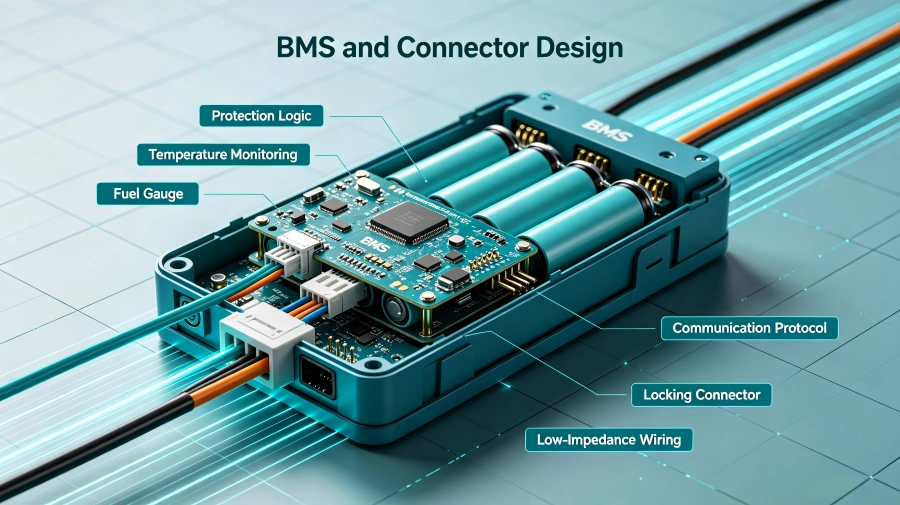
- The BMS, connectors, communication protocols, and fuel-gauging functions are important parts of how the battery pack works with the medical device, especially for products that require battery-level display, low-battery alerts, or battery identification.
- Battery safety testing, transportation testing, and medical device system-level validation are different stages.For example, UN 38.3 primarily addresses lithium battery transportation requirements and does not, by itself, demonstrate that a battery is suitable for a specific medical device. Pipeline and Hazardous Materials Safety Administration
- Custom battery development should take future mass production and change control into account early in the project.If cells, the BMS, connectors, or other critical materials are changed, the impact on previous validation results and the final device should be evaluated.
- For medical device manufacturers, OEMs, and product development teams, providing complete project requirements early can help reduce redesign work caused by mismatches in dimensions, electrical interfaces, charging systems, or compliance requirements.
Why Do Portable Medical Devices Need Batteries Designed Around the Complete System?
Portable patient monitors, infusion pumps, portable respiratory equipment, diagnostic instruments, and other mobile medical devices may rely on batteries to operate away from a fixed power source.
However, battery requirements can vary significantly from one device to another.
Some devices need to operate for long periods at a relatively stable power level. Others may experience short bursts of higher load during startup, pump operation, or certain functions. Some devices also need to read battery data in real time, such as remaining capacity, temperature, or cycle count.
For medical device manufacturers, a better starting point for custom battery development is usually not:
“We need a 5000mAh lithium battery.”
Instead, the project should begin by answering:
“How much energy and power does the device need under actual operating conditions, and how should the battery work with the complete system?”
This is one of the first questions to address when moving from standard cells to a Custom Medical Device Battery Pack.
What Information Should You Provide to a Battery Manufacturer Before Development Begins?
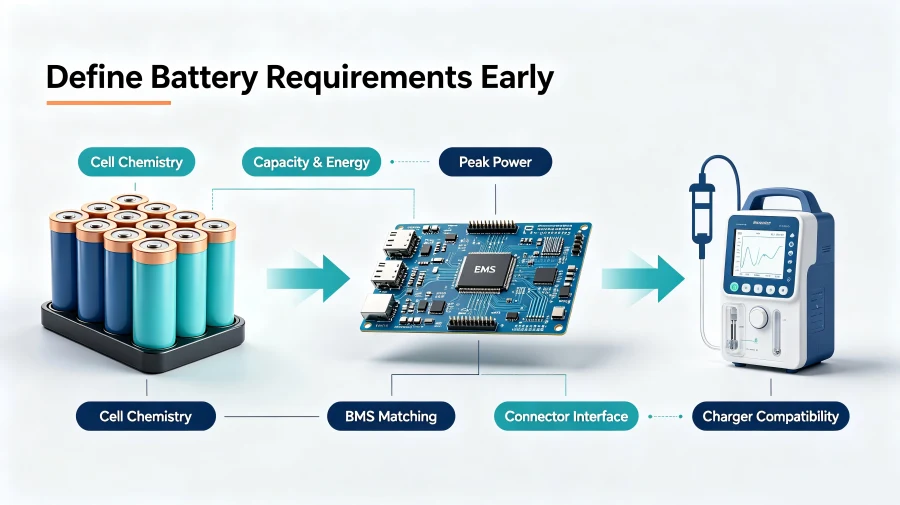
A B2B custom battery project usually starts with defining the device requirements. The more complete the information provided by the product development team, the easier it is for the battery manufacturer to determine whether the proposed cells, series/parallel configuration, BMS, and mechanical design are appropriate.
| Item | Information to Provide | Impact on Battery Design |
| Operating Voltage | Nominal voltage, acceptable input range | Number of cells in series, voltage platform |
| Power Consumption | Average power, peak power | Capacity, cell discharge capability, BMS |
| Target Runtime | For example, 2 hours, 4 hours, or a specific duty cycle | Wh and Ah requirements |
| Installation Space | Length, width, height, and mechanical constraints | Cell format, layout, enclosure design |
| Weight Requirement | Allowable battery weight range | Cell chemistry and capacity configuration |
| Charging Method | Charging voltage, current, charging interface | Charging strategy and protection design |
| Output Interface | Connector model, polarity, pin definition | Wire harness and connector design |
| Communication Requirements | SMBus, I²C, UART, or other protocols | Smart BMS and software development |
| Operating Environment | Temperature, humidity, vibration, and other conditions | Cell selection, mechanical design, validation plan |
| Target Market | United States, European Union, or other regions | Compliance and testing plan |
For replacement battery projects involving existing devices, the original battery specifications, device input requirements, and charging system information should also be provided. Two batteries should not be considered interchangeable simply because they have the same nominal voltage and capacity.
Step 1: How Do You Select the Right Battery Cells?
Battery Chemistry Is About More Than Energy Density
Common rechargeable battery options for portable medical devices may include lithium-ion, lithium-polymer, LiFePO4, and NiMH chemistries. The appropriate choice depends on the specific device requirements.
For example, compact portable devices may place greater emphasis on size and weight. Devices expected to undergo frequent charge and discharge cycles may place greater emphasis on cycle performance. Some applications may also require careful consideration of discharge performance at specific temperatures.
Cell selection can therefore be evaluated across several dimensions:
| Evaluation Factor | Questions to Consider |
| Voltage Platform | Does it match the device input requirements and power architecture? |
| Energy Density | Can the target Wh be achieved within the available space? |
| Discharge Capability | Can the cell support both continuous and peak loads? |
| Cycle Performance | Does it meet the expected usage and maintenance cycle? |
| Temperature Performance | How does it perform during charging and discharging in the target environment? |
| Size and Format | Is a cylindrical, prismatic, or pouch cell structure more suitable? |
| Consistency | How will capacity, internal resistance, and other parameters be controlled in mass production? |
| Supply Continuity | Is the cell suitable for long-term product lifecycle management? |
For medical device OEM projects, long-term cell availability is also worth considering. If a product is expected to remain on the market for several years, changing the cell model later may require a reassessment of electrical performance, safety, and whether previous validation results still apply.
Step 2: How Should Capacity and Runtime Be Determined?
Medical device battery capacity should not be evaluated by mAh alone.
Wh is generally more useful when calculating energy requirements:
Nominal Energy (Wh) ≈ Nominal Voltage (V) × Rated Capacity (Ah)
For example, a 14.8V, 5Ah battery pack has a nominal energy of approximately:
14.8 × 5 = 74Wh
However, 74Wh does not mean that the device will necessarily be able to use the full 74Wh.
Actual usable energy can be affected by discharge cutoff voltage, conversion efficiency, temperature, battery aging, device operating modes, and the design margin built into the system.
During custom development, a practical starting point is:
Average Device Power Consumption × Target Operating Time
This provides a baseline energy requirement, which can then be adjusted based on real-world testing and the required design margin.
For devices with widely varying power consumption, different operating states should also be tested, including startup, standby, normal operation, wireless communication, and specific functional modes, rather than relying on a single average power figure.
Step 3: Why Does Peak Current Matter?
Capacity answers the question, “How much energy can the battery store?”
Power delivery answers a different question: “Can the battery deliver enough power when the device needs it?”
These are not the same issue.
For example, some devices with pumps, motors, heating elements, or other dynamic loads may draw significantly more current during certain operating stages than during normal operation.
Even if the cells store enough energy, problems can still occur if the cells, nickel strips, wiring, connectors, or BMS are not rated for the required current. Possible issues include:
- Significant voltage drop at the battery terminals;
- BMS overcurrent protection being triggered;
- Increased temperature at connection points;
- Low-battery alerts appearing on the device;
- Certain loads failing to start properly.
For this reason, specifications for a custom medical device battery should define both Continuous Current and Peak Current, along with the peak duration and test conditions.
Step 4: How Should the BMS Work with the Medical Device?
A BMS, or Battery Management System, is more than just a protection board.
Depending on the battery pack design, the BMS may monitor voltage, current, and temperature while also providing protection against overcharge, over-discharge, overcurrent, and short circuits. Smart battery systems may also require state-of-charge estimation, data logging, and communication functions.
For portable medical devices, one particularly important question is:
Does the BMS protection logic match the device’s actual load profile?
For example, if a device draws a short burst of high current at startup but the BMS overcurrent threshold or delay time was not designed with that behavior in mind, normal startup could unintentionally trigger protection.
BMS parameters therefore should not be defined independently of the complete device load.
Step 5: Why Should Connectors and Communication Protocols Be Defined Early?
In some custom battery projects, customers first determine the cells and capacity, then wait until the battery design is nearly complete before confirming the connector.
This approach can increase the risk of rework.
A medical device battery interface may include more than positive and negative terminals. It may also support:
NTC temperature sensing, ID identification, SOC data, clock/data communication, and other control signals.
If the device uses a smart battery system, the communication protocol, data format, alarm logic, and the way the device reads remaining battery capacity should also be confirmed early in the development process.
The connector itself may need to meet requirements related to current rating, mating-cycle life, locking mechanism, reverse-polarity prevention, and installation space.
For this reason, Connector + Pinout + Communication Protocol should be included in the technical specification early in the custom battery development process, rather than treated as an accessory decision at the end.
Step 6: Why Should the Charger and Battery Be Considered Together?
Battery pack design is directly related to the charging system.
Different cell chemistries, series configurations, and BMS designs may require different charging voltages, currents, and control strategies. If the device includes an internal charging circuit, the compatibility between that charging system and the custom battery pack needs to be confirmed.
The FDA’s safety guidance for charging medical devices also advises users to follow the device manufacturer’s instructions and use the specified charging accessories. Incompatible third-party chargers may create risks such as overheating, sparks, or fire. U.S. Food and Drug Administration
For new OEM device development, the battery manufacturer and the device power-system design team should therefore confirm the complete power chain early:
Battery → BMS → Charging Circuit → Adapter/Power Supply → Device
The system should be considered as a whole rather than designing each component separately and trying to combine them later.
Step 7: How Should Safety, Transportation, and Medical Device Compliance Be Understood?
This is an area where misunderstandings can easily occur in custom medical device battery projects.
A battery passing a particular test does not mean that the medical device using that battery automatically meets all requirements for its target market.
Different standards and tests address different aspects of the product:
| Standard / Testing Area | Primary Focus | What to Consider in the Project |
| UN 38.3 | Lithium battery transportation testing | Does not equal certification of the complete medical device |
| IEC 62133-2 | Safety of portable sealed rechargeable lithium cells and batteries within its scope | Applicability should be evaluated based on the product and target market |
| Medical Device Standards | Safety, performance, and other requirements for medical electrical equipment | The device manufacturer should determine applicability based on device classification |
| System Compatibility Validation | How the battery performs in the actual device | Should cover real operating modes and abnormal conditions |
PHMSA explains that lithium cells and batteries offered for transportation must meet the applicable design testing requirements in Section 38.3 of the UN Manual of Tests and Criteria. Manufacturers and subsequent distributors may also be subject to requirements related to providing a Test Summary. Pipeline and Hazardous Materials Safety Administration
At the same time, even if a battery itself meets applicable safety requirements, its acceptability in the final product still depends on the complete device and the requirements that apply to it. FDA-recognized standards for lithium battery safety also reflect this distinction between a battery component and the finished product. FDA Access Data
For a B2B project, a more practical approach is to identify the target market, device classification, and expected standards at the beginning of the project, then work backward to define battery design, testing, and documentation requirements.

Step 8: What Should Be Validated from Prototype to Mass Production?
Completing the battery design drawings does not mean the custom battery project is finished.
Prototype validation is usually needed to confirm that the battery actually works with the device as intended. Depending on the project, key validation areas may include:
| Validation Item | Main Purpose |
| Dimensions and Assembly | Confirm that the battery fits and can be properly secured |
| Voltage Range | Confirm that the device operates normally from full charge to discharge cutoff |
| Runtime Testing | Verify actual operating time under the target use case |
| Peak Load Testing | Evaluate voltage response and protection behavior under dynamic loads |
| Charging Testing | Verify charging parameters, temperature rise, and charge termination logic |
| Communication Testing | Verify SOC, temperature, alarms, and other data |
| Temperature Testing | Evaluate performance under specified environmental conditions |
| Power Switching | Verify switching behavior between external power and battery power |
Once the project moves into mass production, control of critical materials and change management should also be established.
For example, if the cell, protection IC, MOSFET, connector, or another critical component is changed, the decision should not be based only on whether the replacement “looks equivalent on paper.” The impact on previous performance testing, safety testing, and device-level validation should also be evaluated.
PHMSA guidance related to UN 38.3 also notes that if a lithium battery design change could lead to failure of the applicable tests, it may be considered a new type and may need to be retested accordingly. Pipeline and Hazardous Materials Safety Administration
How Can Medical Device OEMs Improve the Efficiency of a Custom Battery Development Project?
For medical device manufacturers, rather than sending a battery supplier a simple request such as:
“We need a 12V 5000mAh battery for a medical device.”
it is more useful to prepare a relatively complete Battery Requirement Specification.
At a minimum, it should include:
Operating Voltage + Capacity/Wh + Average Power Consumption + Peak Power/Current + Target Runtime + Dimensions + Weight + Connector + Pinout + Communication Protocol + Charging Parameters + Operating Temperature + Target Market + Estimated Annual Volume
With this information, the battery manufacturer can evaluate the project across multiple areas, including cell selection, series/parallel configuration, BMS design, mechanical structure, connectors, and testing requirements.
For new medical device projects, involving the battery, power supply, and device engineering teams earlier in the requirements-definition process can help reduce redesign work later due to changes in space constraints, electrical interfaces, or validation requirements.
Frequently Asked Questions
Should a Custom Battery for a Portable Medical Device Use Lithium-Ion or LiFePO4?
The decision should not be based on chemistry alone. Device voltage, available space, weight, energy requirements, discharge characteristics, cycle-life expectations, operating conditions, and product lifecycle should all be evaluated before selecting a battery chemistry.
Is a Higher-Capacity Medical Device Battery Always Better?
No. Increasing capacity can also affect battery size, weight, charging time, and other system parameters. A more appropriate approach is to determine the required Wh based on device power consumption, target runtime, and validation conditions, then design the battery pack around those requirements.
Does Every Custom Medical Device Battery Need a BMS?
It depends on the battery chemistry, series/parallel configuration, device requirements, and overall design. Rechargeable lithium-ion battery packs generally require appropriate protection and management functions, but the specific BMS architecture and feature set should be determined based on the actual application.
Why Would a Medical Device Battery Need Communication Functions?
Not every battery requires communication. Some smart medical devices may need to read SOC, temperature, battery identification, or other status information, which may require a battery management system with communication capabilities. Whether communication is needed, and which protocol should be used, depends on the device architecture.
Does Passing UN 38.3 Mean a Battery Can Be Used Directly in a Medical Device?
No. UN 38.3 primarily addresses testing requirements related to lithium battery transportation. A medical device may still require additional validation based on the specific device, target market, and applicable regulations and standards. Pipeline and Hazardous Materials Safety Administration
If the Cells Have Already Been Tested, Does the Finished Battery Pack Still Need to Be Evaluated?
Yes, depending on the battery pack design and applicable requirements. It should not be assumed that a battery pack requires no further consideration simply because the individual cells have already been tested. PHMSA interpretation guidance notes that an electrically connected assembly of lithium-ion cells may meet the definition of a “battery” and may therefore be subject to applicable UN 38.3 requirements. Pipeline and Hazardous Materials Safety Administration
What Information Should I Prepare When Requesting a Custom Medical Device Battery from a Battery Manufacturer?
It is helpful to provide the device operating voltage, average and peak power demand, target runtime, installation dimensions, weight limits, connector and pinout, communication protocol, charging method, operating environment, target market, project stage, and estimated annual volume. If you already have a prototype, original battery specifications, or electrical drawings, these can also support the technical evaluation.
About Himax Electronics
Himax Electronics focuses on providing custom battery and power solutions for a wide range of applications. Its products and services include custom lithium-ion battery packs, LiFePO4 batteries, lithium-polymer batteries, NiMH batteries, as well as compatible power supplies, chargers, and related accessories.
For portable medical device projects, battery development can begin with the requirements of the complete device and include technical evaluation of cell selection, voltage and capacity configuration, BMS design, mechanical dimensions, connectors, communication, charging solutions, and project validation. For OEMs, device manufacturers, and product development teams, providing clear electrical, mechanical, and application requirements early in the project can help create a more structured path for custom battery development.
It is also important to distinguish between battery test documentation, transportation compliance documentation, and market-access requirements for the finished medical device. Specific product parameters, testing requirements, applicable standards, and final device suitability should be determined based on the actual design, target market, and technical requirements agreed upon by the parties involved.