Solar Street Light Battery Solutions: LiFePO4 Battery Capacity, Cycle Life, and Outdoor Performance
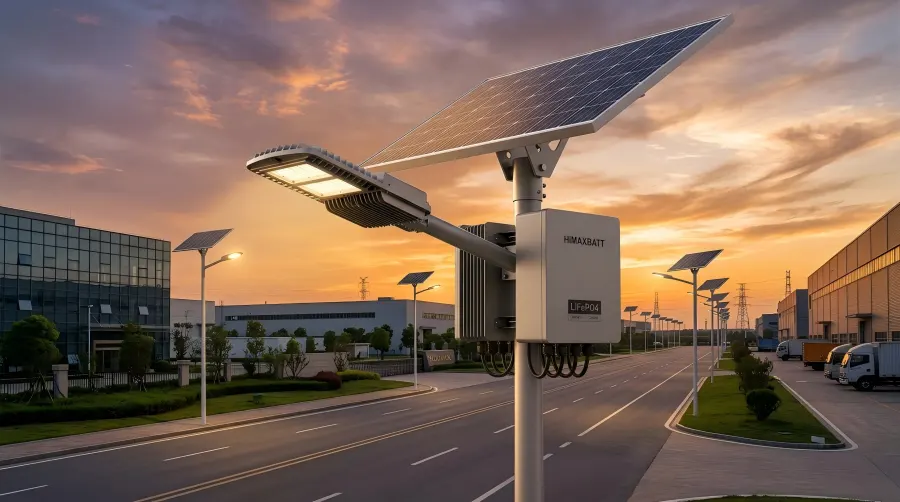
Solar Street Light Battery Solutions: LiFePO4 Battery Capacity, Cycle Life, and Outdoor Performance
Commercial Disclosure: The HiMAXBATT Editorial Team brings together expertise in lithium battery manufacturing, battery engineering, power systems, and global application support to provide practical, technically informed content for businesses and industry professionals. Our content covers lithium-ion and LiFePO4 batteries, custom battery packs, BMS technology, charging solutions, battery selection, industrial applications, product updates, and HiMAXBATT news. All content reflects HiMAXBATT’s official editorial perspective and our commitment to delivering safe, reliable, and application-focused lithium battery solutions to customers worldwide.
Key Takeaways
- Solar street light battery capacity should be calculated based on the light’s actual power consumption, daily lighting hours, required backup days, depth of discharge, and overall system efficiency.
- Ah alone does not indicate how much energy a battery stores. Battery voltage and Wh should also be considered when comparing battery options.
- The cycle life of a LiFePO4 battery is affected by depth of discharge, temperature, charge and discharge rates, and cell consistency.
- High temperatures can accelerate battery aging, while low temperatures may reduce usable capacity and limit charging capability.
- The solar panel, controller, LED light, and battery must be properly matched. Simply increasing battery capacity will not necessarily solve an energy shortage.
- Outdoor battery designs should account for water and dust protection, condensation, corrosion, vibration, and theft.
- The BMS should provide overcharge, over-discharge, overcurrent, short-circuit, and temperature protection while working properly with the solar charge controller.
- Project buyers should compare total life-cycle costs rather than focusing only on the battery’s upfront price.
Introduction
Solar street lights use energy collected during the day to provide lighting at night without the need for long cable runs. They are widely used on urban and rural roads, in parking lots, industrial parks, parks, campuses, and remote areas. As the core energy storage component, the battery directly affects nightly operating time, backup runtime during consecutive cloudy or rainy days, failure rates, and long-term maintenance costs.
Among solar street light battery solutions, lithium iron phosphate (LiFePO4) batteries have become a common choice for many new projects because of their relatively long cycle life, good thermal stability, and efficient energy utilization. However, selecting a lithium battery for a solar street light involves more than choosing a capacity. The complete system should be designed around the LED power demand, lighting schedule, local solar conditions, controller parameters, and outdoor operating environment.
Why Are LiFePO4 Batteries Well Suited for Solar Street Lights?
Traditional solar street lights often use lead-acid or gel batteries. These are mature battery technologies with relatively low upfront costs, but they are typically heavier and bulkier, while their deep-cycle performance and energy utilization may not meet the requirements of some long-term outdoor lighting projects.
LiFePO4 batteries for solar street lights typically offer several advantages:
- Relatively long cycle life for applications involving daily charging and discharging;
- Good thermal stability for outdoor applications;
- A relatively stable discharge voltage plateau;
- High charging efficiency for better use of available solar energy;
- Generally lower weight and smaller size than lead-acid batteries for the same usable energy;
- Low self-discharge;
- Relatively low routine maintenance requirements;
- Compatibility with smart BMS monitoring;
- Suitability for both all-in-one and split-type solar street light designs.
However, using LiFePO4 batteries does not eliminate the need for proper system matching. Insufficient solar panel output, incorrect charging parameters, prolonged exposure to high battery-compartment temperatures, or poor water protection can still result in insufficient runtime and premature battery degradation.
How Do You Calculate Solar Street Light Battery Capacity?
Battery capacity should be calculated based on daily energy consumption, required backup days, depth of discharge (DoD), and system efficiency.
Daily Energy Consumption (Wh) = Actual Light Power (W) × Lighting Time (h)
If scheduled dimming is used, calculate the energy consumption for each period separately. For example, consider a 60W solar street light operating for 12 hours per night: 100% brightness for the first 4 hours, 60% for the next 4 hours, and 30% for the final 4 hours:
60 × 4 + 60 × 60% × 4 + 60 × 30% × 4 = 456Wh
Next, estimate the required battery energy:
Recommended Battery Energy (Wh) = Daily Energy Consumption × Backup Days ÷ Allowable Depth of Discharge ÷ System Efficiency
If the system needs to support three nights, with an 80% DoD and 90% overall system efficiency:
456 × 3 ÷ 0.8 ÷ 0.9 ≈ 1900Wh
For a 12.8V LiFePO4 battery:
1900 ÷ 12.8 ≈ 148Ah
Under these example conditions, a 12.8V 150Ah battery or a custom battery solution with an appropriate design margin could be considered as a starting point. Final sizing should also account for solar irradiance during the worst month, temperature, battery aging, and the controller’s own power consumption.
What’s the Difference Between Ah and Wh?
Ah stands for amp-hours, while Wh stands for watt-hours. Solar street lights may use 12V, 24V, or other voltage platforms, so comparing Ah alone can be misleading.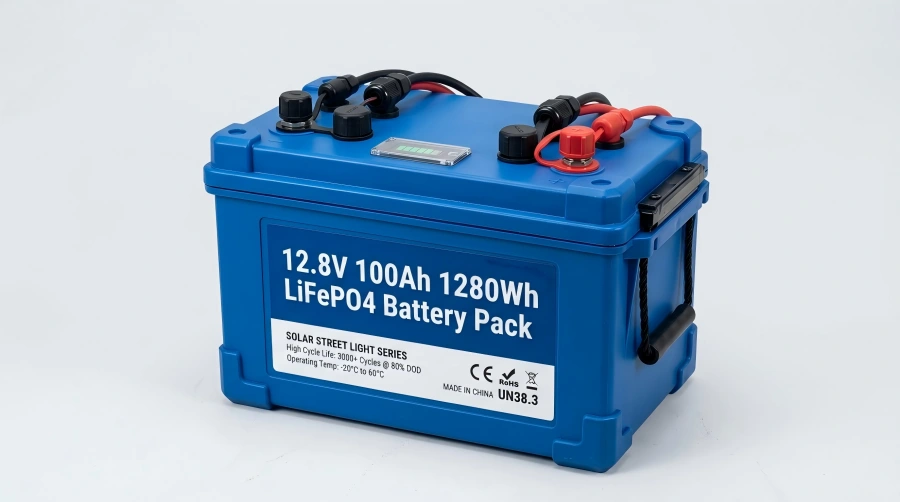
Battery Energy (Wh) = Nominal Voltage (V) × Battery Capacity (Ah)
| LiFePO4 Battery Specification | Theoretical Energy | Selection Considerations |
| 12.8V 50Ah | 640Wh | Suitable for lower-power systems or shorter lighting periods |
| 12.8V 100Ah | 1280Wh | Common option for small to medium solar street light systems |
| 12.8V 150Ah | 1920Wh | Can support longer lighting periods or additional backup time |
| 25.6V 50Ah | 1280Wh | Similar theoretical energy to a 12.8V 100Ah battery |
| 25.6V 100Ah | 2560Wh | Suitable for higher-power or longer-runtime requirements |
At the same 50Ah capacity, a 25.6V battery has approximately twice the theoretical energy of a 12.8V battery. For this reason, solar street light battery selection should consider V, Ah, and Wh together.
What Factors Affect Actual Battery Capacity Requirements?
Actual Input Power of the Light
Some products are labeled according to LED chip power, peak power, or equivalent lighting power, which may not be the same as the actual input power of the complete light. Battery calculations should use measured input power at each brightness setting.
Nightly Lighting Time
Winter nights are longer. If a system is designed only around summer lighting hours, it may shut off too early during winter. Battery sizing should be based on the longest required nightly operating time.
Consecutive Cloudy or Rainy Days
The required number of backup days is an important factor in battery sizing. Rainy seasons and solar irradiance vary significantly by location, so a single backup-day assumption should not be applied to every project.
Smart Dimming Strategy
Reducing brightness during periods of low traffic or using motion detection for pedestrians and vehicles can significantly reduce daily energy consumption. However, the dimming strategy still needs to meet roadway lighting and safety requirements.
Battery Aging Margin
The usable capacity of a LiFePO4 battery gradually decreases over long-term cycling. If the system only meets its requirements when the battery is new, it may no longer provide sufficient backup during poor weather later in its service life. Battery sizing should therefore account for end-of-life capacity.
Ambient Temperature
Low temperatures can reduce usable battery capacity and output capability, while high temperatures accelerate battery aging. Capacity calculations should be adjusted according to the actual temperature range at the project location.
How Should the Solar Panel Be Matched to a LiFePO4 Battery?
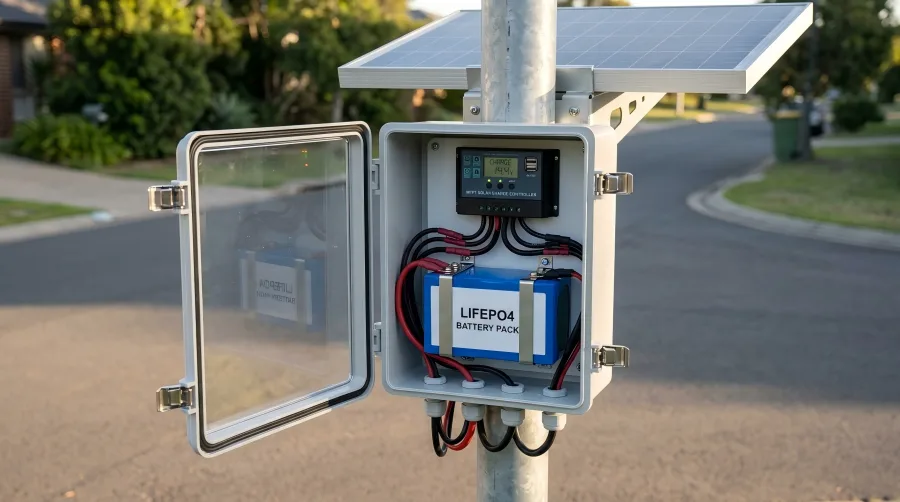
The battery stores energy, while the solar panel generates it. If the solar panel consistently produces less energy each day than the street light consumes, even a large battery will eventually become depleted.
Daily solar energy generation can be roughly estimated using:
Daily Energy Generation (Wh) ≈ Solar Panel Power (W) × Peak Sun Hours (h) × System Efficiency
For example, if a 200W solar panel receives 4 peak sun hours per day and overall system efficiency is estimated at 75%:
200 × 4 × 0.75 = 600Wh
If the street light consumes 456Wh per day, the system theoretically has some charging margin. However, after several cloudy or rainy days, the solar panel must supply enough energy for that night’s lighting while also replenishing energy previously drawn from the battery. Solar panel capacity should therefore also be designed around the desired recovery time.
| System Component | Key Selection Parameters | Common Issues |
| Solar Panel | Power, operating voltage, installation angle | Insufficient output or shading |
| LiFePO4 Battery | Voltage, Wh capacity, temperature range | Insufficient capacity or low-temperature charging limitations |
| Solar Charge Controller | Charging parameters, efficiency, maximum current | Charging profile does not match the battery |
| LED Light | Actual power, luminous efficacy, dimming strategy | Rated power differs from actual consumption |
| Cables and Connectors | Current capacity, voltage drop, water resistance | Power loss, corrosion, or poor connections |
| Energy Losses | Conversion efficiency of the battery, controller, and wiring | |
| Recycling and Disposal Cost | Transportation, recycling, and compliant disposal of used batteries |
How Many Cycles Can a LiFePO4 Solar Street Light Battery Last?
Cycle life should not be compared as a standalone number without considering the test conditions. A manufacturer’s stated cycle count typically applies under specified temperature, charge/discharge rate, depth of discharge, and capacity-retention conditions.
Factors affecting solar street light battery cycle life include:
- Daily depth of discharge;
- Charge cutoff voltage;
- Charge and discharge rates;
- Long-term operating temperature;
- Cell quality and consistency;
- BMS protection and balancing performance;
- Matching between the solar panel and load;
- How long the battery remains at a high state of charge;
- Frequency of deep discharge during extended cloudy or rainy weather;
- Battery enclosure protection and thermal management.
When comparing cycle-life specifications from different suppliers, check the test temperature, depth of discharge, charge/discharge current, and capacity-retention criteria. Cycle counts measured under different conditions should not be compared directly, even if the published numbers appear identical.
How Does High Temperature Affect Solar Street Light Batteries?
During summer, direct sunlight can cause temperatures inside the light fixture, behind the solar panel, or inside a sealed battery enclosure to rise well above ambient temperature. Prolonged exposure to high temperatures may:
- Accelerate battery capacity degradation;
- Increase heat buildup in the battery and BMS;
- Cause high-temperature protection to trigger more frequently;
- Shorten the service life of seals and connectors;
- Accelerate aging of insulation materials and electronic components;
- Reduce the long-term reliability of the complete system.
Outdoor battery systems can manage temperature through shading, thermal insulation, separation from heat sources, appropriate placement of temperature sensors, and optimized charging strategies. A fully sealed enclosure may improve water protection but can also make heat dissipation more difficult, so environmental protection and thermal management need to be considered together.
Can LiFePO4 Batteries Operate Normally in Cold Weather?
Low temperatures can reduce the usable capacity and discharge capability of LiFePO4 batteries, while charging performance is often affected even more significantly. Charging at relatively high current when the battery temperature is too low may damage the cells.
For solar street light batteries used in cold climates, consider:
- Low-temperature charging protection in the BMS;
- Temperature-based charging current limits;
- Cells designed for better low-temperature performance;
- Thermal insulation;
- Self-heating when necessary;
- Additional temperature margin in winter capacity calculations;
- Avoiding prolonged storage or operation at a low state of charge.
Self-heating also consumes energy, so heater power, activation temperature, and operating duration should be included in the overall solar street light energy budget.
What Should You Consider for Outdoor Water, Dust, and Condensation Protection?
Solar street lights are continuously exposed to rain, dust, UV radiation, salt spray, and day-to-night temperature changes. Even when the battery is not directly exposed to rain, moisture may enter the battery compartment through cable entries, enclosure seams, or pressure changes caused by temperature fluctuations.
The mechanical design should consider:
- Water and dust resistance of the enclosure;
- Sealing around connectors and cable entries;
- UV resistance of enclosure materials;
- Corrosion protection for metal components;
- Condensation management and pressure equalization;
- Electrical insulation for cells and the BMS;
- Harness retention and abrasion protection;
- Anti-theft design;
- Accessibility for inspection and replacement;
- Vibration resistance during transportation and installation.
A higher enclosure protection rating is not automatically better in every application. Excessive sealing can create challenges for heat dissipation and pressure equalization. The enclosure should be designed according to the battery’s installation location and actual environmental risks.
How Do You Choose Between Buried, Pole-Mounted, and Integrated Batteries?
| Installation Method | Main Advantages | Key Considerations |
| Buried | Relatively stable temperature and clean appearance | Water resistance, moisture protection, drainage, and maintenance access |
| Inside the Pole | Better theft protection and no additional external space required | Available dimensions, heat dissipation, and maintenance access |
| Separate Battery Box | Easier inspection and replacement | Sun exposure, water resistance, theft protection, and corrosion resistance |
| Integrated into the Light Fixture | Compact design and relatively easy installation | High temperature, weight, available space, and heat dissipation |
| Behind the Solar Panel | Shorter wiring and high system integration | High temperatures caused by direct sunlight |
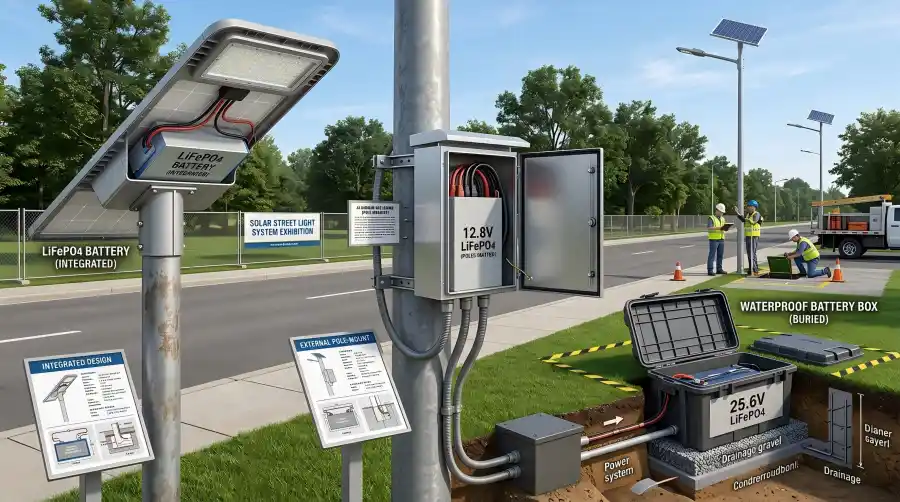
In hot climates, integrated batteries and batteries installed behind solar panels should be validated under worst-case summer temperature conditions. In areas prone to standing water, buried battery enclosures require more rigorous sealing and drainage design.
What Does a BMS Do in a Solar Street Light Battery?
A BMS, or battery management system, is an important part of a LiFePO4 solar street light battery. Common functions include:
- Individual cell and total pack voltage monitoring;
- Charge and discharge current monitoring;
- Overcharge and over-discharge protection;
- Overcurrent and external short-circuit protection;
- High- and low-temperature protection;
- Cell balancing;
- State-of-charge (SOC) estimation;
- Fault logging;
- Status communication when required.
Solar panel output changes continuously with weather conditions, so the BMS needs to work properly with the solar charge controller. If the BMS disconnects charging or discharging and the controller does not have appropriate recovery logic, the battery may fail to resume charging or the street light may not turn on as expected.
How Do You Choose Between PWM and MPPT Controllers?
PWM controllers have a relatively simple design and can be suitable for lower-power, cost-sensitive systems where the solar panel and battery voltage are properly matched. MPPT controllers track the solar panel’s maximum power point and can improve solar energy utilization under certain irradiance and temperature conditions, although they typically add cost and system complexity.
Regardless of controller type, confirm:
- Whether it supports LiFePO4 batteries;
- Whether the charge cutoff voltage can be set correctly;
- Whether the maximum charging current meets system requirements;
- The controller’s own standby power consumption;
- Whether temperature sensing is available;
- Whether light control and scheduled dimming are supported;
- Low-voltage protection and recovery thresholds;
- Compatibility between controller and BMS protection logic.
Charging parameters intended for lead-acid batteries should not be applied directly to LiFePO4 batteries without confirming compatibility.
How Can You Reduce the Total Life-Cycle Cost of Solar Street Lights?
The initial purchase price is only one part of the total project cost. For large roadway lighting projects, battery replacement may involve significant costs for vehicles, labor, working at height, and traffic management.
| Cost Category | What to Evaluate |
| Initial Purchase Cost | Battery, solar panel, controller, and installation hardware |
| Installation Cost | Transportation, foundation work, working at height, and commissioning |
| Routine Maintenance Cost | Inspection, cleaning, troubleshooting, and spare parts |
| Battery Replacement Cost | Replacement battery, labor, vehicles, and traffic management |
| Lighting Downtime Cost | Safety risks, complaints, and project service costs |
| Energy Losses | Conversion efficiency of the battery, controller, and wiring |
| Recycling and Disposal Cost | Transportation, recycling, and compliant disposal of used batteries |
A high-quality LiFePO4 solar street light battery may have a higher upfront price, but if it reduces replacement frequency, maintenance requirements, and lighting failures, it may offer a lower total life-cycle cost.
Solar Street Light Battery Selection Checklist
When requesting a custom battery solution from a battery manufacturer, prepare the following information:
- Actual LED light power;
- Nightly lighting duration;
- Scheduled or motion-based dimming strategy;
- Project location and solar irradiance data;
- Required number of consecutive backup days;
- Solar panel power, quantity, and operating voltage;
- Controller model, maximum current, and charging parameters;
- Battery system voltage and target capacity;
- Maximum charge and discharge current;
- Minimum and maximum ambient temperatures;
- Battery installation location and available space;
- Water, dust, theft, and corrosion protection requirements;
- Low-temperature heating or remote communication requirements;
- Target cycle life and warranty requirements;
- Transportation, testing, and target-market requirements;
- Project quantity and delivery schedule.
Frequently Asked Questions (FAQ)
What Battery Capacity Does a Solar Street Light Need?
Battery capacity should be calculated based on the light’s actual power consumption, lighting duration, dimming strategy, required backup days, depth of discharge, system efficiency, and ambient temperature. The light’s rated wattage alone is generally not enough to determine the required battery capacity accurately.
How Long Can a 12.8V 100Ah Battery Power a Street Light?
A 12.8V 100Ah battery has a theoretical energy capacity of approximately 1280Wh. If 80% is considered usable, that provides about 1024Wh. With an average light power consumption of 40W, the theoretical runtime would be approximately 25.6 hours. Actual runtime will also depend on temperature, wiring losses, and battery condition.
Is a 12V or 24V Battery Better for a Solar Street Light?
Both system voltages have suitable applications. Lower-power street lights commonly use 12V-class systems, while higher-power equipment may benefit from a 24V-class system to reduce operating current at the same power level. The final choice should be based on the LED light, controller, and solar panel as a complete system.
Why Does a Solar Street Light Turn Off Early During Cloudy or Rainy Weather?
Possible causes include insufficient battery capacity, undersized solar panels, panel shading, reduced winter sunlight, battery aging, incorrect controller settings, excessive wiring losses, or an unsuitable dimming strategy.
Can a LiFePO4 Solar Street Light Battery Be Charged Below Freezing?
The minimum allowable charging temperature and charging current should be determined from the cell and battery specifications. Conventional LiFePO4 batteries generally require charging to be limited or stopped at low temperatures. For cold-climate projects, low-temperature protection, insulation, or self-heating can be considered.
How Often Should a Solar Street Light Battery Be Replaced?
Replacement intervals depend on ambient temperature, depth of discharge, charge and discharge rates, cell quality, and how well the solar system is matched. Battery condition should not be judged by age alone. Capacity, internal resistance, runtime, and fault history should also be evaluated.
Does a Larger Solar Panel Charge the Battery Faster?
When sunlight, controller capacity, and battery charging limits allow, a higher-power solar panel can generally provide greater charging capability. However, increasing panel power may not produce the expected result if the controller limits current, low-temperature protection is active, or the panel is shaded.
Is It Suitable to Install the Battery Under the Solar Panel?
This configuration can provide a compact design, but temperatures behind the solar panel may become high. Battery enclosure temperatures should be validated under strong summer sunlight, with appropriate shading, insulation, heat dissipation, and water protection incorporated into the design.
Does a Solar Street Light Battery Need Communication Capability?
Communication is not always necessary for small standalone street lights. In larger projects, communication can provide access to voltage, SOC, temperature, and fault information, supporting remote maintenance and reducing the need for on-site troubleshooting.
Why Can a Newly Installed Solar Street Light Still Have a Low Battery?
Possible causes include the battery not being fully charged before installation, incorrect solar panel wiring or orientation, incompatible controller settings, panel shading, or actual light power consumption exceeding the design assumptions. The complete system should be inspected rather than assuming the battery itself is the problem.
Can Increasing Battery Capacity Solve Runtime Problems During Consecutive Cloudy or Rainy Days?
Increasing capacity can provide more stored energy, but if the solar panel cannot generate enough energy, the battery may not recharge adequately after poor weather. A better approach is to evaluate battery capacity, solar panel power, dimming strategy, and expected energy recovery time together.
How Can You Extend the Life of a LiFePO4 Solar Street Light Battery?
Avoid prolonged exposure to high temperatures, frequent deep discharge, and incompatible charging parameters, while ensuring the solar panel provides sufficient energy margin. A reliable BMS, appropriate battery enclosure design, and suitable maintenance plan can also help extend battery service life.
About Himax Electronics
Himax Electronics specializes in custom battery and power solutions for complex applications worldwide. For solar street lights, outdoor lighting, remote monitoring systems, and other off-grid equipment, we can develop application-specific LiFePO4 battery packs, power supplies, chargers, control interfaces, and related accessories based on system voltage, LED power requirements, backup days, solar panel specifications, installation space, and operating temperature.
From cell selection, battery capacity calculations, BMS protection, and mechanical design to low-temperature heating, wiring connections, and solar charging compatibility, Himax Electronics works with customers to develop energy storage systems designed for stable operation, durability, and easier system integration.