Pure Sine Wave vs. Simulated Sine Wave UPS (Uninterruptible Power Supply): Which Is Right for Your Equipment?
Commercial Disclosure: The Himax Electronics Editorial Team brings together expertise in battery products, power technologies, engineering applications, and global customer support to share practical information about battery technology, custom battery solutions, and power applications. Our content covers lithium-ion batteries, LiFePO4 batteries, battery pack design and selection, charging and power solutions, industry application guides, product updates, and official Himax Electronics news. Our goal is to help engineers, procurement professionals, and businesses better understand battery technologies and make informed decisions based on their specific application requirements. All content reflects the official editorial perspective of Himax Electronics and our commitment to providing reliable, flexible, and professional custom battery and power solutions for complex applications worldwide.
Key Takeaways
- Choosing a lithium battery for an AGV or AMR involves more than capacity. System voltage, peak current, runtime, charging method, and available installation space all need to be considered.
- LiFePO4 batteries offer long cycle life, good thermal stability, and a strong safety profile, making them a common choice for warehouse robots.
- Equipment that operates frequently may benefit from opportunity charging or automated charging to minimize downtime.
- The battery management system (BMS) should communicate properly with the vehicle control system, charging equipment, and fleet management platform.
- Low temperatures, high temperatures, humidity, dust, and vibration may require application-specific cell selection, enclosure design, and protection.
- When developing a custom AGV battery pack, electrical specifications, mechanical dimensions, connectors, certifications, and total lifecycle cost should all be evaluated.
Introduction
As smart warehousing, flexible manufacturing, and automated logistics continue to expand, AGVs (Automated Guided Vehicles) and AMRs (Autonomous Mobile Robots) are becoming essential equipment in factories, distribution centers, e-commerce warehouses, and automated production lines. As the vehicle’s primary power source, the battery pack affects more than just AGV and AMR runtime. It can also influence charging efficiency, fleet scheduling, operational safety, and total cost of ownership.
So, how should you choose the right AGV lithium battery or AMR lithium battery for a warehouse automation project? This guide covers the key factors to consider, including battery chemistry, capacity, voltage, charging methods, communication protocols, safety design, and operating environment.
How Do Battery Requirements Differ Between AGVs and AMRs?
AGVs typically follow magnetic strips, QR codes, reflectors, or predefined routes, so their travel paths and operating cycles tend to be relatively predictable. AMRs, on the other hand, use technologies such as LiDAR, vision sensors, SLAM navigation, and real-time algorithms to plan their routes autonomously, resulting in more dynamic operating patterns.
Although both types of equipment require a reliable power system, AMRs often carry more computing hardware, sensors, and communication modules, which may continue drawing power even when the robot is idle. As a result, an AMR battery solution must not only meet the power requirements of the drive motors but also provide stable power for navigation, sensing, control, and wireless communication systems.
| Comparison | AGV Battery Requirements | AMR Battery Requirements |
| Travel Route | Usually fixed, making loads easier to predict | Routes change dynamically, which can cause greater variations in power consumption |
| Powered Equipment | Drive system, controls, and basic sensors | Drive system, industrial computer, LiDAR, cameras, and communication modules |
| Peak Power | Related to startup, acceleration, and material-handling loads | Related to acceleration, steering, obstacle avoidance, and computing loads |
| Charging Strategy | Battery swapping, scheduled charging, or automated charging | Automated charging or opportunity charging is commonly used |
| Communication Requirements | CAN, RS485, etc. | CAN, RS485, and more extensive battery status data exchange |
| Battery Design Priorities | Durability, cost, and cycle life | Energy density, dynamic power capability, communication, and intelligent management |
Why Are LiFePO4 Batteries Well Suited for Warehouse Automation Equipment?
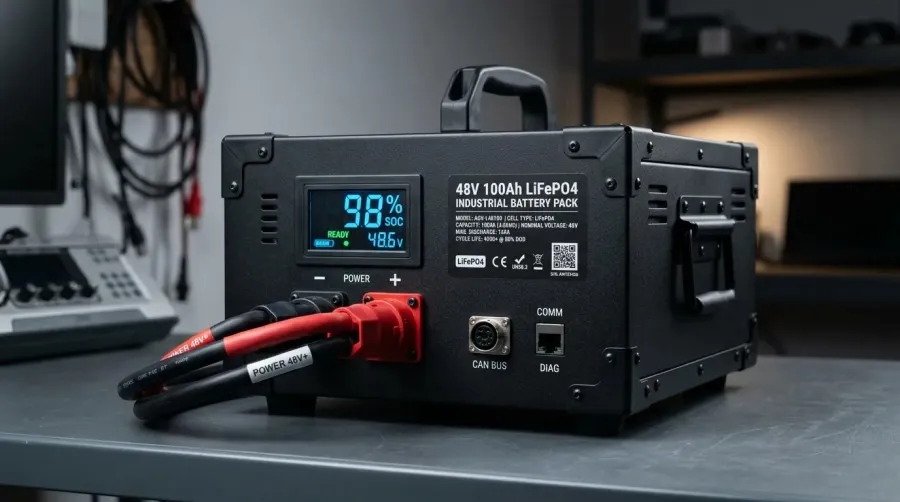
Traditional lead-acid batteries have a relatively low upfront cost, but they are heavy, take longer to charge, and have a more limited cycle life. Their performance can also decline significantly after repeated deep discharges. For AGVs and AMRs that operate frequently every day, frequent battery replacement can increase labor costs, spare battery inventory, and equipment downtime.
LiFePO4 batteries typically offer the following advantages:
- Long cycle life, making them suitable for frequent charge and discharge cycles;
- Good thermal stability, which can contribute to overall system safety;
- High charge and discharge efficiency with relatively flexible charging strategies;
- Lower weight than lead-acid batteries for a comparable amount of usable energy;
- A relatively stable discharge voltage, supporting consistent equipment performance;
- Low self-discharge, reducing routine maintenance requirements;
- Real-time monitoring of voltage, current, temperature, and state of charge through an intelligent BMS.
However, not every AGV or AMR needs to use the same battery chemistry. For robots with limited installation space, strict weight requirements, or a need for higher energy density, other lithium-ion chemistries, such as NMC, may also be worth evaluating. The final choice should balance safety, runtime, size, weight, cycle life, and cost.
How Do You Determine the Right Voltage and Capacity for an AGV or AMR Lithium Battery?
Match the Vehicle’s System Voltage
Common AGV and AMR power systems may operate at 24V, 36V, 48V, 60V, or higher. The battery pack’s nominal voltage, fully charged voltage, and minimum discharge voltage must all be compatible with the motor controller, onboard power electronics, and charger.
Do not select a battery simply because the equipment is labeled “48V.” Different battery chemistries use different numbers of cells in series and have different full-charge and discharge cutoff voltages. Before selecting a battery, verify the controller’s allowable operating voltage range.
Estimate Capacity Based on Actual Power Consumption
A basic estimate of the required battery capacity can be calculated as follows:
Required Battery Energy (Wh) ≈ Average Equipment Power (W) × Target Runtime (h) ÷ System Efficiency
Then convert the required energy into amp-hours based on battery voltage:
Battery Capacity (Ah) ≈ Required Battery Energy (Wh) ÷ Nominal Battery Voltage (V)
For example, suppose an AMR consumes an average of 800W and needs to operate continuously for 8 hours. Assuming an overall power system efficiency of 90%, the theoretical energy requirement would be approximately:
800 × 8 ÷ 0.9 ≈ 7,111Wh
If the system uses a LiFePO4 battery pack with a nominal voltage of 51.2V, the theoretical capacity would be approximately:
7,111 ÷ 51.2 ≈ 139Ah
In an actual design, however, you also need to account for depth of discharge, aging margin, ambient temperature, peak loads, and available charging windows. For that reason, simply selecting a 140Ah battery based on the theoretical calculation may not be appropriate. A battery manufacturer will typically add a reasonable design margin based on the vehicle’s actual duty cycle.
Verify Peak and Continuous Current Requirements
Current demand can increase significantly for short periods when an AGV starts, turns, climbs a slope, lifts a load, or transports heavy materials. If the battery can handle the average load but not the peak current, the BMS may trigger overcurrent protection and cause the vehicle to shut down unexpectedly.
The following information should be provided when selecting a battery:
- Average current during normal operation;
- Maximum continuous current while the motors are operating;
- Peak current during startup, climbing, or lifting;
- Duration and frequency of peak-current events;
- Whether the system produces regenerative current or uses regenerative braking.
How Do You Choose the Right Charging Method?
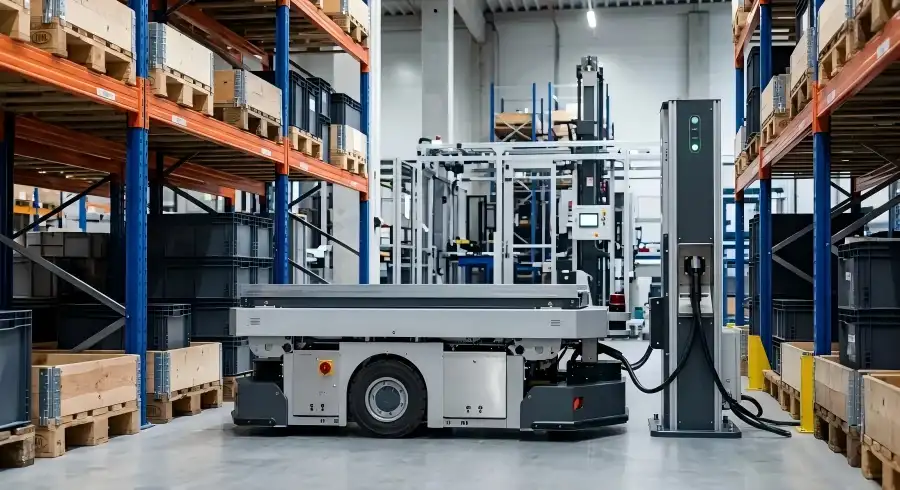
Common charging methods for AGVs and AMRs include manual plug-in charging, automatic docking, opportunity charging, and rapid battery swapping. The charging method directly affects vehicle utilization, battery capacity requirements, and warehouse scheduling strategies.
| Charging Method | Best Suited For | Main Advantages | Key Considerations |
| Manual Charging | Small fleets with centralized overnight downtime | Simple system and lower initial investment | Requires manual operation and may limit continuous operation |
| Automatic Docking | Automated warehouses and production lines | High level of automation with less manual intervention | Charging contacts, positioning accuracy, and communication must be compatible |
| Opportunity Charging | Operations with frequent short idle periods and long uptime requirements | Uses short breaks to replenish battery capacity | Battery must support frequent charging |
| Rapid Battery Swapping | High-load applications where downtime must be minimized | Allows the vehicle to return to operation quickly after a battery change | Requires spare batteries, swapping space, and standardized interfaces |
If the equipment operates for only one shift per day, a larger battery pack can be used and charged during off-hours. If the equipment needs to operate around the clock, simply increasing battery capacity can add weight, consume valuable space, and increase purchasing costs. In these cases, opportunity charging or automated charging is often a better solution.
The charger and battery pack should use a compatible charging profile, with the necessary communication or hardware interlocks to verify temperature, voltage, and connection status. An unverified or incompatible charger may result in incomplete charging, repeated overvoltage protection events, or reduced battery life.
Why Is the BMS Critical to an AGV Battery Pack?
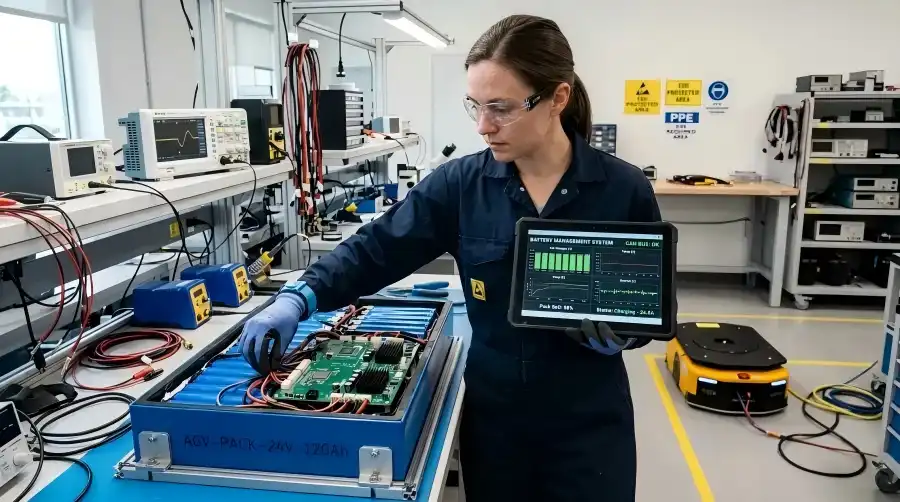
A BMS, or Battery Management System, monitors and manages the operating condition of the battery pack. In warehouse automation equipment, the BMS is more than a protection device—it also serves as the data bridge between the battery and the vehicle.
An intelligent BMS designed for AGVs and AMRs will typically include:
- Individual cell voltage and total pack voltage monitoring;
- Charge and discharge current monitoring;
- Multi-point temperature monitoring;
- Overcharge, over-discharge, overcurrent, short-circuit, and overtemperature protection;
- Cell balancing;
- SOC (State of Charge) estimation;
- SOH (State of Health) estimation;
- Charge/discharge MOSFET or contactor control;
- Fault logging and operating data storage;
- CAN, RS485, UART, or other communication capabilities.
SOC accuracy can directly affect vehicle scheduling. If the SOC estimate is significantly inaccurate, the fleet management system may send a vehicle to charge too early, reducing equipment utilization. It may also overestimate the remaining capacity and cause a robot to shut down in the middle of a task.
For this reason, the BMS SOC algorithm should be calibrated based on battery chemistry, load characteristics, temperature changes, and battery aging rather than relying solely on battery voltage.
What Communication Protocols and Interfaces Should You Confirm?
Even if a battery meets all voltage and capacity requirements, incompatible communication protocols can prevent it from working properly with the vehicle. Before ordering a custom AMR or AGV battery pack, confirm the following:
- Whether the vehicle communicates with the battery through CAN, RS485, or another protocol;
- Baud rate, node address, and message cycle;
- Definitions for SOC, SOH, voltage, current, temperature, and other data;
- Charge enable, discharge enable, and fault alarm logic;
- Emergency stop, wake-up, and sleep signals;
- Power, charging, and communication connector models;
- Positive and negative terminal definitions and wire harness lengths;
- Whether the charging station needs to perform a handshake with the BMS;
- How the vehicle controller should respond if communication is interrupted.
For new projects, it is a good idea to involve the battery supplier early in vehicle development and system integration. This makes it easier to identify protocol, interface, or control-logic issues during the prototype stage instead of making extensive modifications after mass production begins.
How Does the Operating Environment Affect Battery Selection?
Low-Temperature Environments
In cold-storage facilities, warehouses in cold climates, or outdoor logistics applications, low temperatures can reduce the usable capacity and charging capability of lithium batteries. Charging at relatively high currents in very cold conditions can also accelerate battery degradation.
For low-temperature AGV applications, battery heating, thermal insulation, and temperature-control strategies may be considered. The BMS should limit or disable charging when the battery temperature is outside the acceptable charging range and resume charging once the required conditions are met.
High-Temperature Environments
High temperatures can accelerate cell aging and may also affect the reliability of electronic components and connectors. Battery enclosure design should account for heat dissipation paths, temperature sensor placement, and appropriate protection thresholds. For high-temperature production environments, it is also important to evaluate the actual internal temperature rise of the battery during continuous operation rather than relying only on ambient temperature.
Dust, Moisture, and Vibration
Food processing, chemical processing, woodworking, and some manufacturing environments may expose equipment to dust, oil, or moisture. Battery enclosures should be designed with an appropriate level of protection for the operating environment, with particular attention to connector sealing, wire harness retention, and corrosion resistance.
Vehicles that frequently travel over uneven floors, ramps, or speed bumps may also require enhanced cell retention, shock-absorbing structures, and vibration-resistant designs.
What Certifications Should You Consider for AGV and AMR Battery Packs?
Certification requirements depend on the market where the product will be sold, the shipping method, and the intended use of the complete equipment. Common testing and compliance requirements may include UN 38.3, IEC 62133, CE, UL, and documentation required for ocean or air transportation.
It is important to understand that certification of individual battery cells does not necessarily mean that the complete battery pack automatically meets the same requirements. Changes to the battery enclosure, BMS, wiring, protection devices, or pack configuration may require additional evaluation or testing.
For this reason, the battery supplier should be informed early in the project about the target market, shipping method, equipment certification plan, and customer acceptance requirements so that the appropriate testing time and costs can be factored into the project.
AGV and AMR Lithium Battery Selection Checklist
When requesting a battery solution from a manufacturer, it is helpful to provide the following project information:
- Equipment type and application;
- Power requirements of the motors, controllers, and other loads;
- Nominal voltage and allowable operating voltage range;
- Average, continuous, and peak current;
- Target runtime and daily operating hours;
- Planned charging method and available charging time;
- Battery installation space, weight limits, and mounting method;
- Operating temperature, humidity, dust, and water-resistance requirements;
- Communication protocol and message definitions;
- Connector, wire harness, and interface requirements;
- Target markets and certification requirements;
- Estimated order quantity and project timeline.
The more complete the information, the easier it is for the battery supplier to develop an accurate AGV battery solution and shorten the prototype development and vehicle validation process.
Frequently Asked Questions (FAQ)
Can AGVs and AMRs Use the Same Lithium Battery Pack?
Not necessarily. Even if two vehicles use the same nominal voltage, their power consumption, peak current, communication protocols, installation space, and charging methods may be different. The same battery should only be used when the electrical specifications, mechanical dimensions, interfaces, and control logic are fully compatible.
Is a Larger AGV Lithium Battery Always Better?
No. A battery that is too small can result in insufficient runtime and frequent charging, while an oversized battery increases cost, weight, and space requirements. The appropriate capacity should be calculated based on the duty cycle, average power consumption, charging windows, and required reserve capacity.
How Long Does an AGV LiFePO4 Battery Typically Last?
Actual battery life depends on cell quality, depth of discharge, charge and discharge rates, operating temperature, vehicle load, and maintenance practices. When evaluating whether a battery is suitable for a project, review the supplier’s cycle-life data under clearly defined test conditions rather than relying on a cycle count without supporting test parameters.
Can an AMR Automatically Recharge During Short Idle Periods?
Yes. This approach is commonly known as opportunity charging. It is well suited for equipment with demanding workloads and long uptime requirements. Before implementation, confirm the battery’s allowable charge rate, the reliability of the charging contacts, BMS-to-charger communication, and the fleet management system’s charging strategy.
Can an Older Lead-Acid AGV Be Converted to Lithium Batteries?
Some vehicles can be converted, but the process involves more than replacing the battery itself. The voltage range, charger, controller, counterweight, installation dimensions, connectors, and SOC display method should all be checked.
Lithium batteries are typically lighter than lead-acid batteries. If the vehicle was designed to use the lead-acid battery as part of its counterweight, the vehicle’s stability may need to be reevaluated after conversion.
Why Is the Battery SOC Reading Inaccurate?
Common causes include improper algorithm calibration, current-sensing errors, long periods without a full charge/discharge calibration cycle, temperature changes, and battery aging. Operating data can be used to check the current sensor, communication messages, and BMS parameters.
Do AGV Batteries Require Regular Maintenance?
Lithium batteries generally require less routine maintenance than lead-acid batteries, but connectors, wiring harnesses, mounting structures, charging contacts, abnormal temperature rise, and fault records should still be inspected periodically. During long-term storage, the battery should be kept at an appropriate SOC and stored within the temperature range recommended by the battery supplier.
What Information Is Needed for a Custom AGV Battery Pack?
At a minimum, provide the system voltage, capacity or runtime target, continuous and peak current, installation dimensions, connectors, communication protocol, charging method, operating temperature, and certification requirements. Providing vehicle power-consumption data, duty-cycle information, and specifications for the existing battery will allow the supplier to develop a more accurate solution.
About Himax Electronics
Himax Electronics specializes in lithium battery solutions for industrial equipment and intelligent logistics applications. Based on the specific requirements of AGVs, AMRs, material-handling robots, and other automated equipment, we can provide custom support for cell selection, battery pack structure, intelligent BMS design, communication protocols, connectors, and charging solutions.
Whether your project requires a 24V, 36V, 48V, or another voltage platform, or prioritizes long cycle life, fast charging, low-temperature operation, or CAN/RS485 communication, Himax Electronics can evaluate a battery solution based on your vehicle’s power requirements, available installation space, and target-market requirements.