
Common Questions About Shipping Lithium Batteries: What OEMs and Buyers Need to Know

Commercial Disclosure: The Himax Electronics Editorial Team brings together expertise in battery products, power technologies, engineering applications, and global customer support to share practical information about battery technology, custom battery solutions, and power applications. Our content covers lithium-ion batteries, LiFePO4 batteries, battery pack design and selection, charging and power solutions, industry application guides, product updates, and official Himax Electronics news. Our goal is to help engineers, procurement professionals, and businesses better understand battery technologies and make informed decisions based on their specific application requirements. All content reflects the official editorial perspective of Himax Electronics and our commitment to providing reliable, flexible, and professional custom battery and power solutions for complex applications worldwide.
Key Takeaways
- Lithium battery shipping requirements depend on the battery type, rated energy, packaging configuration, mode of transportation, and product condition. A shipping solution used for one order should not automatically be applied to another.
- UN 38.3 test reports, test summaries, and SDS documents serve different purposes. Buyers should verify that the documents correspond to the actual model being shipped.
- A cell passing the required tests does not necessarily mean that a custom battery pack assembled with that cell has met the applicable transportation testing requirements.
- Air-shipping state-of-charge requirements differ depending on whether batteries are shipped by themselves, packed with equipment, or contained in equipment.
- Packaging design, manufacturing changes, and shipping documentation should be incorporated into project management. Confirming these requirements early can help reduce rework, returned shipments, and delivery delays.
Introduction
For OEMs and buyers, lithium battery shipping affects more than freight costs. It can also influence prototype validation, equipment assembly, and order delivery. Even if a battery pack has completed performance testing, inaccurate transportation classification, mismatched model information in documentation, or noncompliant packaging may prevent it from shipping as planned.
From a battery manufacturing perspective, transportation planning should begin during the product-definition stage. Cell selection, series-parallel configuration, rated energy, enclosure design, and the form in which the product will be shipped can all affect subsequent transportation arrangements.
This article focuses on commercial shipments of conventional lithium batteries and equipment containing batteries. The regulatory information is based on publicly available information for 2026. Specific shipments should be reviewed against the rules in effect at the time of shipment, applicable national requirements, and individual carrier policies. Passenger baggage, battery-powered vehicles, and certain other products are subject to separate requirements.
Lithium Battery Shipping Classification: Start by Identifying What Is Being Shipped
Even when the same type of lithium battery is involved, shipping the battery by itself and shipping it installed in equipment may result in different packaging and handling requirements. When requesting a quote, OEMs should accurately describe the actual shipping configuration.
| Battery Type | Shipping Configuration | Common UN Number |
| Lithium-ion battery | Batteries shipped by themselves | UN 3480 |
| Lithium-ion battery | Packed with the equipment they power, but not installed | UN 3481 |
| Lithium-ion battery | Contained in equipment | UN 3481 |
| Lithium metal battery | Batteries shipped by themselves | UN 3090 |
| Lithium metal battery | Packed with or contained in the equipment they power | UN 3091 |
These classifications apply to conventional battery shipments and do not cover every special product or circumstance. Although the two UN 3481 configurations share the same UN number, different air-transport packing instructions apply, so the actual shipping configuration still needs to be clearly identified in the documentation. Reference: IATA Lithium Battery Shipping Information
During procurement discussions, avoid vague descriptions such as “product with battery.” A clearer description would be: “Rechargeable lithium-ion battery pack, not installed in the equipment, packed in the same outer packaging as the equipment it powers.” This helps the manufacturer and logistics provider determine the applicable shipping requirements.
Why Should Procurement Documents Specify Wh?
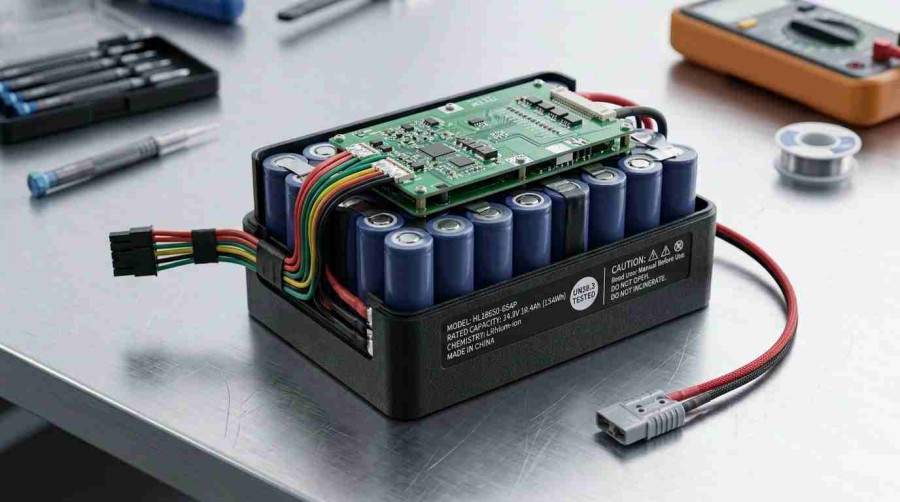
Providing only “5000mAh” does not fully describe the energy of a battery pack. Battery packs with the same capacity but different voltages have different rated energy.
A common conversion is:
Rated Energy (Wh) = Nominal Voltage (V) × Rated Capacity (Ah)
For example, a battery pack with a nominal voltage of 14.8V and a rated capacity of 5Ah has a rated energy of 74Wh. The calculation should use nominal voltage, and mAh should be converted to Ah before calculating.
Rated energy is an important parameter when determining lithium-ion battery shipping requirements, but it is not the only factor. A battery should not be assumed to fall outside transportation requirements simply because it has a relatively small capacity or falls below a particular Wh value. Battery type, quantity per package, shipping configuration, and applicable provisions must also be considered.
Manufacturers should manage voltage, capacity, and Wh information consistently across product specifications, labels, and transportation documents. This helps prevent situations in which a specification sheet has been updated while the outer packaging or shipping documentation still contains outdated parameters.
What Is the Difference Between a UN 38.3 Test Summary, Test Report, and SDS?
Lithium battery export documents are sometimes collectively referred to as “battery certificates,” but different documents serve different purposes.
| Document or Information | Primary Purpose | What OEMs and Buyers Should Verify |
| UN 38.3 test report | Records the applicable tests and results for a particular design type | Model, sample description, report number, and conclusion |
| UN 38.3 test summary | Provides standardized traceability information to the supply chain | Manufacturer, test laboratory, model, and related report information |
| SDS, commonly called MSDS | Provides hazard, handling, storage, and emergency-response information | Whether it corresponds to the actual product and battery chemistry |
| Transportation assessment or carrier-review documents | Used to review cargo for a particular shipping channel | Applicable transportation mode, model, document version, and acceptance conditions |
| Dangerous goods declaration documents | Used for transportation declarations when applicable | Proper shipping name, classification, quantity, and packaging information |
An SDS does not replace UN 38.3 testing evidence, nor does it independently prove that a particular shipment meets all applicable transportation requirements. Not every shipment requires the same combination of documents, so the required documentation should be confirmed for the specific shipping route.
UN 38.3 is a transportation-related design-type test. Manufacturers and subsequent distributors are required to make the applicable test summary available so that the supply chain can identify and trace the corresponding battery design. The test summary should not be interpreted as evidence that every production batch has been retested. Reference: PHMSA Lithium Battery Test Summary Requirements
If the Cells Have Passed UN 38.3, Does a Custom Battery Pack Still Need to Be Evaluated?
Yes. Cells and battery packs are different product levels. Battery-pack assembly introduces interconnections, protection circuitry, enclosures, and other components, so a cell-level report alone should not be used to conclude that the complete pack meets the applicable requirements.
OEMs should ask the manufacturer to confirm which tests apply to the battery-pack design and whether existing reports cover the actual configuration being shipped. Changes to the cell model, series-parallel configuration, or protection design should also trigger a change assessment.
Design changes that may affect UN 38.3 test results may require testing as a new type. Keeping the same model name does not, by itself, mean that existing documentation remains applicable. Reference: PHMSA Lithium Battery Shipping Guide
From a project-management perspective, maintaining revision records for custom battery packs is recommended. The bill of materials, structural drawings, test documentation, and labels should be linked to the applicable product revision. This allows buyers to verify whether repeat orders or changes in supply batches remain within the configuration that has already been evaluated.
How Do Air-Shipment State-of-Charge Requirements Differ in 2026?
State of charge, commonly abbreviated as SoC, describes the battery’s current charge level relative to its rated capacity. When discussing SoC requirements for lithium battery air shipments, the packaging configuration should be identified first.
| Lithium-Ion Battery Air-Shipment Configuration | Packing Instruction | Overview of 2026 SoC Requirements |
| Batteries shipped by themselves | PI 965 | Generally limited to no more than 30% SoC; shipments above this level require approval under the applicable provisions |
| Packed with equipment but not installed | PI 966 | Section I is limited to no more than 30% SoC; under Section II, cells and batteries above 2.7Wh are limited to no more than 30% SoC; exceeding the applicable limit requires approval and compliance with the relevant provisions |
| Contained in equipment | PI 967 | SoC of no more than 30%, or an indicated battery capacity of no more than 25%, is recommended; this is not a uniform mandatory requirement under this packing instruction |
It is therefore inaccurate to conclude that “all equipment containing lithium batteries must be below 30% SoC for air transportation.” The percentage displayed by a device should also not automatically be treated as the battery’s actual SoC. Reference: IATA 2026 Battery Guidance Document
For manufacturers, SoC control also affects production planning. Capacity reference points, charge and discharge procedures, measurement tolerances, and packing times should be clearly defined, while BMS quiescent current and expected transit time should also be considered. For battery chemistries with relatively flat voltage curves, a single open-circuit voltage measurement may not provide sufficiently reliable SoC control for shipping purposes.

What Should You Consider When Packaging Lithium Batteries for Shipping?
Packaging should be designed around risks such as short circuits, movement, compression, and accidental activation rather than simply preventing cosmetic damage. Specific packaging performance, quantity limits, marks, and labels should be confirmed according to the applicable transportation requirements. Reference: IATA Lithium Battery Shipping Guidance
During the manufacturing stage, key considerations include:
- Terminal protection:Use suitable insulation or protective components to prevent exposed terminals from contacting other batteries or conductive materials.
- Internal restraint:Design internal packaging according to battery weight and shape, and verify that the battery remains securely positioned after handling and vibration.
- Wire and harness protection:Prevent cables from being pulled, pinched, or continuously rubbing against enclosure edges.
- Equipment condition:For equipment containing batteries, check switch protection and available transport modes to reduce the possibility of accidental activation.
- Outer-package information:Include packaging photos, label revisions, and package quantities in the pre-shipment review process.
Bubble wrap, ordinary cardboard boxes, or boxes bearing UN markings do not independently demonstrate that a packaging solution meets applicable requirements unless they are evaluated in the context of the actual shipment.
If packaging materials, quantities per package, or battery weight change, the original packaging solution should be reviewed again for continued applicability.

Can the Same Shipping Solution Be Used for Ocean Freight, Air Freight, and Returns?
Not automatically. When the mode of transportation changes, packaging, documentation, and carrier conditions need to be reviewed again. International ocean shipments should be checked against the applicable International Maritime Dangerous Goods (IMDG) Code. Amendment 42-24 of the IMDG Code became mandatory on January 1, 2026. Reference: IMO IMDG Code Information
When OEMs compare shipping options, they should consider packaging costs, document-preparation time, booking lead times, warehousing, and destination-delivery costs rather than comparing freight rates per kilogram alone.
Returns should also be managed separately. An unused battery being returned under normal conditions may be treated differently from a battery that is swollen, leaking, damaged, or recalled because of a safety defect. Damaged or defective batteries that may generate heat, catch fire, or short-circuit are subject to air-transport restrictions and cannot simply be shipped using the same process as new batteries. Reference: IATA 2026 Battery Guidance Document
What Information Should Be Confirmed Before Purchasing to Reduce Delivery Delays?
Consider including the following information in the RFQ or order attachment so that the manufacturer, procurement team, and logistics team are all working from the same version.
| Project Stage | Information to Confirm |
| Project RFQ | Battery type, voltage, capacity, Wh, weight, and destination |
| Design confirmation | Cell and battery-pack model, design revision, and applicable test coverage |
| Prototype shipment | Whether applicable testing has been completed, shipping configuration, and intended transportation route |
| Mass-production planning | Packaging solution, SoC control, labels, and documentation lead time |
| Packing and delivery | Quantity, model, document revision, and carrier-review status |
| After-sales returns | Battery condition, fault description, photos, and available shipping channels |
Responsibilities should also be clearly defined for providing product data, preparing packaging, completing applicable declarations, and verifying destination requirements. Logistics providers need accurate information from the manufacturer, while buyers should communicate the actual application and delivery destination in a timely manner.
FAQ: Lithium Battery Shipping Questions for OEMs and Buyers
- Can a Few R&D Samples Be Shipped Without UN 38.3 Testing?
This cannot be determined based only on the small quantity involved. Prototypes and low-production-run batteries may be covered by specific transportation provisions, but these have applicable conditions and should not be treated as a general exemption from dangerous goods requirements. The available shipping route and any required approvals should be confirmed during the prototype planning stage. Reference: PHMSA Lithium Battery Shipping Guide
- Does Having a UN 38.3 Test Summary Mean a Carrier Will Definitely Accept the Shipment?
No. A test summary addresses traceability of the battery design and testing. Actual carrier acceptance also depends on packaging, quantity, SoC, routing, and carrier-specific requirements. Buyers should confirm the shipping channel before establishing the final delivery date.
- Does a UN 38.3 Test Summary Need to Be Reissued for Every Shipment?
Not simply because a new production batch is being shipped. However, the test summary should correspond to the current design and contain accurate information. If the product changes, the continued applicability of the existing documentation should be reassessed.
- If a Standalone Battery Is Packed With a Charger, Can It Be Classified as “Packed With Equipment”?
Not solely because a charger is included in the same package. “Packed with equipment” involves the relationship between the battery and the equipment it is intended to power. The actual configuration should be classified by personnel familiar with the applicable requirements; adding an accessory does not change the nature of the shipment.
- What Information Is Needed Before Requesting an International Lithium Battery Shipping Quote?
Consider providing the product specification, Wh rating, weight, quantity, packaging configuration, test summary, product condition, origin, and destination. Clearly stating whether the batteries are shipped separately or installed in equipment can help logistics providers provide a more actionable quote and delivery estimate.
- Why Is the Battery Production Lead Time Different From the Earliest Shipping Date?
After manufacturing is complete, SoC adjustment, documentation review, packaging verification, and carrier approval may still be required. Custom battery projects should include these steps in the delivery schedule rather than planning equipment assembly solely around the battery production completion date.
About Himax Electronics
Himax Electronics specializes in customized battery and power solutions for a wide range of demanding applications worldwide, including proprietary lithium-ion battery packs, power supplies, chargers, and accessories designed for specific industry requirements. For projects involving prototype validation, volume purchasing, and cross-border delivery, buyers can provide Himax Electronics with application requirements, target markets, and intended shipping methods during the solution-development stage. Confirming product configurations and delivery requirements early helps provide adequate time for subsequent testing, packaging, and transportation preparation.