
How to Measure Drone Battery Internal Resistance: What the Results Reveal About Battery Health

Commercial Disclosure: The Himax Electronics Editorial Team brings together expertise in battery products, power technologies, engineering applications, and global customer support to share practical information about battery technology, custom battery solutions, and power applications. Our content covers lithium-ion batteries, LiFePO4 batteries, battery pack design and selection, charging and power solutions, industry application guides, product updates, and official Himax Electronics news. Our goal is to help engineers, procurement professionals, and businesses better understand battery technologies and make informed decisions based on their specific application requirements. All content reflects the official editorial perspective of Himax Electronics and our commitment to providing reliable, flexible, and professional custom battery and power solutions for complex applications worldwide.
Key Takeaways
- Drone battery internal resistance is typically expressed in milliohms (mΩ), and readings should be compared under the same test conditions, either across batteries or against historical data.
- Before testing, standardize battery temperature, state of charge, rest time, test equipment, and measurement points to avoid mistaking environmental differences for battery ageing.
- Common measurement methods include AC internal resistance testing, DC pulse testing, and electrochemical impedance spectroscopy (EIS). Results obtained using different methods should not be compared directly.
- Similar internal resistance across individual cells does not necessarily mean the entire battery pack is healthy. Cell voltage differences, connection resistance, the protection board, and wiring condition should also be checked.
- A continuing increase in internal resistance, unusually high resistance in one cell, greater voltage sag during flight, or abnormal heat generation can indicate that further inspection is needed.
- During testing, never short-circuit, puncture, disassemble, or use incompatible test fixtures on the battery. Batteries that are swollen, damaged, or abnormally hot should not undergo further charge or discharge testing.
Introduction
Drone battery internal resistance is an important reference parameter for evaluating power-delivery capability and cell consistency. In applications such as aerial photography, inspection, surveying and mapping, and agricultural spraying, batteries may experience high current during takeoff, rapid acceleration, and hovering in strong winds. As internal resistance increases, effects such as greater voltage sag under load, increased heat generation, and reduced usable flight time may become more noticeable.
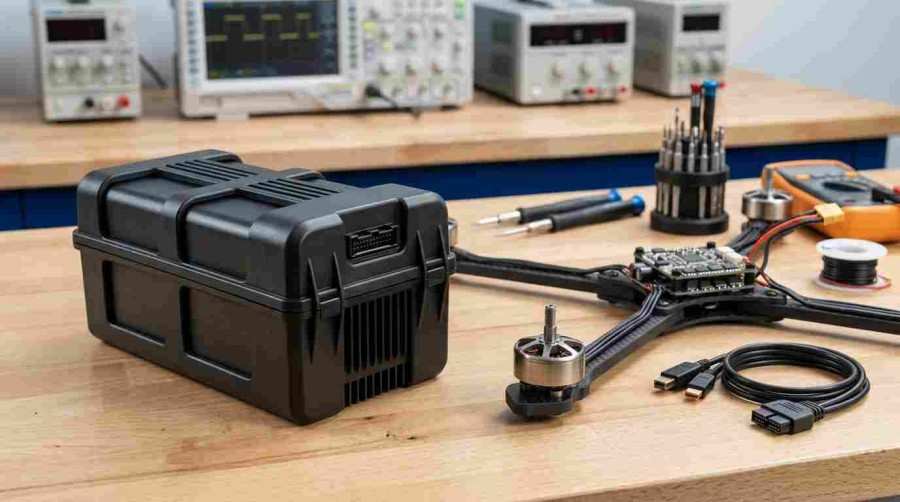
However, internal resistance is not a single “battery health score.” Cell chemistry, capacity, series-parallel configuration, state of charge (SOC), temperature, test frequency, and instrument algorithms can all affect the reading. When evaluating the health of a drone lithium battery, internal resistance trends should be considered together with capacity, cell voltage differences, cycle records, flight logs, and physical condition.
- What Is Drone Battery Internal Resistance?
Battery internal resistance can be understood as the resistance to current flow within the battery and its electrical connection path. In a drone lithium battery, this resistance does not come only from the cells themselves. It may also include resistance from tabs, welds, nickel strips, wires, connectors, protection boards, and smart battery management modules.
When drone motors suddenly demand more power, the increase in current causes the battery voltage to drop. A simplified relationship can be used to understand this effect:
Voltage Sag Under Load ≈ Discharge Current × Equivalent Internal Resistance
For example, under otherwise similar conditions, a battery pack with higher equivalent internal resistance may experience greater instantaneous voltage sag during high-current takeoff or flight against strong winds. If the voltage drop becomes excessive, the flight controller may trigger low-voltage protection earlier, creating a situation where the battery appears to have remaining charge but provides less usable flight time than expected.
From a battery manufacturing and quality-control perspective, internal resistance is more useful for monitoring trends, identifying outliers, and verifying batch consistency than for establishing a universal pass/fail threshold without reference to the battery specifications.
- Why Does Drone Battery Internal Resistance Change?
As lithium-ion batteries undergo storage, charge-discharge cycling, and high-load operation, the condition of internal materials and interfaces gradually changes. Publicly available information from the U.S. Department of Energy indicates that battery ageing can involve both capacity loss and impedance growth, while factors such as higher temperatures, higher cutoff voltages, and wider cycling voltage windows can affect ageing behavior. U.S. Department of Energy Battery Diagnostics Research
Changes in the internal resistance of a drone battery are commonly associated with the following factors:
| Factor | Possible Effect on Internal Resistance Readings | Recommended Check |
| Increasing cycle count | Electrochemical impedance may gradually increase | Review cycle records and compare them with early baseline values |
| High-temperature storage or operation | Short-term readings may fluctuate, while long-term exposure may accelerate ageing | Record battery surface temperature during testing |
| Low-temperature testing | Internal resistance generally increases noticeably | Do not directly compare with historical room-temperature data |
| Different SOC levels | Resistance varies across the battery’s state-of-charge range | Standardize testing within a defined SOC range, such as 40% to 60% |
| High-current operation | May result in greater temperature rise and voltage sag under load | Review voltage curves together with flight logs |
| Connector oxidation or poor contact | Equivalent pack resistance may increase | Inspect connectors, wiring, welds, and terminals |
| Reduced cell consistency | One cell may become the weak point in the pack | Review individual cell voltages and cell-level internal resistance data |
NASA’s publicly available battery ageing datasets also show that differences in depth of discharge, rest periods, and individual cells can result in different states of health even at the same cycle count. A single resistance reading therefore should not replace a more complete battery health assessment. NASA Li-Ion Battery Aging Datasets
- How Do You Measure Drone Battery Internal Resistance?
Method 1: Use an AC Internal Resistance Meter
An AC internal resistance meter typically applies a small AC signal at a fixed frequency to measure battery impedance. The method is relatively fast and is suitable for incoming inspection, routine screening, and batch-level trend monitoring. Many instruments display the result directly in mΩ, but readings may vary depending on the instrument brand, test frequency, fixture contact method, and calculation algorithm.

During testing, the fixture should make stable contact with the battery’s main positive and negative terminals. If the battery has a dedicated diagnostic or balance connector, whether it can be used for measurement should be determined from the product documentation. Do not pry open the enclosure or access internal terminals that are not designed for user operation simply to make testing easier.
Method 2: DC Pulse Testing
The DC pulse method applies a known load current, records the voltage before and during the load pulse, and then estimates DC internal resistance. A simplified formula is:
DC Internal Resistance R ≈ (Resting Voltage U₁ − Pulse-Load Voltage U₂) ÷ Pulse Current I
For example, if the battery’s resting voltage is 15.80V and the voltage drops to 15.50V under a 10A pulse:
(15.80 − 15.50) ÷ 10 = 0.03Ω, or 30mΩ
This method more closely reflects battery behavior during the high-current discharge conditions encountered by drones. However, pulse current, pulse duration, sampling rate, and battery temperature all affect the result. For smart battery packs, protection-board control strategies may also influence the response. The resulting value therefore represents the equivalent internal resistance of the battery system, not the AC internal resistance of a bare cell.
Method 3: Electrochemical Impedance Spectroscopy (EIS)
EIS measures impedance response across multiple frequency ranges and can help engineers involved in R&D, failure analysis, and ageing studies distinguish among ohmic resistance, charge-transfer resistance, and diffusion-related characteristics. It requires specialized equipment, test fixtures, and expertise in interpreting the data, so EIS results are generally not suitable as a single quick diagnostic indicator for everyday users.
| Measurement Method | Typical Application | Advantages | Limitations |
| AC internal resistance | Incoming inspection, routine sampling, trend monitoring | Fast and convenient for building historical records | Readings from different instruments and frequencies should not be compared directly |
| DC pulse testing | Simulating voltage sag and evaluating high-power performance | More closely related to drone discharge conditions | Pulse parameters, temperature, and SOC must be controlled |
| EIS | R&D validation, failure analysis, ageing studies | Provides more detailed impedance information | Requires specialized equipment, modeling, and data interpretation |
| Flight log analysis | Maintenance troubleshooting, fleet management | Shows actual voltage sag and power-demand behavior | Results are affected by payload, wind speed, and flight profile |
- A Standardized Process for Testing Drone Battery Internal Resistance
To make measurements taken on different dates comparable, establish a standardized testing procedure. The following process is suitable for routine screening, but specific voltage, rest-time, and temperature requirements should always follow the battery specifications and test-equipment instructions.
- Inspect the battery. Confirm that there is no swelling, cracking, leakage, scorching, unusual odor, loose terminals, or damaged wiring. If any abnormal condition is found, do not continue with charge, discharge, or internal resistance testing.
- Standardize the state of charge. Batteries from the same batch can be brought to a similar SOC range, such as 40% to 60%. Readings obtained at different SOC levels should be recorded separately.
- Stabilize the temperature. Allow the battery to rest in a stable environment until its surface temperature approaches the test-environment temperature. Batteries that have just completed a flight, charging session, or prolonged sun exposure should be allowed to cool.
- Clean the terminals. Make sure the terminals are dry and free from visible oxidation, oil, or debris. The test fixture should make firm contact with a consistent contact area.
- Use a consistent test method. For long-term tracking, use the same instrument or instrument model, test mode, fixture, and measurement points.
- Repeat the measurement. Take several consecutive readings and record the average and range of variation. If readings fluctuate significantly, inspect fixture contact, terminal condition, and instrument calibration.
- Evaluate multiple parameters together. Record individual cell voltage, pack voltage, capacity-test results, cycle count, in-flight voltage sag, temperature rise, and fault codes alongside internal resistance.
- What Do Internal Resistance Test Results Reveal About Drone Battery Health?
Internal resistance data is most useful when compared with the battery’s own baseline. This baseline may come from new-battery acceptance testing, stable samples from the same model and production batch, or early records from the same battery under standardized conditions.
| Test Result | What It May Indicate | Recommended Next Step | Limitations |
| Internal resistance remains close to the historical baseline with small differences between cells | Power capability may remain within the normal range of variation | Continue maintaining records under standardized conditions | Readings from different instruments and frequencies should not be compared directly |
| Internal resistance gradually increases while capacity still meets mission requirements | Normal ageing or changes in operating conditions may be occurring | Shorten the inspection interval and monitor in-flight voltage sag | Pulse parameters, temperature, and SOC must be controlled |
| One cell shows significantly higher internal resistance | Cell ageing, connection problems, or measurement error may be involved | Retest and check cell voltage differences, terminals, and temperature | Requires specialized equipment, modeling, and data interpretation |
| Pack resistance increases while individual cell data appears normal | Connectors, wiring, the protection board, or welded connections may require inspection | Have the system inspected by qualified personnel | Results are affected by payload, wind speed, and flight profile |
| Internal resistance increases while capacity decreases | Battery health may be deteriorating | Adjust the operating and retirement plan based on mission power requirements | |
| Internal resistance increases together with swelling, overheating, or alarms | A potential safety issue may be present | Stop using the battery, isolate it, and contact after-sales support or a professional recycling service |
It is important to emphasize that there is no single fixed milliohm threshold that can be universally applied across batteries with different capacities, discharge-rate capabilities, and chemistries. For example, a high-capacity drone battery with multiple cells in parallel and a small racing-drone battery may have very different pack-level internal resistance values even when both are in similar states of health. Monitoring trends within the same battery model at similar temperatures and SOC levels generally provides more useful information.

- Drone Battery Internal Resistance Testing FAQ
Is Lower Drone Battery Internal Resistance Always Better?
Under the same battery model, temperature, SOC, and test method, lower internal resistance generally means less voltage sag and lower resistive heat loss under load. However, internal resistance is not the only performance criterion. The battery must also meet requirements for capacity, discharge rate, temperature rise, cycle life, weight, and protection strategy.
Can I Measure Internal Resistance Immediately After a Flight?
A battery that has just completed a flight is still changing in temperature and SOC, so its reading may differ from one taken after resting at room temperature. If you are building a comparable database, test after a defined rest period and under standardized temperature conditions. If the goal is to evaluate actual high-load flight behavior, record those operating conditions separately.
Can I Measure Drone Battery Internal Resistance With a Multimeter?
A standard multimeter generally measures DC resistance and cannot reliably determine the equivalent internal resistance of a lithium battery under operating conditions. It is also not suitable for simply connecting across the battery terminals to make this type of assessment. DC pulse testing requires a controlled electronic load, sufficient sampling capability, and appropriate safety fixtures.
Can a Smart Drone Battery Show Internal Resistance Directly in an App?
Some smart batteries or flight-control systems record state of health, cycle count, individual cell voltage differences, temperature, and fault codes. Whether internal resistance is displayed, and how it is calculated, depends on the manufacturer. Health information shown in an app can be useful for maintenance, but it should still be interpreted according to the manufacturer’s diagnostic procedures.
If Cell Voltage Differences Are Normal, Does That Mean Internal Resistance Is Also Normal?
Not necessarily. Similar cell voltages may indicate acceptable consistency under static or low-load conditions, but a cell with higher internal resistance may still experience greater instantaneous voltage sag under high-current discharge. For high-power drones, cell voltage differences, internal resistance trends, and load-voltage curves should be evaluated together.
Can a Drone Battery With High Internal Resistance Still Be Used for Flight?
This should be evaluated based on how much the resistance has increased, how quickly it is changing, remaining capacity, temperature rise, mission risk, and manufacturer requirements. If high internal resistance is accompanied by battery swelling, significant overheating, abnormal warnings, terminal damage, or excessive voltage sag under load, the battery should be removed from service and inspected. For payload operations, flights over populated areas, or mission-critical applications, battery maintenance criteria should be more conservative.
Himax Electronics: Manage Drone Battery Health Through Data Trends
The value of measuring drone battery internal resistance lies in turning otherwise invisible changes in power-delivery capability into data that can be recorded and compared. For fleet operators and equipment manufacturers, establishing standardized SOC, temperature, instruments, fixtures, and recording procedures—and combining those records with capacity, cell voltage differences, flight logs, and physical inspections—can help identify batteries that require further evaluation and provide useful data for maintenance or retirement decisions.
Himax Electronics specializes in customized battery and power solutions for demanding applications worldwide, including lithium-ion battery packs, power supplies, chargers, and accessories. For drones and other high-power portable equipment, Himax Electronics can support technical matching based on system voltage, capacity, continuous and pulse discharge requirements, BMS functions, communication interfaces, charging solutions, and environmental conditions. Final solutions should be based on application requirements, prototype validation, test data, and technical specifications agreed upon by both parties.