Steel-Case, Aluminum-Case, or Pouch Cells? How Cell Packaging Affects Battery Pack Design
Commercial Disclosure: The Himax Electronics Editorial Team brings together expertise in battery products, power technologies, engineering applications, and global customer support to share practical information about battery technology, custom battery solutions, and power applications. Our content covers lithium-ion batteries, LiFePO4 batteries, battery pack design and selection, charging and power solutions, industry application guides, product updates, and official Himax Electronics news. Our goal is to help engineers, procurement professionals, and businesses better understand battery technologies and make informed decisions based on their specific application requirements. All content reflects the official editorial perspective of Himax Electronics and our commitment to providing reliable, flexible, and professional custom battery and power solutions for complex applications worldwide.
Key Takeaways
- Steel-case, aluminum-case, and pouch cells describe cell packaging structures. They do not directly indicate battery chemistry, discharge capability, or safety level.
- Cell packaging affects more than weight and dimensions. It also influences how cells are secured within the battery pack, how heat is transferred, how electrical connections are made, and how the pack is manufactured.
- Hard-case cells still require consideration of dimensional changes, insulation, and venting clearance. Pouch cells require particular attention to mechanical support, edge-seal protection, and thickness changes.
- A weight advantage at the cell level does not necessarily translate into a lighter battery pack. Brackets, enclosures, interconnects, and thermal-management materials should all be included in the comparison.
- Custom battery packs should use cells selected according to actual load requirements, available installation space, operating environment, and service-life targets, with the final design verified through complete pack-level testing.
Introduction
When developing a custom lithium battery pack, OEMs and purchasing teams often begin by comparing voltage, capacity, and price before deciding whether to use steel-case, aluminum-case, or pouch cells. However, cell packaging affects much more than the appearance of the product. It also influences how the battery manufacturer secures the cells, creates the current path, transfers heat, and accommodates dimensional changes over long-term use.
A more practical approach is to compare cells within the context of the complete battery pack design. Suitable specifications at the individual cell level do not necessarily mean that the assembled pack will also meet the project’s requirements for size, temperature rise, and mechanical reliability.
- Distinguishing Packaging Material, Cell Format, and Battery Chemistry
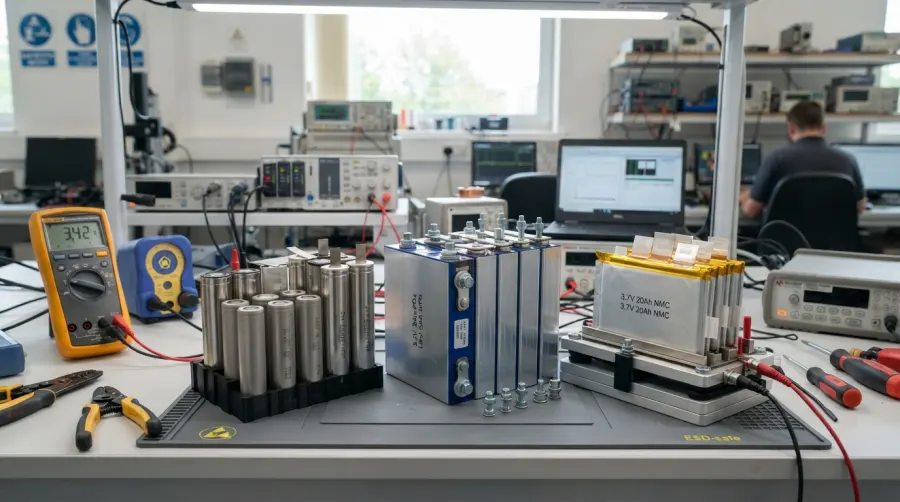
Steel-case and aluminum-case primarily describe the casing material. Cylindrical and prismatic primarily describe the cell geometry. Pouch cells typically use a laminated composite film with an aluminum barrier layer. These concepts are related, but they should not be treated as interchangeable.
For example, a steel case is not limited to cylindrical cells, and an aluminum case does not fully define what is meant by a “prismatic cell.” The aluminum-laminated composite film used in pouch cells is also different from a rigid aluminum case.
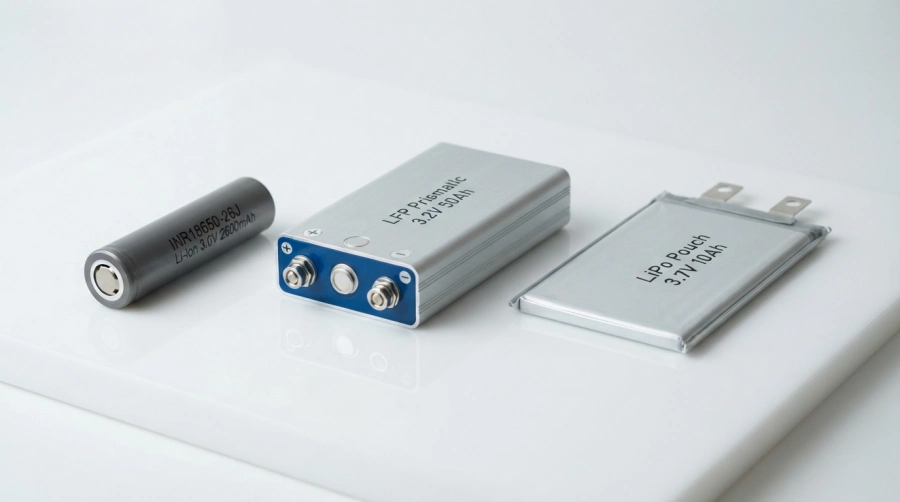
In addition, lithium iron phosphate (LiFePO4), NMC, and other chemistries refer to the electrochemical system and cannot be identified solely by the external packaging. When comparing different solutions, the following information should be specified together:
- Battery chemistry and specific cell model;
- Packaging material and cell dimensions;
- Rated capacity, nominal voltage, and allowable operating range;
- Continuous and peak current requirements;
- Installation, mechanical support, and thermal-management conditions.
Only when these factors are evaluated together is there a meaningful basis for comparing steel-case and aluminum-case cells or determining whether pouch cells are suitable for a particular application.
- What Are the Design Differences Between Steel-Case, Aluminum-Case, and Pouch Cells?
The following table summarizes common engineering considerations. Actual performance still depends on material grade, wall thickness, dimensions, and the specific cell design.
| Comparison Factor | Steel-Case Cells | Aluminum-Case Cells | Pouch Cells |
| Packaging Characteristics | Rigid metal case that provides a degree of structural stiffness | Rigid metal case made from a lower-density material | Composite-film packaging; structural support relies more heavily on the module |
| Weight Considerations | Case weight and total cell count should be considered | Potential case-level weight reduction can be evaluated | External supports, compression plates, and protective structures should be included |
| Mechanical Design | Focus on cell retention, case deformation, and insulation | Focus on large-surface deformation, retention, and assembly stress | Focus on compression, puncture protection, edge seals, and tab protection |
| Dimensional Changes | Changes caused by cycling and temperature should not be ignored | Large-surface displacement and restraint conditions may affect assembly | Thickness changes generally require dedicated management |
| Thermal Design | Contact areas depend on cell geometry and internal structure | The case can provide favorable thermal conduction, but a complete heat-transfer path is still required | Large surfaces can be used for thermal contact, while pressure and insulation must also be considered |
| Manufacturing Considerations | Terminal connections, positioning, and case protection | Terminal materials, connection quality, and structural tolerances | Tab connections, edge-seal clearance, and stacking consistency |
- Mechanical Support: A Hard Case Does Not Mean the Cell Can Directly Carry Equipment Loads
Steel-Case and Aluminum-Case Cells: Control Mounting Methods and Localized Stress
A rigid case can provide a degree of mechanical protection, but the cell casing should not automatically be treated as a structural load-bearing component of the equipment. Vibration, drops, and assembly compression can transfer forces to the cells through brackets, screws, or busbars.
The design should evaluate mounting points, contact areas, and tolerance stack-up to prevent excessive localized pressure. Space should also be reserved for dimensional changes and pressure-relief features according to the cell manufacturer’s installation requirements.
Different cell formats can respond differently to mechanical loads. Electrical and thermal behavior after mechanical loading therefore cannot be determined solely from the casing material. Reference: Comparative Study of Mechanical-Electrical-Thermal Responses of Pouch, Cylindrical, and Prismatic Lithium-Ion Cells, available through MIT
Pouch Cells: Protect the Cell Body, Edge Seals, and Tabs
The broad surfaces, sealed edges, and tabs of a pouch cell serve different functions and should not be treated as general-purpose clamping areas during assembly.
Enclosure burrs, screw ends, and sharp edges on interconnects should be prevented from making direct contact with the pouch surface. The tabs also require appropriate strain relief so that wire-harness loads and repeated vibration do not become concentrated at the base of the tabs.
If a cell requires mechanical restraint or preload, it should be applied according to the cell supplier’s specified method, and pressure distribution should be validated. Compression values specified for one cell model should not automatically be applied to another.
- Swelling Management: Clearance Should Not Be Based on a Fixed Percentage
Cell dimensions can change with state of charge, temperature, and aging. The design should distinguish between normal reversible dimensional changes, growth over the cell’s service life, and abnormal conditions such as gas generation.
The required swelling allowance for pouch cells should be determined using data for the specific cell model rather than applying a universal rule such as “leave a few percent of extra space.” Hard-case cells also require verification of dimensional changes and installation-restraint requirements.
Recommended design inputs include:
| Validation Item | Main Areas to Check |
| Assembly and Tolerance Inspection | Interference, retention, edge seals, and terminal loading |
| Vibration and Shock Validation | Cell movement, loose connections, and insulation wear |
| Load and Temperature-Rise Testing | Voltage response, hot spots, and temperature differences between cells |
| Dimensional Change Evaluation | Space accommodation at different SOC levels and stages of service life |
| Connection Process Validation | Joint resistance, mechanical strength, and stability |
| Insulation and Protection Validation | Electrical isolation, temperature sensing, and protection response |
- Thermal Design: Material Thermal Conductivity Does Not Equal Pack-Level Cooling Performance
Aluminum generally conducts heat more effectively than commonly used steels, but battery-pack temperature rise is not determined by casing material alone. Heat must travel through the internal cell structure, packaging, thermal interfaces, and external structures before it can be transferred to the surrounding environment.
Cylindrical, prismatic, and pouch cells have different contact areas, and their internal heat-transfer directions may also differ. When comparing battery-pack thermal designs, engineers should identify where heat is generated, which interfaces it passes through, and where it is ultimately dissipated.

Argonne’s BatPaC battery pack design model also considers cell geometry together with thermal-management layout, illustrating why the cooling strategy needs to be coordinated with the selected cell format. Reference: Argonne BatPaC Battery Pack Design Model Documentation
Practical validation should consider:
- Temperature differences between representative internal cell locations and the cell surface;
- Temperature differences between adjacent cells;
- Localized hot spots around tabs, terminals, and interconnects;
- Contact conditions after thermal-interface materials are assembled;
- Heat accumulation during continuous operation and repeated peak loads.
For pouch and prismatic cells, large surface areas can provide useful opportunities for thermal contact. However, the reaction force created by compressed thermal pads may also affect mechanical loading on the cells. Thermal and mechanical design should therefore be evaluated together.
- Electrical Connections: The Process Depends on Terminal Materials, Not Just the Cell Case
Battery pack connection processes should be selected according to terminal or tab materials, plating, thickness, interconnect design, and current requirements.
Steel-case, aluminum-case, and pouch cells may use different terminal configurations. It is therefore not appropriate to apply a simple rule such as “spot welding for steel cases, laser welding for aluminum cases, and ultrasonic welding for pouch cells.”
Resistance welding, laser welding, and ultrasonic welding each have suitable applications and process limitations. Dissimilar-metal connections also require consideration of heat input, joint design, and material compatibility. Welding equipment manufacturer AMADA WELD TECH likewise treats material combinations and process selection as important factors in battery interconnection design.
Manufacturing validation should go beyond checking whether a joint is physically attached. It should also evaluate connection resistance, mechanical strength, stability after vibration, and whether welding heat affects nearby seals or insulation structures.
- Weight and Cost: Compare the Complete Battery Pack
Pouch packaging may be relatively lightweight, but the battery pack may require additional mechanical support and protection. Hard cases add their own weight but may contribute to positioning and mechanical protection within the assembly.
Weight comparisons should therefore include the cells, brackets, compression plates, enclosure, busbars, BMS, wire harnesses, and thermal-management materials. Volume comparisons should also account for insulation clearances, assembly tolerances, and the space required for dimensional changes.
Cost should not be evaluated based solely on the price of an individual cell. The number of electrical connections, tooling investment, assembly cycle time, inspection requirements, and maintenance strategy can all affect overall project cost.
For OEMs, a more useful comparison is to determine the complete pack weight, dimensions, temperature rise, and manufacturing cost of each solution under the same runtime, power, environmental, and service-life requirements.
- What Validation Is Required for a Custom Battery Pack?
Once the cell packaging structure has been selected, prototype testing should be used to validate the design assumptions.
| Validation Item | Main Areas to Check |
| Assembly and Tolerance Inspection | Interference, retention, edge seals, and terminal loading |
| Vibration and Shock Validation | Cell movement, loose connections, and insulation wear |
| Load and Temperature-Rise Testing | Voltage response, hot spots, and temperature differences between cells |
| Dimensional Change Evaluation | Space accommodation at different SOC levels and stages of service life |
| Connection Process Validation | Joint resistance, mechanical strength, and stability |
| Insulation and Protection Validation | Electrical isolation, temperature sensing, and protection response |
Test conditions should cover the actual operating limits of the equipment. If the cell model, packaging dimensions, thermal-interface materials, or connection method changes, the impact on previous validation results should also be assessed.
FAQ: Common Questions About Cell Packaging and Battery Pack Design
Are Steel-Case Cells Always Safer Than Pouch Cells?
Safety cannot be determined from packaging alone. It also depends on battery chemistry, cell quality, mechanical protection, protection circuits, and operating conditions. Hard-case and pouch cells face different mechanical risks, so the specific battery design should be validated.
Do Aluminum-Case Cells Always Reduce Battery Pack Temperature?
Not necessarily. An aluminum case can support heat conduction, but heat may still accumulate if thermal interfaces, enclosure heat dissipation, or ventilation are inadequate. Temperature rise should be compared under actual operating conditions.
Can Pouch Cells Be Bent to Fit the Available Installation Space?
Conventional pouch cells should not be treated as flexible components. Unless a product is specifically designed for the intended bending conditions and has corresponding validation requirements, the specified cell shape should be maintained and compression or bending should be avoided.
Do All Pouch Cells Need to Be Compressed?
Not necessarily. Whether mechanical restraint is required, and what pressure and structure should be used, depends on the installation requirements of the specific cell. Insufficient or uneven pressure may affect the assembly, while excessive pressure may damage the cell.
Do Metal-Case Cells Still Require Additional Insulation?
This needs to be evaluated. Cell documentation should be reviewed to determine whether the metal casing is electrically active, how it relates to the terminals, and what external insulation is required. The casing should not be assumed to be electrically isolated, and the design should not rely solely on surface coverings that may wear over time.
Can the Same BMS Be Used After Changing the Cell Packaging Structure?
The BMS should be reevaluated. Even if the nominal voltage remains the same, the new cells may have different charge and discharge limits, temperature requirements, current capability, and temperature-sensing locations. The BMS, its installation, thermal conditions, and protection parameters should therefore be reviewed together.
Himax Electronics
Himax Electronics specializes in custom battery and power solutions for a wide range of complex applications, providing application-specific lithium-ion battery packs, power supplies, chargers, and accessories for different industry requirements.
When evaluating steel-case, aluminum-case, or pouch cells, customers are welcome to provide Himax Electronics with available installation space, power requirements, runtime targets, and operating-environment conditions. These inputs can help define the appropriate direction for cell packaging and battery pack structure, ensuring that solution evaluation is based on complete application requirements and verifiable technical criteria.