How Does Cold Weather Affect AI Ski Goggle Batteries? A Guide to Runtime, Charging, and Battery Design
Commercial Disclosure: The Himax Electronics Editorial Team brings together expertise in battery products, power technologies, engineering applications, and global customer support to share practical information about battery technology, custom battery solutions, and power applications. Our content covers lithium-ion batteries, LiFePO4 batteries, battery pack design and selection, charging and power solutions, industry application guides, product updates, and official Himax Electronics news. Our goal is to help engineers, procurement professionals, and businesses better understand battery technologies and make informed decisions based on their specific application requirements. All content reflects the official editorial perspective of Himax Electronics and our commitment to providing reliable, flexible, and professional custom battery and power solutions for complex applications worldwide.
Key Takeaways
- Cold temperatures can reduce the usable capacity and discharge power of lithium-ion batteries, so the real-world runtime of AI ski goggles may be shorter than their room-temperature ratings.
- Displays, cameras, AI processors, wireless connectivity, and heated anti-fog features create dynamic loads, so energy consumption should be estimated based on actual usage patterns.
- Low-temperature charging requires careful management. Cell temperature, charging current, and BMS limits should be coordinated.
- Battery packs need to balance low weight, comfortable weight distribution, water resistance, condensation protection, impact resistance, and thermal management rather than simply maximizing capacity.
- Low-temperature performance depends on factors such as cell chemistry, electrolyte formulation, electrode design, packaging, and software control strategies.
- During sourcing or product development, suppliers should provide discharge curves, cycle-test data, and protection-logic documentation under the target temperature and load conditions.
Introduction
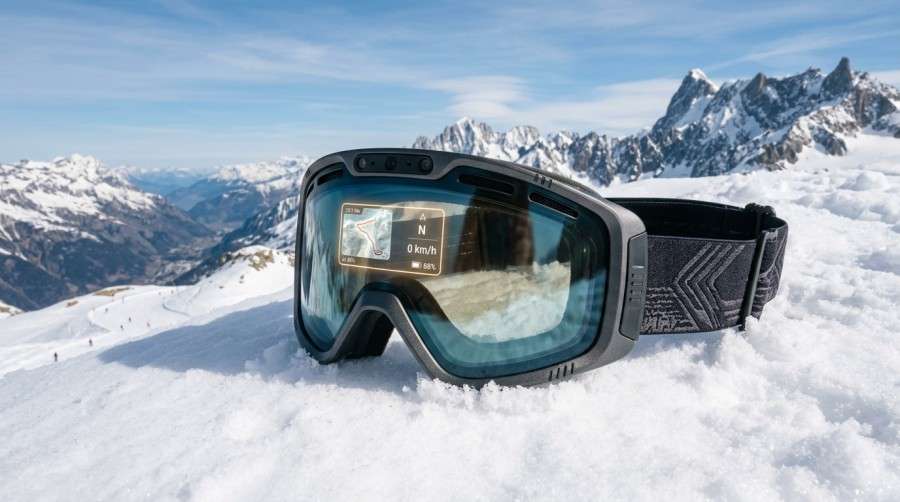
AI ski goggles integrate features such as displays, cameras, motion sensors, voice interaction, Bluetooth, positioning, communications, and image processing. The battery not only determines how long the device can operate but can also affect startup, display performance, recording, and connection stability on the slopes. Low temperatures, wind chill, snow and moisture, and frequent transitions between indoor and outdoor environments can expose the battery system to more demanding conditions than typical consumer electronics.
For brands and product development teams, a low-temperature battery solution should not be designed around rated capacity alone. Cell chemistry, load profiles, insulation, BMS strategies, charging limitations, and overall device protection should all be evaluated together.
Why Does Cold Weather Reduce AI Ski Goggle Battery Runtime?
Li-ion batteries rely on lithium ions moving between the positive and negative electrodes during charging and discharging. As temperature drops, electrolyte viscosity can increase, ion transport becomes more difficult, and battery internal resistance can change. As a result, the battery may experience earlier voltage drop, limited power output, or low-battery protection under cold conditions.
Research from the U.S. National Renewable Energy Laboratory (NREL) indicates that low temperatures can reduce lithium-ion battery capacity and power performance while increasing internal resistance. The extent of these effects depends on factors such as battery chemistry, load current, and temperature conditions. NREL Research on Low-Temperature Lithium-Ion Battery Performance
AI ski goggles differ from simpler devices such as Bluetooth earbuds or fitness trackers because their loads can fluctuate significantly. Power consumption may increase when users activate 4K video recording, AR prompts, navigation, real-time translation, slope recognition, or anti-fog heating. If the battery is already cold, the resulting voltage drop may become more pronounced under these higher loads.
| Cold-Weather Factor | Potential Effect on AI Ski Goggles | Design or Sourcing Consideration |
| Increased battery internal resistance | Faster voltage drop under high loads and possible protection triggering | Review low-temperature discharge curves and pulse-discharge capability |
| Reduced usable capacity | Shorter actual recording, display, and communication time | Estimate runtime using capacity data at the target temperature |
| Limited peak output | Simultaneous camera, display, and AI processing loads may cause lag or restarts | Evaluate peak current, wiring voltage drop, and BMS current limits |
| Low-temperature charging risk | Charging efficiency decreases, and charging may need to be limited under certain conditions | Implement temperature sensing and charging lockout strategies |
| Temperature differences and condensation | Terminals, FPCs, and battery compartments may be exposed to moisture | Optimize sealing, venting, and condensation-control design |

How Should AI Ski Goggle Battery Runtime Be Calculated?
Runtime figures shown on product pages are typically based on specific test conditions, while actual use on the slopes may be very different. AI ski goggle runtime should therefore be estimated according to combinations of active features and operating temperatures rather than represented by a single number alone.
An initial estimate can use:
Estimated Runtime ≈ Usable Battery Energy (Wh) ÷ Average System Power Consumption (W)
Usable battery energy is not necessarily the same as nominal battery energy. Low temperatures, ageing, peak loads, power-conversion efficiency, and protection thresholds can all affect how much energy is actually available.
| Operating Mode | Typical Loads | Power Consumption Characteristics | Runtime Evaluation Recommendation |
| Basic display mode | Low-brightness display, sensors, Bluetooth | Relatively stable | Suitable as a baseline runtime reference |
| Navigation and voice mode | Display, positioning, voice processing, communications | Periodic power peaks | Include wireless transmission peaks |
| Video recording mode | Camera, encoding processor, storage, display | Higher continuous power consumption | Use continuous recording tests as a reference |
| AI recognition mode | Camera, NPU, display, sensor fusion | Power increases while algorithms are running | Evaluate processor duty cycle |
| Anti-fog or heating mode | Heating film, temperature control, power management | Power demand may increase significantly for short periods | Calculate heating energy separately |
For example, a battery rated at 7.4V and 2,000mAh has a theoretical energy capacity of approximately 14.8Wh. If the AI ski goggles consume an average of 2.5W at room temperature, the theoretical runtime would be approximately 5.9 hours. However, actual runtime may change under low temperatures, higher display brightness, continuous video recording, and active wireless connectivity.
During product development, it is better to establish a runtime test matrix covering multiple temperatures, brightness settings, and feature combinations.
Can You Charge AI Ski Goggles in Cold Weather?
Low-temperature discharge and low-temperature charging are two different issues. A battery may still be capable of discharging in cold conditions, while charging requires greater caution. When some lithium-ion cells are charged at low temperatures, lithium-ion intercalation into the graphite anode can be affected, and prolonged charging under unsuitable conditions may affect battery condition and service life.
For this reason, AI ski goggle battery packs should use temperature sensors and BMS logic to manage charging limits. Common strategies include pausing charging when cell temperature falls below the supplier-specified range, reducing charging current within an allowable low-temperature charging range, and restoring normal charging only after the device has returned indoors and warmed sufficiently.
Specific temperature and current limits should be based on the selected cell datasheet, actual thermal conditions within the product, and complete device validation. General USB charging practices should not automatically be applied to every low-temperature lithium battery design.
How Does Battery Chemistry Affect Low-Temperature Performance?
AI ski goggles are sensitive to weight, size, and wearing comfort. Common battery options may include pouch lithium-ion cells, cylindrical lithium-ion cells, and customized lithium-polymer batteries. Different solutions involve trade-offs in energy density, low-temperature discharge capability, cost, cycle life, and mechanical integration.
| Battery Design Approach | Application Characteristics | Low-Temperature Design Considerations |
| High-energy-density lithium-ion solution | Helps store more energy within limited temple or rear-headband space | Verify low-temperature discharge rates and allowable charging temperatures |
| Wide-temperature lithium-polymer solution | Supports thin and custom-shaped battery designs | Pay attention to pouch protection, impact resistance, and packaging reliability |
| Battery pack with heating strategy | Can help improve usable performance in very cold conditions | Heating consumes energy and must be balanced against runtime |
| External replaceable battery | Can extend operating time over a full day of skiing | Consider connector water resistance, mating-cycle life, and weight distribution |
IEC 62133-2 from the International Electrotechnical Commission is one of the safety standards covering portable sealed secondary lithium cells and batteries. For consumer-oriented AI ski goggles, applicable standards, actual product-structure testing, and target-market regulatory requirements should all be incorporated into the product validation plan.
Key Design Considerations for AI Ski Goggle Batteries in Cold Weather
Position the Battery Near Available Heat Sources
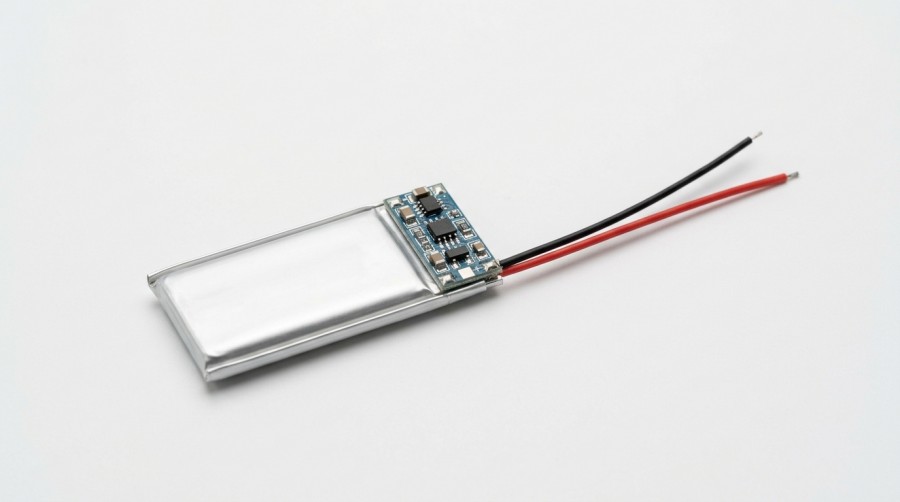
Battery placement can affect low-temperature performance. Positioning the battery in the temples, rear head strap, or closer to the user’s head may help maintain a more stable temperature than placing it directly on an exposed outer section of the goggle frame.
However, mechanical design must also account for wearing comfort, weight distribution, heat dissipation, and appropriate safety clearances.
Combine Thermal Insulation With Condensation Protection
Simply increasing sealing does not necessarily make a product suitable for ski environments. When equipment moves from a cold ski slope into a warm indoor environment, the temperature difference can cause condensation.
Battery compartments, connectors, FPC interfaces, and charging ports can incorporate gaskets, hydrophobic structures, pressure-equalization or venting solutions, and protective coatings. The water-resistance rating should match the actual use environment and be validated under realistic conditions.
Use the BMS to Manage Temperature, Power, and Warnings
Small battery packs still require clearly defined protection logic. A BMS can monitor cell temperature, voltage, current, and state of charge, and can limit current, issue warnings, or stop operation when charging conditions are unsuitable, overcurrent occurs, or temperature limits are exceeded.
For AI ski goggles connected to an app, low-temperature limitations, estimated remaining runtime, and charging status can also be communicated directly to the user.
Use Low-Temperature Testing Instead of Extrapolating From Room-Temperature Data
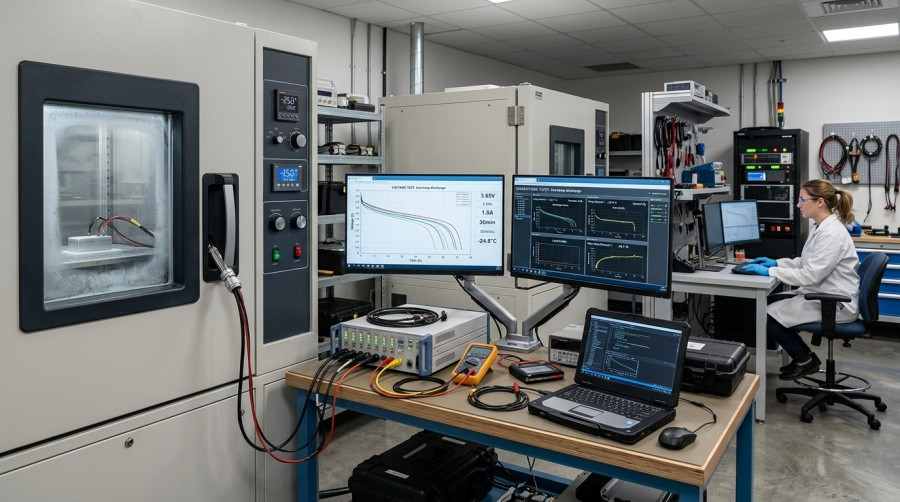
Battery manufacturing and complete-device development should include testing across the intended operating temperature range, such as 0°C, -10°C, and -20°C. Standby, video recording, AI recognition, wireless communication, high-brightness display, and anti-fog functions should be tested separately and in realistic combinations.
Testing should also monitor voltage behavior, enclosure temperature, protection trigger points, charging recovery behavior, and capacity performance after repeated cycling.
Common Questions About AI Ski Goggle Batteries in Cold Weather
Will AI Ski Goggle Battery Runtime Be Shorter Below Freezing?
It can be. Low temperatures affect lithium-ion transport and battery internal resistance. The actual reduction in runtime depends on cell chemistry, ambient temperature, load, the device’s thermal design, and battery ageing.
Runtime claims should ideally be supported by complete-device testing at the target operating temperature.
Does Warming AI Ski Goggles in a Pocket Before Use Help?
Keeping the battery relatively warm before use can generally help improve its initial output performance. However, once the device is operating, it will continue exchanging heat with the cold environment. The benefit therefore depends on battery placement, thermal insulation, and usage duration.
Can You Use a Power Bank to Charge Ski Goggles in Cold Weather?
Check the allowable charging temperature of both the device and its battery pack. If cell temperature is below the permitted charging range, the BMS may limit or stop charging even if the power bank can provide power. This is part of the battery protection strategy.
Do AI Features Use More Power Than Regular Ski Goggles?
Generally, yes. Image capture, displays, AI inference, wireless communication, and data storage all consume energy. During development, average power consumption can be reduced through processor low-power modes, on-demand wake-up, display brightness management, and tiered feature operation.
Can a Larger Battery Solve Cold-Weather Performance Problems?
A larger battery can provide more stored energy, but it also adds weight, volume, and charging time and may change the device’s weight distribution. Cold-weather runtime also depends on cell performance, insulation, power management, and BMS strategies, so battery sizing should be evaluated at the complete-system level.
About Himax Electronics
Himax Electronics specializes in custom battery and power solutions for demanding applications worldwide, including proprietary lithium-ion battery packs, power supplies, chargers, and accessories. For AI ski goggles, smart wearables, outdoor sports equipment, and other low-temperature applications, Himax Electronics can help customers evaluate battery-pack and power-system solutions based on target runtime, available installation space, operating temperature range, peak loads, charging method, and communication requirements, while supporting customized product development and project delivery.