
How to Choose a Battery for a Tennis Ball Machine: Lead-Acid vs. LiFePO4
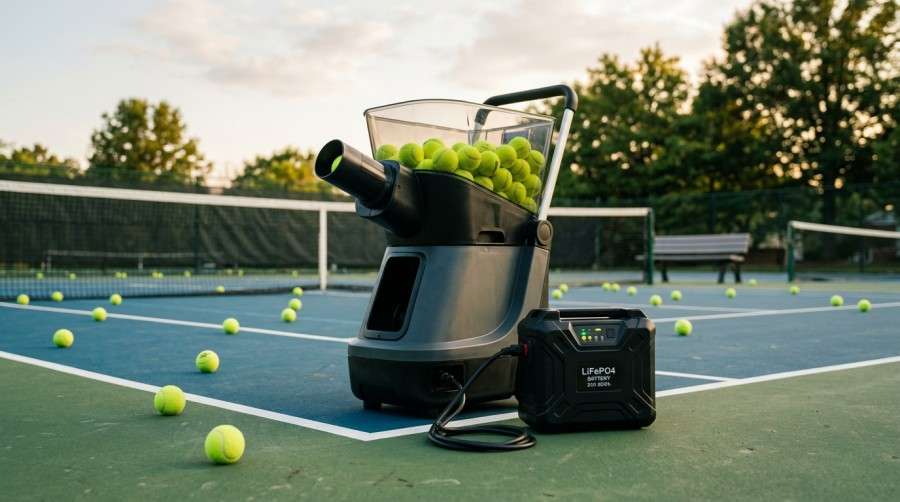
Commercial Disclosure: The Himax Electronics Editorial Team brings together expertise in battery products, power technologies, engineering applications, and global customer support to share practical information about battery technology, custom battery solutions, and power applications. Our content covers lithium-ion batteries, LiFePO4 batteries, battery pack design and selection, charging and power solutions, industry application guides, product updates, and official Himax Electronics news. Our goal is to help engineers, procurement professionals, and businesses better understand battery technologies and make informed decisions based on their specific application requirements. All content reflects the official editorial perspective of Himax Electronics and our commitment to providing reliable, flexible, and professional custom battery and power solutions for complex applications worldwide.
Key Takeaways
- Before choosing a battery for a tennis ball machine, confirm the system voltage, continuous power consumption, startup current, and desired training time.
- Lead-acid batteries generally have a lower upfront cost and may be suitable for some existing 12V or 24V systems designed around lead-acid batteries.
- LiFePO4 batteries typically offer higher energy density, which can help reduce equipment weight and make them well suited for applications involving frequent charge-discharge cycles.
- Even at the same rated capacity, lead-acid and LiFePO4 batteries can differ in usable energy, discharge-voltage characteristics, and long-term capacity degradation.
- When replacing a lead-acid battery with LiFePO4, verify charger compatibility, operating voltage range, low-voltage protection thresholds, and installation dimensions.
- When purchasing batteries, request cell specifications, BMS protection logic, discharge curves, cycle-test data, and transportation documentation.
Introduction
The battery in a tennis ball machine can affect portability, continuous training time, ball-launching consistency, and long-term maintenance costs. Whether the machine is used for daily club training, coaching sessions, school programs, or individual practice, battery selection should not be based on Ah alone. Motor startup and continuous ball feeding can create pulsed loads, while outdoor heat, long periods of storage, frequent charging, and repeated transportation around the court can also affect battery performance.
Lead-acid and LiFePO4 batteries are two common options for tennis ball machines. Neither chemistry is universally better for every application. A more practical approach is to evaluate system voltage, load profile, usage frequency, machine design, charger compatibility, and long-term budget together.
Why Shouldn’t You Choose a Tennis Ball Machine Battery Based on Ah Alone?
Ah, or amp-hours, describes a battery’s charge capacity under specified conditions, but it does not fully indicate how long a tennis ball machine will operate. Motor loads can change when the machine starts, feeds balls, adjusts ball speed, changes oscillation patterns, or raises and lowers the ball trajectory. Machines with remote controls, displays, or smart training programs may also have additional electronic power consumption.
A more useful metric for comparing stored energy is Wh, or watt-hours:
Battery Energy (Wh) = Nominal Voltage (V) × Rated Capacity (Ah)
For example, a 12V 50Ah battery has a theoretical energy capacity of approximately 600Wh. A 24V 25Ah battery also provides approximately 600Wh. Although their stored energy is similar, their operating voltages, wiring requirements, and controller compatibility are different, so they cannot simply be interchanged.
Estimated runtime can be calculated using:
Estimated Runtime ≈ Usable Battery Energy (Wh) ÷ Average Tennis Ball Machine Power Consumption (W)
“Usable battery energy” should also account for depth of discharge, temperature, battery ageing, motor peak current, and controller efficiency. For training equipment, real-world machine testing is recommended when establishing final runtime specifications.
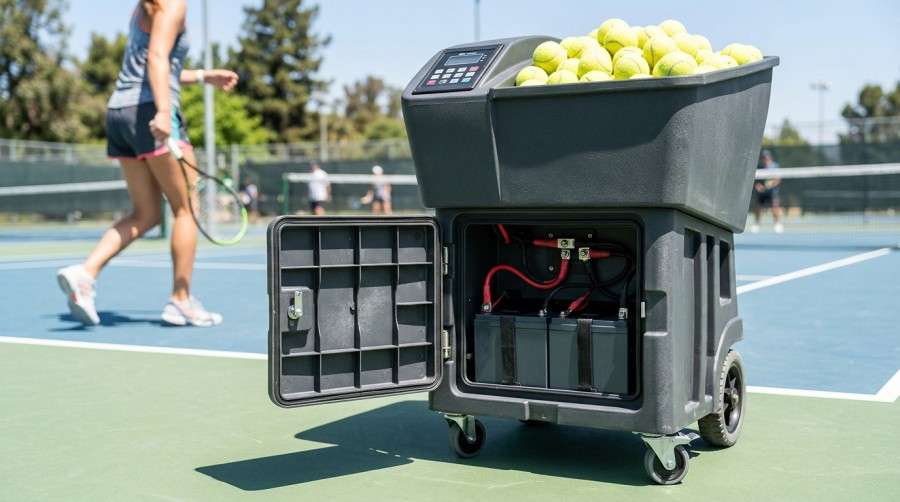
| Factor Affecting Runtime | Effect on the Tennis Ball Machine | What to Verify When Purchasing |
| Ball speed and feed rate | Changes motor duty cycle and power consumption | Power consumption under different training modes |
| Motor startup current | Startup or acceleration may create short high-current demands | Peak current, wiring, and fuse specifications |
| Battery temperature | Low temperatures can reduce discharge capability, while high temperatures can affect battery life | Charge and discharge temperature ranges |
| Battery ageing | Usable capacity changes over time | Cycle life and capacity-retention data |
| Controller efficiency | Motor drives and DC-DC conversion introduce energy losses | Overall system efficiency or measured runtime |
| Training duration | Different continuous operating times require different battery configurations | Session length and daily usage frequency |
Lead-Acid vs. LiFePO4 Batteries for Tennis Ball Machines
| Comparison | Lead-Acid Battery | LiFePO4 Battery |
| Upfront cost | Generally easier to keep initial costs low | Typically higher than a comparable lead-acid solution |
| Weight and size | Usually heavier and larger for the same amount of stored energy | Can help reduce equipment weight for a similar amount of stored energy |
| Usable capacity range | Depth of discharge is often limited to help preserve battery life | A wider portion of rated capacity may be usable with appropriate BMS management |
| Frequent cycling | May be suitable for lower-frequency use or float-service applications | Well suited for frequent training and repeated cycling |
| Discharge voltage | Terminal voltage tends to change more noticeably as the battery discharges | Relatively stable discharge voltage, but protection cutoff thresholds still matter |
| Maintenance considerations | Requires attention to long-term storage, undercharging, and storage conditions | Requires proper BMS operation, charger compatibility, and low-temperature charging protection |
| Replacement compatibility | Commonly compatible with charging systems in many existing machines | Charger logic and system voltage range should be verified before replacement |
| Portability | Battery weight may be noticeable when moving the machine | Can help reduce the effort required to move equipment around the court |
U.S. Department of Energy energy-storage information notes that conventional lead-acid technology generally has a lower upfront cost, while differences exist between lead-acid and lithium-ion technologies in areas such as energy density, cycle life, and deep-discharge performance. Total lifecycle cost should therefore be evaluated according to the actual operating conditions. U.S. Department of Energy Energy Storage Technology and Cost Information
When Should You Consider a Lead-Acid Battery?
Lead-acid batteries still have a place in tennis ball machine applications. For example, a valve-regulated lead-acid battery may be worth considering when the machine is used infrequently, the existing charger is designed around a lead-acid charging profile, there is sufficient battery-compartment space, and minimizing upfront cost is a priority.
However, lead-acid batteries should not be stored in a deeply discharged state for extended periods. Capacity can be affected when a tennis ball machine is left unused during the off-season, goes for long periods without charging, or regularly experiences deep discharge.
When purchasing a battery, determine whether it is designed primarily for starting or deep-cycle applications. Tennis ball machines should be matched to batteries appropriate for repeated cycling rather than automatically using a battery intended primarily for short bursts of high starting current.
When Should You Consider a LiFePO4 Battery?
LiFePO4 batteries can be a good fit for tennis ball machines where equipment weight, repeated cycling, and usable battery capacity are important. For coaches, tennis academies, and frequently used court equipment, batteries may go through repeated charge-discharge cycles, making cycle performance and charging efficiency important operational considerations.
However, upgrading from lead-acid to LiFePO4 is not as simple as replacing a “12V lead-acid battery” with a “12V lithium battery.” Common 12V LiFePO4 batteries use multiple cells connected in series, and their full-charge voltage, discharge cutoff voltage, and charging profile differ from those of lead-acid batteries. If the machine’s original charger uses a long-term float-charging strategy that is not appropriate for the lithium battery, it may not work properly with the battery management system.
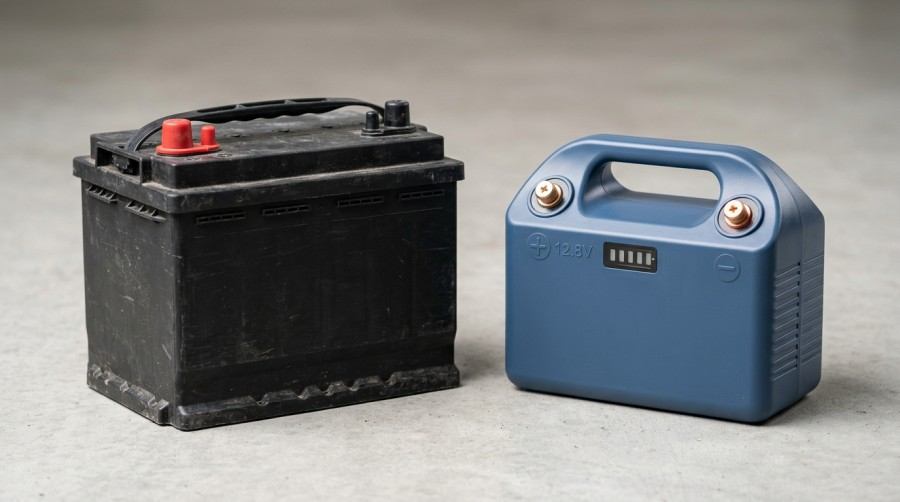
For lithium batteries used in industrial and motive auxiliary applications, the safety requirements and test approaches covered by IEC 62619:2022 may provide a useful reference. This standard does not replace product-specific testing, but it can be considered during supplier quality reviews and technical discussions.
What Should You Check Before Replacing a Lead-Acid Tennis Ball Machine Battery With LiFePO4?
| Item to Check | What to Confirm | Potential Issue |
| Nominal voltage | Whether the original machine uses a 12V, 24V, or another voltage system | Incorrect voltage may cause controller problems |
| Full-charge voltage | Allowable input-voltage range of the controller and motor driver | Full-charge voltage may trigger overvoltage protection |
| Low-voltage protection | Original equipment shutdown threshold and lithium BMS cutoff point | The machine may shut down early or the BMS may disconnect |
| Charger parameters | Constant-current and constant-voltage settings and whether long-term float charging is used | Battery may not fully charge or the charging profile may be unsuitable |
| Peak current | Instantaneous current during motor startup and high-frequency ball feeding | BMS overcurrent protection may be triggered |
| Battery compartment dimensions | Length, width, height, terminal orientation, and mounting method | Installation problems or vibration-related loosening |
| Communication and display | Whether a battery gauge, CAN, RS485, or Bluetooth is required | Original battery-level indicator may become inaccurate |
What Should Tennis Ball Machine Battery Design Consider From a Manufacturer’s Perspective?
Cell and BMS Matching
The performance of a LiFePO4 battery pack depends on the interaction between the cells, BMS, wiring, connectors, fuses, and mechanical components. The BMS should be matched to the motor’s peak-current requirements and provide appropriate overcharge, over-discharge, overcurrent, short-circuit, and temperature protection.
For tennis ball machines requiring faster charging, the allowable cell charging rate and charger power should also be evaluated.
Vibration and Drop Protection
Tennis ball machines may be moved across hard courts, gravel paths, or transported in vehicle trunks, exposing the battery pack to vibration and impact. Secure mounting brackets, flame-retardant insulation materials, anti-loosening terminal designs, and strain relief for wiring can help reduce the risk of loose electrical connections.
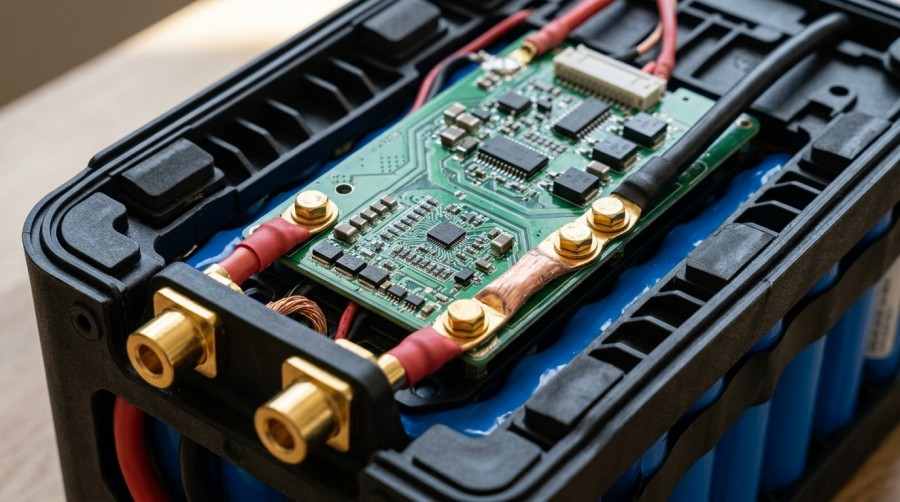
The battery compartment should also prevent metallic foreign objects from entering and potentially shorting the terminals.
Temperature and Storage Management
Tennis courts can become hot during summer, while winter or outdoor use may expose batteries to low temperatures. High temperatures can accelerate battery ageing, while low temperatures may reduce discharge capability.
For equipment stored for extended periods, follow the battery supplier’s recommendations for state of charge, storage temperature, and recharge intervals. Batteries should not remain deeply discharged for long periods.
Charging Interface and User Experience
Tennis ball machines are often operated by nontechnical users, so charging-connector design, charge-status indicators, fault warnings, and battery-level displays can affect the overall user experience.
For removable batteries, connector mating-cycle life, terminal plating, water resistance, and locking mechanisms should also be evaluated to help prevent poor electrical contact during operation.
Common Questions About Tennis Ball Machine Batteries
What Battery Capacity Does a Tennis Ball Machine Need?
Battery capacity should be calculated based on system voltage, average power consumption, training duration, and peak current. Ideally, collect power-consumption data under different ball speeds, oscillation modes, and feed rates, then account for temperature and ageing margins when determining the required capacity.
Selecting a battery based only on machine weight or available battery-compartment space may result in inadequate runtime.
Can You Replace a 12V 50Ah Lead-Acid Battery With a 12V 50Ah LiFePO4 Battery?
The same capacity rating does not mean the batteries are directly interchangeable. Full-charge voltage, low-voltage protection thresholds, charger output, motor peak current, battery-compartment dimensions, and terminal orientation should all be verified.
After these factors have been checked, prototype testing should be performed before the replacement is finalized.
Can a LiFePO4 Battery Make a Tennis Ball Machine Lighter?
For a similar amount of usable energy, LiFePO4 batteries can generally help reduce battery weight. However, the total reduction in machine weight also depends on the motors, frame, ball hopper, wheels, and battery mounting structure.
Can a Lead-Acid Battery Be Damaged by Long-Term Storage?
Storing a lead-acid battery in a deeply discharged state for an extended period can affect its capacity and service life. When a tennis ball machine is stored during the off-season, the battery should be recharged and inspected according to the supplier’s recommendations and kept away from excessive heat, moisture, and prolonged direct sunlight.
Does a Lithium Battery for a Tennis Ball Machine Need a BMS?
LiFePO4 battery packs typically require a BMS to monitor individual cell voltage, temperature, and current and to provide protection or fault warnings. The BMS’s continuous-current and peak-current capabilities should be matched to the equipment’s load profile.
About Himax Electronics
Himax Electronics specializes in custom battery and power solutions for demanding applications worldwide, including proprietary lithium-ion battery packs, power supplies, chargers, and accessories. For tennis ball machines, training equipment, outdoor sports equipment, and other mobile devices, Himax Electronics can help customers evaluate lead-acid and LiFePO4 battery solutions based on system voltage, peak current, required training time, available installation space, operating temperature, and charging requirements, while providing customized support for project development and delivery.