Houseboat Power Solutions: A Complete Battery Maintenance Guide

Commercial Summary: From HiMAXBATT’s manufacturing perspective, this article outlines the factors that shape houseboat battery performance and maintenance. Product specifications, system compatibility, and documented operating limits should guide purchasing and installation decisions.
Key Takeaways
-
Houseboat power planning should account for daily energy use, equipment startup demands, charging sources, and backup power needs—not just a battery’s amp-hour rating.
-
House batteries and engine starting batteries serve different purposes and should be selected and managed accordingly.
-
Marine lithium iron phosphate battery maintenance focuses on charging settings, temperature management, terminal connections, moisture and corrosion protection, and battery management system status.
-
Regularly recording state of charge, temperature, and fault alerts can help identify capacity loss, connection problems, and inadequate charging.
-
Extended docking, winter storage, and battery bank expansion require separate planning. Use the technical documentation for the specific battery model to establish operating limits.
Introduction
A houseboat is both a recreational space and a place to live. Refrigerators, lights, water pumps, communications equipment, and air conditioners all place demands on its electrical system. An undersized battery bank, incompatible charging equipment, or a poor electrical connection can trigger inverter alarms or equipment shutdowns—even when the battery monitor still shows remaining capacity.
From a battery manufacturing and system integration perspective, a dependable houseboat power solution requires the battery cells, battery management system, charging equipment, and electrical distribution system to work together. This guide focuses on houseboat house battery systems, covering capacity calculations, routine maintenance, and troubleshooting to help owners build a practical battery care routine.
What Should You Evaluate Before Choosing a Houseboat Power System?
Before buying batteries, review how you use the equipment onboard. Lighting and communications devices often draw relatively little power but run for long periods. Water pumps and refrigerator compressors cycle on and off. Air conditioners, induction cooktops, and similar appliances can create substantial sustained loads.
The following factors deserve attention:
| Planning Factor | Information to Gather | How It Affects the Battery System |
| Daily energy consumption | Equipment wattage, actual operating time, and standby consumption | Determines required energy storage |
| Simultaneous power demand | Equipment likely to run at the same time | Affects continuous battery discharge requirements and inverter selection |
| Startup loads | Motor and compressor startup power and duration | Affects surge capability and protection settings |
| Time without charging | Required operating time without shore power or meaningful recharging | Determines autonomy and backup power needs |
| Charging availability | Available charging periods from shore power, solar, and generators | Determines whether consumed energy can be replenished |
| Operating environment | Compartment temperature, humidity, salt exposure, vibration, and water intrusion risk | Affects protective features and installation location |
Engine starting batteries deliver high current for short periods, while house batteries support sustained loads and repeated cycling. Matching nominal voltage alone does not make these battery types interchangeable. Batteries used for engine starting, propulsion, or emergency equipment should be specifically evaluated for those applications.
How Do You Calculate Houseboat Battery Capacity?
Start by calculating energy use in watt-hours (Wh) or kilowatt-hours (kWh). Then use the battery bank’s nominal voltage to convert that energy requirement into amp-hours (Ah).
Daily energy use per device = Device power × Equivalent daily operating time
The following hypothetical figures illustrate the calculation method. They are not measured specifications for particular appliances.
| Equipment | Assumed Power | Equivalent Daily Operating Time | Daily Energy Use |
| LED lighting | 30W | 5 hours | 150Wh |
| Refrigerator | 60W | 8 hours | 480Wh |
| Communications and networking equipment | 20W | 10 hours | 200Wh |
| Water pump | 100W | 0.5 hour | 50Wh |
| Laptop and other devices | 80W | 3 hours | 240Wh |
| Total | — | — | 1,120Wh |
A refrigerator’s equivalent operating time depends on ambient temperature, door openings, and insulation. Measuring its actual consumption with an energy meter provides a more useful basis for planning.
If all the loads above run through an inverter, assume 90% inverter efficiency, an operating window that uses 80% of the battery’s rated energy, and one day of operation:
Required rated energy ≈ 1,120 ÷ 0.90 ÷ 0.80 ≈ 1,556Wh
For a battery with a nominal voltage of 12.8V, the calculated capacity would be approximately:
1,556 ÷ 12.8 ≈ 122Ah
The 90% efficiency and 80% operating window are calculation assumptions, not universal product specifications. Actual system sizing should also account for inverter standby consumption, wiring losses, cold-weather effects, and battery aging. Calculate DC and AC loads separately to avoid counting conversion losses twice.
Meeting the energy requirement also does not guarantee that the battery can run every appliance. Check the continuous current limits of the battery, BMS, inverter, and wiring, along with the current and duration required by startup loads.
Lead-Acid or Lithium Iron Phosphate Batteries for a Houseboat?
Different battery chemistries suit different applications. Compare usable energy, weight, charging requirements, and maintenance costs under comparable operating conditions.
| Comparison | Lead-Acid Batteries | Lithium Iron Phosphate Batteries |
| Weight and space | Typically heavier for the same usable energy | Typically lighter for the same usable energy |
| Usable discharge range | Discharge depth should reflect the intended service life | Often supports a broader usable range, subject to product limits |
| Charging management | Charging profiles must match the specific lead-acid type | Requires a compatible charging strategy and BMS protection |
| Routine maintenance | Flooded models may require electrolyte checks; sealed models have different requirements | Generally requires no watering; maintenance focuses on system condition and connections |
| Existing system upgrades | Battery type and charging equipment still require verification | Also requires evaluation of alternator loading, protection coordination, and temperature limits |
| Service life evaluation | Affected by discharge depth, temperature, and charging condition | Also affected by temperature, charge and discharge rates, and operating window |
Lithium iron phosphate batteries are worth evaluating for houseboat house power systems. However, treating an upgrade as a simple battery swap can overlook important compatibility issues.
The UK’s Boat Safety Scheme guidance on installed lithium-ion batteries emphasizes competent installation, equipment suitable for marine use, and compatible battery management and charging controls. This highlights a practical point: battery performance depends on proper system integration.
Marine Battery Maintenance: Build a Practical Inspection Schedule
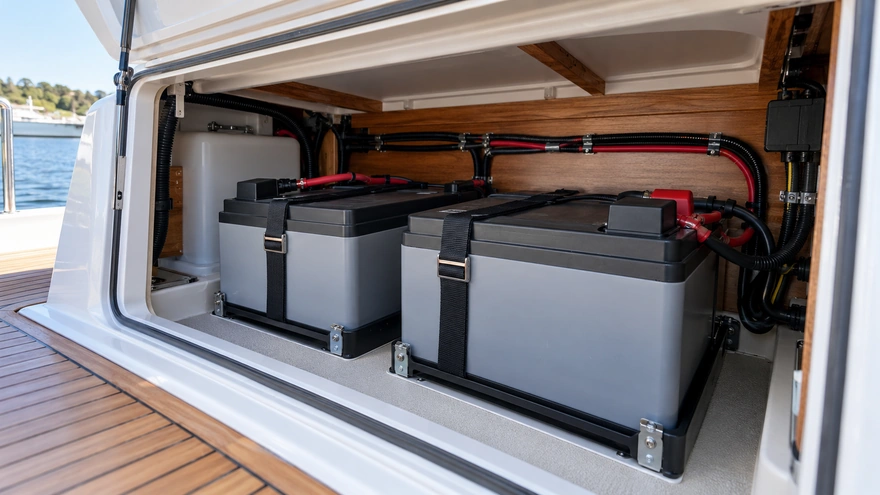
Marine lithium iron phosphate battery maintenance involves more than checking the battery case. Moisture, salt exposure, and ongoing vibration can also affect terminals, cables, and mounting hardware.
Use the following schedule as a starting point. Adjust inspection intervals based on operating conditions, usage, and manufacturer instructions.
| When to Check | What to Inspect | What to Address |
| Before departure or an extended stay onboard | State of charge, temperature, alarm history, and estimated runtime | Confirm available energy matches the planned loads |
| During normal use | Charging and discharging current, compartment conditions, unusual odors, and sounds | Watch for changes from normal operation |
| During scheduled maintenance | Terminal corrosion, cable wear, mounting hardware, and signs of water intrusion | Have qualified personnel inspect and correct issues using the appropriate shutdown procedure |
| During high-load checks | Connection temperatures, voltage drop, and inverter status | Investigate loose connections, excessive resistance, and inadequate wiring capacity |
| Before extended docking | Storage charge level, parasitic loads, and charging strategy | Configure and document settings according to the manual |
| Before returning to service | Physical condition, voltage, protection status, and charging settings | Restore loads gradually after confirming normal conditions |
Keep water and cleaning products out of electrical connections. Tighten terminals to the specified torque rather than relying on feel or repeatedly tightening them. Terminal removal, fuse inspection, and measurements on energized circuits should be handled by someone with the appropriate skills.
Keep a basic maintenance log with inspection dates, state of charge, temperature, fault codes, and operating time. Trends recorded under similar conditions are often more useful than a single voltage reading.
Managing Shore Power, Solar, and Alternator Charging
A houseboat solar battery system may receive power from several charging sources. Maintenance should include checking each charger and verifying the combined charging current when multiple sources operate together.
| Charging Source | What to Verify | Commonly Overlooked Issue |
| Shore power charger | Battery chemistry settings, charging voltage, current, and maintenance charging strategy | An existing lead-acid profile may not suit the replacement battery |
| Solar charge controller | Battery settings, temperature protection, and current limits | Actual solar production may fall below expectations |
| Engine alternator | Regulation, sustained load capability, current limiting, and protection coordination | Lithium battery charging demand may keep the alternator under a heavy load |
| Multiple charging sources | Combined current, BMS charging permission, and communication or shutdown controls | Individually acceptable chargers may exceed the battery’s current limit when used together |
Some lithium batteries require charging to stop at low temperatures or use controlled heating before charging can begin. Follow the specific model’s temperature thresholds, restart conditions, and heating logic. Low-temperature protection does not mean a battery can accept charging at any ambient temperature.
If the battery enters protection mode, do not repeatedly force a reset. Determine whether the cause involves temperature, voltage, current, or equipment compatibility, then follow the manufacturer’s recovery procedure.
Marine Battery Winter Storage and Extended Docking
During extended docking, monitors, communications modules, and other standby devices may continue drawing power. Turning off some switches does not necessarily disconnect every circuit.
There is no single storage charge level or inspection interval that applies to every battery. Lithium iron phosphate and lead-acid batteries have different storage requirements, and products within the same chemistry can also vary. Follow the product manual for storage charge level, environmental conditions, and recharging procedures.
Do not casually disconnect equipment that needs continuous power, such as bilge pumps and alarms. Calculate these loads separately and arrange suitable inspections or replenishment charging. Before returning the system to service, check its physical condition and alarm status, then restore charging and loads according to the operating procedure.
How to Troubleshoot Onboard Power Problems
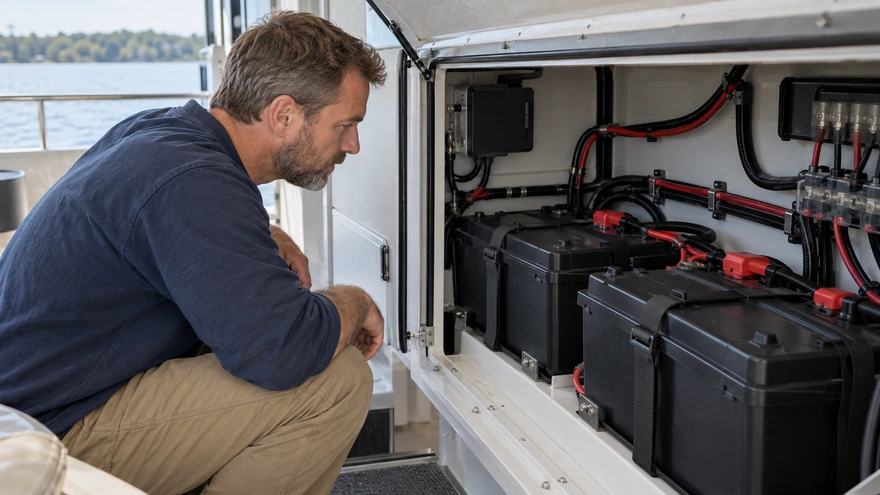
An unexpected equipment shutdown does not necessarily mean the battery bank is undersized. Wiring voltage drop, inverter overload, and BMS protection can cause similar symptoms.
| Symptom | Possible Causes | What to Check |
| Power cuts out when a pump or refrigerator starts | Startup current exceeds limits, excessive voltage drop, or a loose connection | Review startup requirements, protection logs, and connection condition |
| Inverter reports low input voltage | Low state of charge, cable voltage drop, or poor terminal contact | Compare voltage at the battery terminals and inverter input under load |
| Charging current is unusually low | Battery is approaching full charge, temperature limits are active, or charging input is insufficient | Check BMS status, charger settings, and available input power |
| Runtime gradually decreases | Increased loads, temperature changes, incomplete charging, or capacity loss | Establish comparable test conditions before assessing usable capacity |
| Parallel batteries share current unevenly | Different connection resistance, battery condition, or protection activity | Inspect the wiring arrangement and individual battery operating data |
Stop using a battery that shows significant swelling, abnormal heat, smoke, or a strong chemical odor. Isolate the affected power source only if it is safe to do so. Follow the boat’s emergency procedures, evacuate, and seek help. Do not approach or move a smoking battery.
Houseboat Power and Battery Maintenance FAQ
Do marine lithium iron phosphate batteries need to be fully discharged regularly?
No. Repeated deep discharging is not needed to “activate” the battery. Set the operating range according to the product instructions. Some battery monitors require calibration under specific conditions, but calibration is not the same as routine deep discharging.
Can voltage alone show how much charge remains in a marine lithium battery?
Not accurately across much of the operating range. Lithium iron phosphate batteries have a relatively flat voltage curve. Use a current-integrating battery monitor, BMS data, and the appropriate calibration procedure to assess state of charge.
Can lead-acid and lithium iron phosphate batteries be connected directly in parallel?
Direct parallel connection is not recommended. Their voltage characteristics, internal resistance, and charging requirements differ, which can lead to uncontrolled current sharing. If a boat retains different battery chemistries, have a qualified professional design the isolation and charging arrangements.
Does a houseboat still need backup power after installing solar panels?
Evaluate backup requirements based on prolonged cloudy weather, shading, seasonal conditions, and changing loads. A solar panel’s rated power does not equal its actual daily energy production. Consider backup power and low-charge alerts separately for essential equipment such as bilge pumps, alarms, and communications devices.
Does a BMS eliminate the need for fuses and circuit breakers?
No. A BMS and circuit protection devices perform different functions. Fuses, circuit breakers, disconnect switches, and cables must be selected for the system voltage, expected current, and potential fault conditions.
Can you expand a battery bank at any time using batteries from the same brand with the same capacity?
You still need to confirm whether the model supports parallel operation, the permitted number of batteries, compatibility between new and existing units, and connection requirements. The same brand and amp-hour rating do not guarantee matching specifications. Series connections also require explicit product support.
How often should marine batteries be replaced?
Age alone is not a sufficient replacement criterion. Evaluate usable capacity, changes in internal resistance, temperature behavior, alarm history, and the runtime required by essential loads. When reviewing cycle-life figures, also check the test temperature, depth of discharge, charge and discharge rates, and end-of-life criteria.
Explore HiMAXBATT Batteries for Your Houseboat Power Requirements
HiMAXBATT is a lithium battery manufacturing brand. For houseboat house power, solar energy storage, and backup power applications, the selection process should begin with your load list, system voltage, installation space, and charging conditions. Share your project requirements with HiMAXBATT and request technical documentation for the relevant models. Review capacity, continuous and surge discharge capability, BMS protection, operating temperatures, and permitted series or parallel configurations. Marine suitability, enclosure protection ratings, and certification requirements should also be verified against the documentation for the specific model, helping align the battery configuration with the equipment it needs to power.