Himax Electronics: A Technical Guide to the Custom Battery Process from Requirements to Delivery
Commercial Disclosure: The Himax Electronics Editorial Team brings together expertise in battery products, power technologies, engineering applications, and global customer support to share practical information about battery technology, custom battery solutions, and power applications. Our content covers lithium-ion batteries, LiFePO4 batteries, battery pack design and selection, charging and power solutions, industry application guides, product updates, and official Himax Electronics news. Our goal is to help engineers, procurement professionals, and businesses better understand battery technologies and make informed decisions based on their specific application requirements. All content reflects the official editorial perspective of Himax Electronics and our commitment to providing reliable, flexible, and professional custom battery and power solutions for complex applications worldwide.
Key Takeaways
- Requirements definition: Custom battery development begins by translating the application and operating conditions into measurable and verifiable technical specifications.
- Cells, the BMS, mechanical structure, thermal management, and charger should be designed as an integrated system. Meeting requirements at the component level does not necessarily mean the complete system is properly matched to the application.
- Runtime and service-life assessments should clearly define temperature, load, charge and discharge conditions, and capacity degradation. Specifications should not be compared without considering the associated test conditions.
- Prototype validation, pilot production, and mass-production inspection serve different purposes and should have separate acceptance criteria.
- Test documentation, transportation documents, revision records, and operating instructions are also important parts of a custom battery deliverable.
Introduction
When an off-the-shelf battery cannot meet a device’s installation space, runtime, or communication requirements, a custom battery solution becomes an option during product development. However, battery customization is not simply a matter of changing the enclosure, adding more cells, or adjusting the capacity of an existing battery.
From a manufacturing perspective, developing a custom lithium battery pack is a systems engineering process involving electrochemistry, electrical design, mechanical engineering, software, and manufacturing processes. If the requirements are not sufficiently defined, a prototype may be able to power on the device but still fail to meet expectations under low temperatures, peak loads, or long-term operation.
This article examines the key technical stages of a custom battery project, from initial requirements through final delivery, based on the types of battery and power solution requirements Himax Electronics handles for complex applications. Specific configurations, test scope, and deliverables should be based on the technical agreement confirmed by both parties for each project.
- Requirements Definition: Translating the Application into Technical Specifications
The starting point for custom battery development is understanding how the device operates, rather than immediately deciding on “how many volts” or “how many amp-hours.”
For example, two devices may have the same average power consumption, but if one experiences frequent motor starts while the other operates with a steady load, their requirements for battery peak current, voltage drop, and protection delay may be different.
| Requirement Category | Recommended Information | Impact on Solution Design |
| Electrical Interface | Operating voltage range, shutdown voltage, and interface definition | Determines the number of cells in series and device compatibility |
| Load Characteristics | Average current, continuous current, peak current, and peak duration | Determines cell rate capability, interconnections, and protection parameters |
| Runtime Target | Operating time, standby time, and daily usage frequency | Helps estimate energy demand and required capacity |
| Mechanical Requirements | Dimensions, weight, mounting method, and installation/removal requirements | Determines cell arrangement and mechanical design |
| Operating Environment | Charge/discharge temperatures, humidity, vibration, and potential liquid exposure | Determines materials, protection, and thermal-management requirements |
| Charging Conditions | Input power source, charging time, and whether the device operates while charging | Determines charger and power-path design |
| Smart Functions | Battery-level indication, communication protocol, and fault logging | Determines BMS functions and software interfaces |
| Market and Delivery | Sales regions, application category, production volume, and maintenance requirements | Determines testing, documentation, and production planning |
For devices still under development, measured load profiles or representative operating cycles can be provided first, with specifications gradually finalized as the project progresses. The battery manufacturer and device development team should also define abnormal operating conditions, such as motor stall, repeated startup, extended standby, and interrupted charging.
- Capacity Calculation and Cell Selection: Consider Both Energy and Power
Amp-hours should not be compared independently of voltage. Batteries operating at different voltage levels can have different nominal energy even when their Ah ratings are the same.
A preliminary calculation can use:
Nominal Energy (Wh) ≈ Nominal Voltage (V) × Capacity (Ah)
Assume a device has an average power consumption of 40W and needs to operate for 5 hours. The load therefore requires approximately 200Wh. If power-path efficiency is estimated at 90% and the planned usable-energy ratio is 80%, the required nominal battery energy would be approximately:
200 ÷ (0.9 × 0.8) ≈ 278Wh
These values are provided only to illustrate the calculation method and do not separately account for low-temperature effects or end-of-life capacity degradation. If measured usable-energy data is used instead, it is important to confirm which losses are already included to avoid accounting for the same losses twice.
Cell selection requires further comparison of battery chemistry, cell format, continuous discharge capability, charging capability, and temperature characteristics. A higher-capacity cell is not necessarily suitable for a high-current device. Likewise, a cell that can withstand a short current pulse may not be able to continuously supply the same current.
Connecting cells in series primarily increases battery-pack voltage, while connecting cells in parallel primarily increases capacity and helps distribute current. In practice, however, current sharing is also affected by cell consistency, connection resistance, and temperature differences. System performance therefore cannot be predicted solely from the number of cells connected in parallel.
- BMS and Electrical Design: Matching Protection Strategies to Device Behavior
The battery management system (BMS) monitors battery conditions and performs protection and management functions according to the system design. Depending on the project, these functions may include overcharge, over-discharge, overcurrent, short-circuit, and temperature protection, as well as cell balancing, state-of-charge estimation, and communication.
The design should distinguish between the normal operating range, software control thresholds, and protective cutoff thresholds. Protection limits should not be treated as normal operating targets for the device.
For example, if a short current surge during motor startup is part of normal operation, the protection logic should evaluate both the magnitude and duration of the current. Simply increasing the protection threshold without sufficient analysis could reduce the system’s ability to identify genuine abnormal conditions.
For devices that display remaining battery capacity, the SOC, or state of charge, estimation method and applicable accuracy conditions should also be defined. Estimating remaining capacity based only on voltage can result in significant errors when loads or temperatures change, particularly with battery chemistries that have relatively flat voltage curves.

Communication interfaces also need to be defined in detail. Simply stating “CAN supported” or “SMBus supported” is not enough. Both parties should confirm the data format, update frequency, abnormal states, sleep and wake behavior, and the system response if communication is interrupted.
- Coordinating Mechanical Design, Thermal Management, and the Charger
Custom lithium battery packs need to provide proper mechanical retention, electrical insulation, and a suitable thermal environment for the cells. The design should consider more than whether the battery physically fits inside the device. It should also account for drops, vibration, wire-harness loads, and long-term temperature changes.
Common areas to evaluate include:
- How cells are secured, cushioned, and insulated from the enclosure.
- The current-carrying capability, temperature rise, and connection reliability of conductive interconnects.
- Whether temperature sensors are positioned to accurately represent critical areas.
- Whether enclosure sealing, heat dissipation, and abnormal venting requirements are properly coordinated.
- Whether pouch cells and similar cell formats have sufficient space for dimensional changes within the cell manufacturer’s requirements.
Heat generation can initially be understood using the relationship between the square of current and resistance, but a complete thermal design should also account for heat generated by interconnections, power components, and different operating phases.
The charger should also be confirmed during this stage. A compatible plug and a similar voltage label do not demonstrate charger compatibility. Charging voltage, charging current, control method, temperature limits, and power distribution when the device operates while charging all need to be verified.
- Prototype Validation: Moving from “It Works” to “It Meets the Operating Requirements”
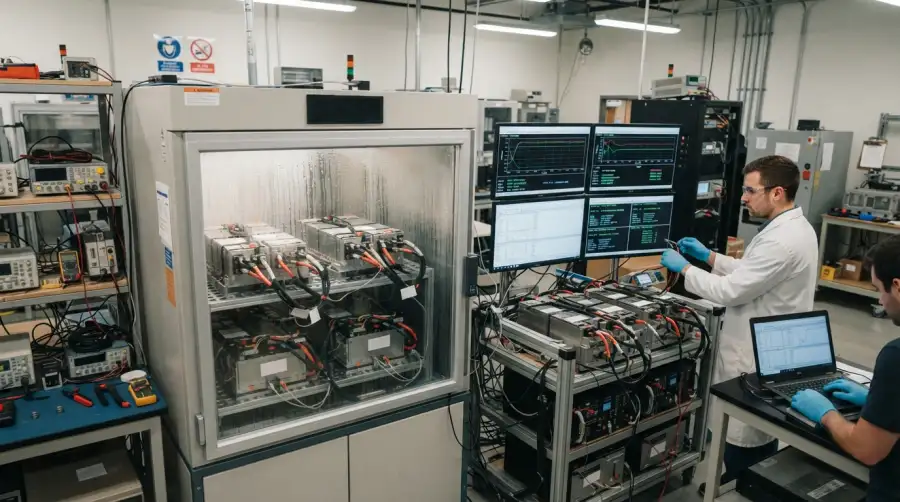
Prototype testing should be performed against acceptance criteria defined in advance. Simply verifying that the device powers on and completes one charge-discharge cycle does not adequately represent how a custom battery will perform in its actual application.
| Validation Category | Main Items to Check | Conditions That Should Be Defined |
| Electrical Performance | Capacity, energy, voltage drop, continuous output, and pulse output | Temperature, current, and cutoff voltage |
| Protection Functions | Voltage, current, and temperature protection behavior | Trigger conditions, delay times, and recovery methods |
| Device Integration | Startup, sleep, wake-up, communication, and charging | Device version, accessories, and operating modes |
| Environmental Performance | Temperature, vibration, shock, and project-specific protection requirements | Test methods, severity levels, and acceptance criteria |
| Service-Life Evaluation | Cycle degradation, internal-resistance changes, and storage effects | Depth of discharge, C-rate, and temperature |
| Safety and Compliance | Tests applicable to the intended application and market | Applicable standards, sample configuration, and product version |
Tests involving hazardous conditions such as short circuits or overcharging should be conducted by personnel and organizations with appropriate facilities and expertise. They are not intended to be performed by end users as normal product-use tests.
Cycle-life claims also need defined test conditions. For example, a statement describing how much capacity remains after a certain number of cycles should also specify temperature, charge and discharge rates, depth of discharge, and end-of-test criteria before the result can be meaningfully compared.
- Testing and Transportation Requirements: Do Not Treat Different Documents as Interchangeable
Battery application-safety testing and transportation testing address different requirements and should be evaluated separately.
IEC 62133-2 addresses safety requirements for portable sealed secondary lithium cells and batteries under intended use and reasonably foreseeable misuse. Whether it applies to a particular project depends on the product application and target market. Reference: IEC 62133-2 Standard
UN 38.3, by contrast, relates to type testing for the transportation of lithium batteries. The test summary provides testing information and traceability for the applicable battery design, but it does not replace complete end-product safety certification. Reference: PHMSA Lithium Battery Test Summary Information
In addition, having test documentation for individual cells does not mean that an assembled custom battery pack automatically meets every applicable requirement. Air transportation requirements must also be determined according to battery type, energy rating, packaging configuration, and shipping status. Reference: IATA Battery Shipping Information
Testing and transportation planning should therefore begin during the design stage rather than after prototypes have been completed, when structural changes, labeling updates, or additional documentation may be more difficult to implement.
- Pilot Production and Mass Production: Verifying Manufacturing Consistency
Passing engineering prototype testing does not mean a battery design is ready for mass production. Pilot production is used to determine whether the design can be manufactured consistently and whether production inspections can reliably identify relevant defects.
Key controls typically include incoming-material verification, cell matching, interconnection processes, insulation assembly, firmware programming, and finished-product inspection. Welding and similar joining processes should be verified using appropriate process-validation methods rather than judging reliability solely by appearance.
Mass-production quality control should distinguish between 100% inspection and sampling-based verification. Voltage, interfaces, communication, and certain protection functions can be checked on finished products according to production requirements, while destructive testing and long-term life testing require separately planned sample quantities and test frequencies.
Revision control is equally important. If the cell model, BMS components, firmware, or mechanical structure changes, the impact on performance, manufacturing processes, and existing test documentation should be evaluated before determining what additional validation is required.
- Delivery and Ongoing Support: The Deliverable Is More Than the Physical Battery
A custom battery delivery should give the customer a clear understanding of how the product should be used, how it should be inspected and accepted, and how issues can be traced if they occur.
Depending on the project agreement, both parties can confirm the following documentation:
- Product specifications, drawings, and interface definitions.
- Model numbers, serial numbers, and hardware and software version information.
- Agreed inspection records, test reports, and applicable transportation documents.
- Charging, storage, installation, and maintenance instructions.
- Procedures for abnormal conditions, change notifications, and after-sales communication.
Project lead time should also not be expressed as a single universal number. Cell procurement, tooling development, prototype revisions, external testing, and customer integration testing can all affect the schedule. Using milestone-based deliverables and approval checkpoints can make it easier for both parties to determine whether the project is ready to move to the next stage.
Frequently Asked Questions (FAQ)
Is Voltage and Capacity Information Enough to Develop a Custom Battery?
It can be enough for an initial discussion, but not for completing the design. Load current, dimensions, operating temperature, charging method, target market, and other application requirements are also needed to evaluate compatibility and determine the appropriate validation scope.
Will Increasing Battery Capacity Always Solve a Device Runtime Problem?
Not necessarily. Device power consumption, conversion losses, cutoff voltage, and low-temperature performance should also be evaluated. If a device shuts down early because of voltage drop during peak loads, the issue may involve battery power capability rather than capacity alone.
Can BMS Cell Balancing Compensate for Cell Inconsistency?
Cell balancing can help manage differences in state of charge within its designed operating range, but it cannot correct severely degraded capacity, abnormal internal resistance, or internal cell defects. Incoming cell quality and cell matching remain important.
Why Is Pilot Production Necessary After a Custom Battery Prototype Has Passed Testing?
Prototype validation primarily confirms the design, while pilot production evaluates manufacturing processes, assembly consistency, inspection methods, and traceability procedures. The two stages address different risks.
If a Battery Pack Uses a Different Cell with the Same Specifications, Does It Need to Be Revalidated?
A change assessment is required. The same nominal voltage and capacity do not necessarily mean the replacement cell has identical internal resistance, temperature rise, dimensions, or interaction with protection settings. The scope of additional validation should be determined according to the specific change and applicable requirements.
Why Can Quotes for Custom Battery Packs Vary Significantly?
Pricing depends on more than the number of cells. BMS functionality, mechanical design and manufacturing processes, interfaces, testing scope, order volume, and required documentation can all affect cost. When comparing proposals, the technical scope and acceptance criteria should be evaluated along with price.
About Himax Electronics
Himax Electronics specializes in custom battery and power solutions for complex applications worldwide, providing application-specific lithium-ion battery packs, power supplies, chargers, and accessories for a range of industry requirements.
Customers are welcome to provide equipment operating conditions, available installation space, electrical interfaces, and target-market information to discuss a battery solution suitable for their project with Himax Electronics. Specific product configurations, validation scope, delivery schedules, and service requirements should be based on the technical specifications and project terms agreed upon by both parties.