Do You Need a Self-Heating Lithium Battery in Winter? Buying Guide
Commercial Summary: This article presents HiMAXBATT’s engineering perspective on winter battery selection. It explains how to assess heating controls, charging compatibility, and test data, with product suitability determined by documented specifications and application conditions.
Key Takeaways
-
Whether you need a self-heating lithium battery depends on actual cell temperature, how often you charge in winter, and whether the installation has reliable temperature control.
-
Cold-weather discharging and charging have different limits. A battery that can deliver power below freezing may not support charging at the same temperature.
-
Battery heating requires energy. Before buying, check the heating power source, activation requirements, warm-up time, and charging control logic.
-
For RVs, outdoor energy storage, and off-grid solar systems, evaluate available charging power, insulation, and maintenance costs together.
-
Compare documented cold-weather test results and complete specifications rather than relying on capacity ratings or general “cold-resistant” claims.
Introduction
Winter can bring shorter battery runtime or a battery that will not accept a charge even when the charger is connected. Can a self-heating lithium battery help, and is it worth the added cost?
If your battery frequently needs charging when its cells are below their permitted charging temperature, and reliable external temperature control is unavailable, self-heating is worth considering. If the battery consistently stays within its permitted temperature range, a conventional lithium battery with appropriate protection may meet your needs.
From a battery manufacturing perspective, winter performance depends on the cells, heating components, battery management system, and charging equipment working together. This guide focuses on common lithium iron phosphate storage batteries and lithium-ion batteries with graphite anodes. It explains when a self-heating lithium battery makes sense and which specifications to check before buying.
Why Do Lithium Batteries Lose Runtime or Limit Charging in Winter?
As temperatures drop, ion transport and electrode reactions slow down, while internal resistance typically increases. Under the same load, voltage may drop more noticeably. Equipment can then reach its low-voltage cutoff earlier, reducing usable energy or making high-power devices harder to start.
Reduced winter runtime does not necessarily mean the battery has permanently lost the same amount of capacity. Some usable capacity may return as the battery warms up. Actual performance also depends on battery age, discharge current, and protection settings.
Cold-weather charging requires additional care. In common graphite-anode batteries, charging at a current that is unsuitable for the cell temperature can cause lithium plating, affecting capacity, service life, and safety.
A study published in IFAC-PapersOnLine and available through the academic repository arXiv examines how low temperatures affect lithium-ion battery power, energy capacity, and lithium plating risk. It also highlights temperature differences within the cell during heating. For battery designers, this means heating speed and temperature uniformity both matter. Source: Combined Film and Pulse Heating of Lithium-Ion Batteries
When comparing batteries, check the charging, discharging, and storage temperature ranges separately. A single “operating temperature” specification does not provide enough information.
How Does a Self-Heating Lithium Battery Work?
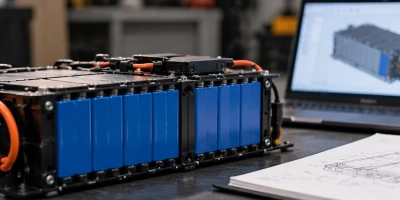
One common design uses electric heating elements inside the battery pack. Temperature sensors and the battery management system, or BMS, coordinate their operation. When cell temperature is too low and the required power conditions are met, the system warms the battery before allowing charging under its programmed limits.
Power sources and control strategies vary by product:
| Heating Approach | Energy Source | Suitable Conditions | What to Confirm Before Buying |
| External-power preheating | Charger, power adapter, or another charging input | External power is available when the battery is cold | Required input current and how power is allocated between heating and charging |
| Battery-powered preheating | Energy stored in the battery | Preheating is needed without external power, and the product supports this feature | Required state of charge, energy use, and low-charge shutdown behavior |
| Temperature-controlled battery enclosure | An externally powered temperature-control system | Fixed installations with centralized temperature management | Control coordination, insulation, moisture management, and total energy use |
A self-heating feature does not necessarily keep the battery warm continuously in cold weather. Some products activate heating only after a charger is connected. Others also require a certain input current. Check the manual for the specific model.
Which Winter Applications Benefit From Self-Heating Lithium Batteries?
Base your decision on the temperature at the battery’s installation location and how it will be charged. Local weather forecasts provide context, but outdoor air temperature does not directly represent cell temperature.
After a battery sits outside overnight, its cells may remain cold even as daytime air temperatures rise.
| Application | Typical Winter Conditions | Selection Guidance |
| Indoor energy storage with consistent heating | Cell temperature is generally easier to maintain within the permitted range | Verify installation temperatures and protection features; self-heating may offer limited additional value |
| Unheated garage or equipment room | The battery may need charging in the morning after cooling overnight | Record battery temperatures before deciding whether preheating is needed |
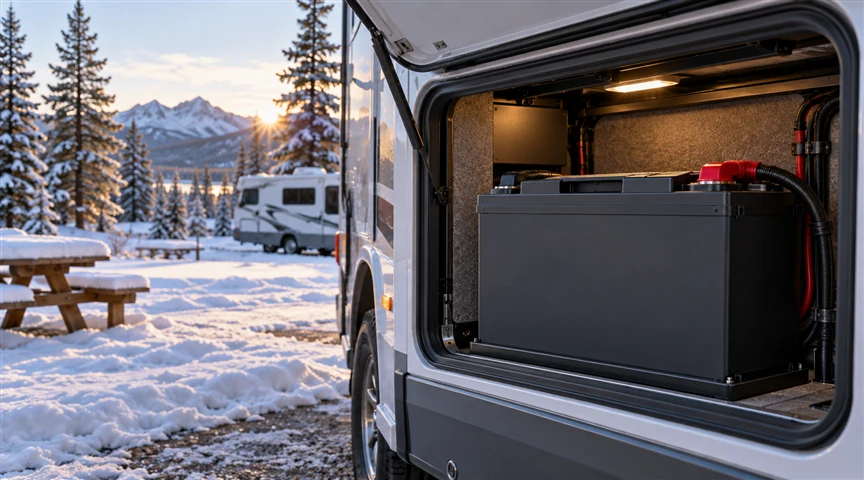
| Winter RV travel | Battery compartment temperature varies considerably with installation location | Consider self-heating or a compatible temperature-control system if charging frequently occurs in a cold compartment |
| Off-grid solar storage | Batteries may be cold in the morning while solar input is still weak | Confirm whether available power can start and complete preheating |
| Outdoor monitoring or communications equipment | Systems may operate unattended and be difficult to service | Evaluate heating energy use, insulation, and power availability together |
| Occasional winter camping | Use is infrequent, and charging locations may be manageable | Compare the total cost of self-heating with a properly designed temperature-control solution |
If you mainly discharge the battery outdoors and can let it warm up in a suitable environment before charging, self-heating may be less necessary. You still need to confirm that its cold-weather discharge capability meets your equipment’s requirements.
Which Specifications Matter When Buying a Self-Heating Lithium Battery?
Check How Permitted Charging Current Changes With Cell Temperature
Many conventional lithium iron phosphate batteries specify a charging temperature lower limit around 32°F (0°C), while some products use more conservative control settings. Cells designed for specialized low-temperature operation may have different temperature and current limits.
A cell temperature above 32°F (0°C) does not automatically mean the battery can accept its full rated charging current. Ask the supplier for the model’s temperature-dependent charging limits, including the permitted charging rate after preheating ends.
Review the Complete Heating Control Logic
| Specification | Questions to Ask the Supplier | Why It Matters |
| Heating activation and shutoff conditions | Which sensor controls heating, and is there a temperature gap between activation and shutoff? | Affects warm-up performance and repeated cycling on and off |
| Charging restart conditions | At what cell temperature does charging resume, and is current limited in stages? | Determines how cold-weather charging protection operates |
| Heating power and input requirements | What are the rated heating power, required input current, and voltage conditions? | Determines whether the charging source is compatible |
| Warm-up test conditions | What were the starting temperature, battery capacity, insulation, and installation conditions? | Helps establish whether the stated warm-up time applies to your setup |
| Temperature monitoring and fault protection | Where are sensors located, and how are overheating or sensor faults handled? | Affects temperature control and fault response |
| Usable energy at low temperatures | What were the test temperature, discharge rate, and cutoff voltage? | Helps estimate actual winter runtime |
| Series and parallel compatibility | Are these configurations supported, and how are heating and protection coordinated? | Affects system expansion and battery bank operation |
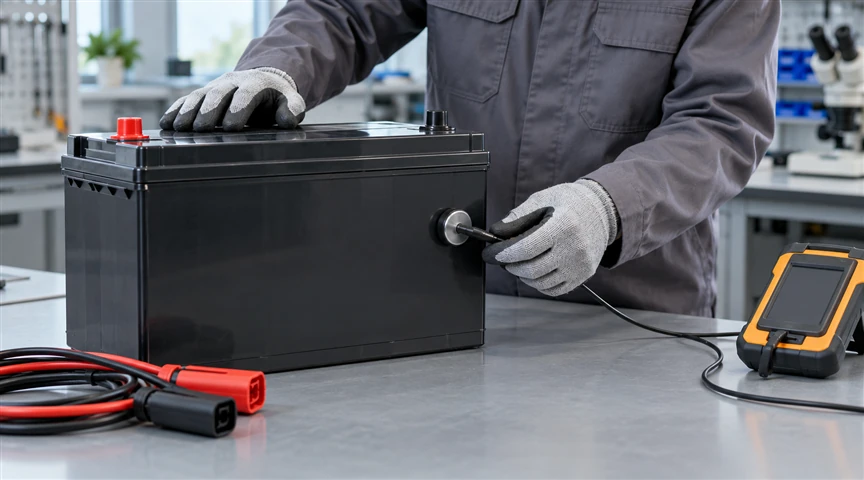
From a manufacturing standpoint, heater attachment, electrical insulation, heat transfer between cells, and sensor placement can all affect performance. Heating wattage alone does not establish how well the complete pack controls temperature.
Verify Compatibility With Your Charging System
An RV may use a shore-power charger, solar charge controller, and vehicle-powered DC-to-DC charger. Check the charging voltage, available output, and startup behavior of each device when selecting a self-heating battery.
For solar systems in particular, the array’s rated output does not represent the power available on a winter morning. If heating requires substantial sustained input, weak sunlight may result in slow warm-up or repeated starts and stops.
Ask the supplier to assess your actual solar configuration rather than simply confirming that the battery “supports solar charging.”
How Much Energy Does Self-Heating Use, and How Should You Compare Costs?
Self-heating consumes energy. Whether that energy comes from an external source or the battery itself depends on the design.
Consider a simple calculation: if a heater runs continuously at 60 watts for 20 minutes, its energy use is approximately:
60 W × (20 ÷ 60 hours) = 20 Wh.
For a battery with a nominal energy rating of 1,280 Wh, 20 Wh is about 1.6% of its rated energy.
This is a calculation example, not a performance claim for a particular product. It also does not establish how long other batteries will take to warm up. Actual heating energy depends on starting temperature, heat loss, battery thermal mass, and control strategy.
If an external source powers the heater, the calculated energy use should not automatically be treated as an equivalent reduction in the battery’s stored energy.
Include the following factors when comparing costs:
| Cost Category | Variables to Consider |
| Battery purchase price | Price differences between batteries with comparable capacity and protection features |
| Winter operating energy | Heating frequency, heating duration, and any ongoing temperature-maintenance needs |
| Installation changes | Battery enclosure, temperature controls, wiring, and charging equipment compatibility |
| Maintenance | Travel distance to outdoor installations, troubleshooting, and ease of replacement |
| Downtime | Whether charging restrictions could interrupt monitoring, communications, or travel |
For equipment that frequently charges in cold environments, self-heating may reduce the need for manual warm-up procedures. For systems with controlled temperatures or limited winter use, compare the added cost with the practical benefit.
Technical FAQ: Self-Heating Lithium Batteries in Winter
Can You Charge a LiFePO4 Battery Below Freezing?
It depends on the specifications of the cells and the complete battery pack. If a conventional battery does not explicitly support below-freezing charging, its ability to discharge in the cold should not be treated as permission to charge it under the same conditions.
A self-heating battery must also meet its preheating, temperature-monitoring, and charging-control requirements before the cells can charge.
Do You Still Need Self-Heating if the Battery Has Low-Temperature Charging Protection?
The two features serve different purposes. Low-temperature charging protection limits or stops charging when cell temperature is unsuitable. Self-heating helps bring the cells into their permitted charging range.
Whether you need both depends on whether the battery must accept a charge while installed in a cold environment.
Will Self-Heating Restore Winter Battery Runtime?
Warming the cells can improve their cold-weather operating conditions, but heating also requires energy. Actual runtime depends on the performance improvement, heating energy use, load, and insulation.
Self-heating should not be treated as a guarantee of room-temperature runtime.
Why Is the Battery Heating Without Gaining Charge?
Some products initially direct incoming power to the heater and begin charging the cells only after the charging restart conditions are met.
Charge level may also rise slowly if input power is weak, heat loss is substantial, or connected equipment is drawing power at the same time. Review heating status, cell temperature, and input power together.
Can You Add Heating Pads to a Conventional Lithium Battery?
Retrofitting heaters involves electrical insulation, localized overheating, sensor placement, and coordination with charging protection.
An unvalidated heating pad may warm part of the case without bringing all cells to a suitable temperature. Have the battery manufacturer or a qualified system integrator evaluate the proposed setup.
Should Self-Heating Stay On During Long-Term Winter Storage?
Not necessarily. Follow the product’s storage temperature, state-of-charge, and inspection requirements, and check its standby power consumption.
For products that can power their own heaters, consider how heating could affect stored charge during extended periods without charging.

How Can You Tell Whether a “Cold-Weather” Battery Fits Your Equipment?
Ask for separate charging, discharging, storage, and heating activation limits. Review test data that reflects your intended operating conditions.
Useful data includes the test temperature, discharge current, delivered energy, and conditions that trigger protection. A temperature rating by itself does not describe the battery’s full operating capability.
HiMAXBATT: Battery Selection Based on Real Operating Conditions
HiMAXBATT provides OEM and ODM services for lithium iron phosphate, lithium-ion, and other battery packs, supporting project evaluations involving cell configuration, BMS design, and battery pack requirements.
For winter RV use, solar storage, or outdoor equipment, share your installation environment, expected winter temperatures, equipment power requirements, charging sources, and runtime targets with our team. These details help guide the evaluation of capacity, low-temperature protection, and whether a heating system is appropriate.
Available features, operating temperatures, and performance specifications depend on the agreed project specifications and test results. Explore HiMAXBATT’s custom battery services to discuss your application.