Custom Battery Prototype Testing: What Engineers Should Validate Before Production
Commercial Summary: Himax Electronics provides this article for OEM engineering and procurement planning. The testing methods discussed are general considerations, not a record of tests performed or a certification claim. Actual validation and production release require project-specific criteria and evidence.
Key Takeaways
-
Custom battery prototype testing involves more than confirming that a battery can charge and discharge. Engineers must also validate electrical performance, battery management system (BMS) protection, thermal behavior, and equipment compatibility.
-
Test results for capacity, runtime, peak current, and temperature rise should include the test temperature, load conditions, cutoff parameters, and prototype revision. Without these details, results from different tests may not be directly comparable.
-
BMS protection thresholds, fault responses, communication functions, and recovery behavior should be validated under operating conditions representative of the intended application.
-
Passing prototype tests does not automatically mean a battery pack is ready for mass production. Component consistency, manufacturing processes, inspection methods, and engineering changes must also be evaluated.
-
OEM buyers should agree with their battery manufacturer on testing scope, acceptance criteria, prototype revisions, and required documentation before approving a design for production.
Introduction
A custom lithium battery pack may charge and discharge normally in the laboratory and successfully power a device during initial testing. However, once installed in the actual product, the same battery may experience insufficient runtime, unexpected shutdowns during startup, communication errors, or excessive temperature rise in certain areas.
For manufacturers of robotics, industrial equipment, medical electronics, and energy storage systems, engineering prototype testing serves more than a functional verification purpose. It helps identify design risks and provides evidence for evaluating production readiness.
This article examines the key validation activities engineers should consider before moving a custom battery pack into pilot production or mass production, along with practical ways to use test results to support engineering decisions.
Why Isn’t Charging and Discharging Testing Enough for a Custom Battery Prototype?
A battery that charges and discharges normally has demonstrated those functions under the specific test conditions. It has not necessarily demonstrated that the complete battery system meets every requirement of its intended application.
A custom battery pack consists of battery cells, electrical connections, protection circuits, mechanical components, wiring harnesses, and related management electronics. The performance of these components can affect one another.
For example, an individual cell may deliver its expected capacity under standard laboratory discharge conditions. However, once the cell is integrated into a battery pack, connection resistance, BMS power consumption, cutoff voltage, and variations in equipment load can all affect the usable energy available to the system.
In industrial equipment with electric motors, average operating current may be relatively low, while startup produces a much higher current for a short period.
If prototype testing only uses a constant-current discharge profile, engineers may overlook voltage drops or unexpected protection events during startup.
For this reason, engineers should evaluate battery performance at three levels:
-
Cell Level: Verify that the selected battery cells meet the project’s electrical, temperature, and operating requirements.
-
Battery Pack Level: Validate electrical connections, BMS functionality, charging management, insulation, and thermal performance.
-
System Level: Confirm compatibility between the battery pack, actual equipment, charger, and communication system.
Test results can support subsequent design and production decisions only when the test configuration and acceptance criteria are clearly defined.
What Battery Pack Performance Tests Should Be Completed Before Production?
The appropriate tests for a custom battery pack depend on the intended application, battery chemistry, operating environment, and project-specific risks.
The following checklist can help OEM engineering teams develop a Design Verification Plan and Report (DVP&R) for a custom battery pack.
Table 1. Key Validation Tests for Custom Battery Pack Prototypes
| Test Category | Key Validation Items | Conditions to Record | Primary Engineering Risks |
| Electrical Performance | Capacity, energy, voltage range, continuous output | Temperature, load, cutoff voltage | Insufficient runtime, abnormal output |
| Dynamic Load | Peak current, repeated pulses, voltage drop | Peak magnitude, duration, frequency | Startup failure, unintended protection trips |
| BMS Functionality | Protection thresholds, fault responses, recovery logic | Cell condition, load, firmware revision | Protection behavior incompatible with actual operating conditions |
| Charging Compatibility | Charging voltage, current, termination conditions | Charger specifications, ambient temperature | Charging faults, excessive temperature rise |
| Thermal Performance | Cell, connector, and BMS temperatures | Load, ambient temperature, measurement locations | Localized overheating, excessive temperature differences |
| Mechanical and Electrical Connections | Dimensions, mounting, insulation, interfaces | Installation method, vibration, mechanical conditions | Loose connections, interference, insulation damage |
| Communication Functions | SOC, temperature data, alarms, communication recovery | Protocol, communication load, fault conditions | Incorrect data, equipment control errors |
| System Integration | Actual runtime, startup, shutdown, power switching | Real operating cycles, equipment configuration | Laboratory tests pass but equipment operation fails |
Table 1 Note: This checklist is based on general battery engineering validation practices and is intended as a testing reference. It is not a mandatory test plan applicable to every product. Specific test items, methods, and acceptance criteria should be established according to the technical agreement and applicable standards.
When preparing a test plan, engineering teams should also record prototype identification numbers and quantities, critical component revisions, firmware versions, test equipment status, test methods, and pass/fail criteria.
Acceptance criteria should be established before testing begins rather than determined after the results are available.
A DVP&R is one possible method for documenting engineering validation activities. The specific format should follow the project’s quality management requirements.
Tests that are incomplete or not applicable should be identified separately, with their status and reasons documented. Tests that have not been performed should not be treated as passed.
How Should Engineers Validate Battery Capacity and Actual Runtime?
Capacity testing should define the test temperature, charging and discharging current, cutoff voltage, and initial battery condition.
Rated capacity is generally determined under specified test conditions and should not be assumed to represent the available capacity under every operating condition.
During engineering validation, the discharge capacity in ampere-hours (Ah) and delivered energy in watt-hours (Wh) should be recorded separately when required by the project.
Capacity (Ah) represents the amount of electric charge delivered under defined conditions, while energy (Wh) represents the electrical energy delivered during discharge.
For battery systems with significant voltage variation during discharge, capacity alone may not accurately represent the usable energy available to the equipment.
For applications requiring extended operating time, engineers should also evaluate energy delivery using representative equipment load profiles.
For example, a remote monitoring device may spend extended periods in a low-power standby state while drawing short current pulses during wireless data transmission.
This operating pattern differs from continuous constant-current discharge.
Results should be evaluated against the operating conditions and acceptance criteria agreed upon by the manufacturer and customer.
Therefore, prototype runtime validation should reflect the device’s intended operating profile wherever practical rather than simply repeating the conditions listed in the cell manufacturer’s datasheet.
Why Should Continuous Current and Peak Current Be Tested Separately?
Continuous discharge capability and short-duration peak current capability are different performance requirements.
For robots, industrial motors, and other equipment with dynamic loads, engineers should define continuous operating current, peak current, peak duration, and repetition frequency.
During testing, they should monitor voltage drop, protection events, temperature rise at electrical connections, and recovery behavior after the peak load ends.
Importantly, a cell’s ability to support a particular peak current does not automatically mean that the complete battery pack can deliver the same current.
The BMS, electrical connections, wiring, and connectors may introduce additional limitations.
If a protection event occurs during testing, engineers should investigate whether the equipment load exceeds the agreed operating limits and whether the protection thresholds are compatible with the hardware capabilities.
Simply increasing the protection threshold without evaluating the underlying cause may introduce additional risks.
Which BMS Functions Should Be Validated During Prototype Testing?
A battery management system (BMS) may perform several functions beyond basic protection, including condition monitoring, state-of-charge estimation, cell balancing, and communication.
For custom lithium battery packs, BMS validation should account for both cell characteristics and the intended equipment operating conditions.
Protection Thresholds and Fault Responses
Engineering teams should validate overvoltage, undervoltage, overcurrent, short-circuit, and temperature protection functions according to the project’s requirements.
The specific tests depend on the BMS architecture and intended application.
In addition to confirming that a protection function activates, engineers should record the triggering conditions, response behavior, fault state, and recovery logic.
For example, some equipment draws a brief surge of current during startup.
If the BMS protection settings conflict with normal startup conditions, the equipment may fail to start.
However, relaxing protection settings to avoid unintended trips could expose battery cells or other components to conditions beyond their design limits.
Protection parameters must therefore be coordinated with cell specifications, battery pack hardware capabilities, and actual load requirements.
Tests involving short circuits, overcharging, or other hazardous conditions should be performed by qualified personnel or laboratories with appropriate equipment and safety controls.
State of Charge (SOC) and Communication Functions
For equipment using CAN, SMBus, or other communication interfaces, engineers should verify that battery status information and alarm data are correctly received and interpreted by the equipment.
State of Charge (SOC) estimates can be influenced by cell characteristics, temperature, operating load, and algorithm parameters.
SOC represents an estimate of the battery’s remaining charge state. It is not directly equivalent to battery capacity or remaining operating time.
Therefore, a single charge-discharge cycle is not sufficient to establish SOC estimation accuracy across all operating conditions.
For applications that display remaining charge or use SOC values to control equipment operation, the BMS-reported SOC should be compared against an appropriate reference estimation or measurement method under agreed initial conditions, temperatures, and load profiles.
The allowable estimation error and fault-handling requirements should also be established.
If the application involves communication interruptions, equipment sleep modes, or power cycling, the agreed fault-handling and recovery behavior should be tested.
When communication loss, undervoltage protection, or unexpected shutdowns occur, engineers should record the fault state, triggering conditions, and recovery behavior where supported by the BMS.
These records can help distinguish battery faults, protection events, and equipment control issues.
Why Are Thermal Performance, Mechanical Design, and Charger Compatibility Important?
Thermal and mechanical issues may become apparent only after cells are assembled into a battery pack or installed in the intended equipment. Individual cell test results are therefore not sufficient to evaluate every system-level risk.
Thermal Validation Must Go Beyond Ambient Temperature
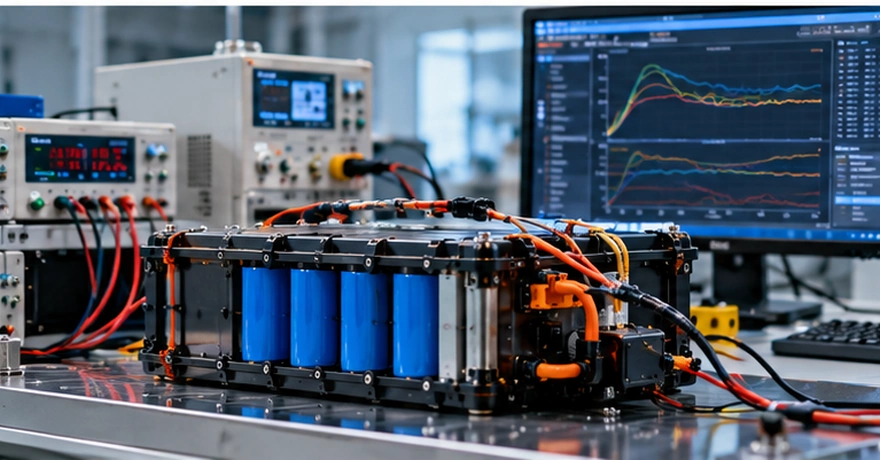
Internal battery temperatures are influenced by operating load, cell internal resistance, electrical connection resistance, BMS power consumption, and heat dissipation conditions.
Even when ambient temperature remains constant, temperatures may vary between cells, around electrical connections, and across electronic components.
Engineers should select appropriate temperature measurement locations based on design risks and record temperature changes under the agreed continuous loads, dynamic loads, and environmental conditions.
The allowable charging and discharging temperature ranges should also be confirmed separately. They should not be assumed to be identical.
Test reports should document sensor locations, ambient temperature, load conditions, and test duration.
For connectors, power electronics, or cell locations that may develop localized hot spots, measurement points should be selected according to the identified design risks.
The results should then be evaluated against the applicable temperature limits.
Where appropriate, engineers may also compare temperature distributions across different prototypes or operating conditions to determine whether localized heating requires further investigation.
Battery Enclosures and Electrical Connections Require Validation
Mechanical testing generally includes external dimensions, mounting tolerances, fastening methods, insulation, cable routing, and interface compatibility.
If the equipment is exposed to vibration or mechanical shock, engineers should evaluate whether the battery mounting components, electrical connections, and insulation systems are suitable for those conditions.
For battery packs using welded or other permanent electrical connections, connection quality should not be judged solely by visual appearance.
Appropriate inspection or process validation methods should be selected according to the applicable manufacturing requirements.
Charger Compatibility Involves More Than Matching Connectors
A charger and battery pack having the same connector type does not necessarily mean their electrical parameters and charging control methods are compatible.
Engineers should verify charging voltage, current limits, charge termination conditions, temperature controls, and other relevant functions.
If the equipment must operate while charging, the power management behavior between the external power source, battery pack, and system load should also be evaluated.
Which Safety and Transportation Tests Should Be Planned Early?
Safety requirements vary depending on battery chemistry, destination market, and intended product application.
During prototype validation, product safety testing should be distinguished from transportation-related testing.
Industrial Lithium Battery Safety Requirements
The International Electrotechnical Commission (IEC) published IEC 62619:2022 on May 24, 2022.
The standard establishes safety requirements and related tests for secondary lithium cells and batteries used in industrial applications, including certain stationary energy storage and industrial motive power applications.
Applicability must be determined according to the specific product category. Certain specialized equipment may be subject to other applicable standards.
It is important to recognize that industrial applications, portable equipment, road vehicles, and other specialized product categories may have different battery safety requirements.
Engineering teams should determine the applicable standards based on product classification, operating conditions, and target markets.
The use of lithium-ion chemistry alone does not establish whether a particular standard applies.
Testing under IEC 62619 also does not replace every system-level safety evaluation that may be required for finished equipment.
UN 38.3 and Battery Transportation Documentation
The U.S. Department of Transportation’s Pipeline and Hazardous Materials Safety Administration (PHMSA) updated its lithium battery test summary guidance in July 2024.
The guidance addresses design testing and test summary requirements associated with Section 38.3 of the United Nations Manual of Tests and Criteria, commonly referred to as UN 38.3.
UN 38.3 primarily addresses lithium battery transportation safety.
Applicable design testing and transportation documentation requirements depend on the battery configuration and relevant shipping regulations.
Certain prototype batteries that meet specified conditions may qualify for special provisions under applicable transportation regulations.
However, these provisions should not be interpreted to mean that all engineering prototypes are exempt from testing or can be shipped without meeting applicable requirements.
Buyers should identify shipping methods, destination markets, prototype status, and relevant documentation requirements early in the project.
In addition, completing applicable transportation design tests does not establish that a battery pack meets every application-specific safety requirement or production acceptance criterion.
If the cell configuration, protection devices, electrical connections, or related software are subsequently changed, the engineering team should evaluate whether previous transportation test conclusions remain applicable and whether additional testing or updated documentation is necessary.
How Can Engineers Determine Whether a Tested Prototype Is Ready for Mass Production?
Prototype functional validation and manufacturing process validation address different engineering questions.
Engineering prototype testing primarily determines whether a battery pack design meets the product requirements.
Pilot production focuses on whether manufacturing processes can repeatedly produce conforming battery packs under agreed production conditions.
Table 2. Production Release Checklist: From Battery Prototype to Mass Production
| Review Item | What Must Be Confirmed | Supporting Evidence |
| Technical Specifications | Voltage, capacity, load, dimensions, and interface requirements | Approved technical specifications |
| Design Verification | Required tests completed and results meet acceptance criteria | Test records and issue resolution status |
| Critical Components | Cell, BMS, connector, and other component models and revisions | Approved BOM |
| Manufacturing Processes | Assembly, electrical connections, insulation, and testing methods | Pilot production and process validation records |
| Software Revision | BMS firmware and communication configuration | Revision records and functional validation |
| Quality Control | Inspection items, acceptance criteria, and traceability methods | Approved inspection documents |
| Change Management | Open issues, material substitutions, and design changes | Change assessments and approval records |
| Production Release | Project meets the agreed conditions for starting mass production | Approved production release decision |
Table 2 Note: This checklist provides a general framework for engineering validation and project management. Actual approval procedures should be established according to application risks, customer requirements, and applicable regulations.
Engineering prototype testing primarily verifies the product design.
Pilot production evaluates whether critical manufacturing processes, material controls, and inspection methods are suitable under the agreed production conditions.
After mass production begins, appropriate process monitoring, finished-product inspections, or sampling verification should continue according to the product risks and quality plan.
Design verification, pilot production validation, and routine production testing serve different purposes.
They should not automatically use the same sample quantities or testing frequencies.
Destructive safety tests and long-duration life tests, for example, require separately defined sample plans and execution arrangements.
Such tests should not be assumed to apply to every battery pack produced during mass production.
Can a Small Number of Prototypes Demonstrate Mass Production Consistency?
A small number of engineering prototypes cannot, by itself, establish the consistency of future production batches.
Engineering prototypes may be assembled using different tooling, manufacturing conditions, or processes from those intended for mass production.
During pilot production, manufacturers should evaluate material consistency, electrical connection quality, insulation assembly, BMS configuration, and finished-product inspection methods according to the actual manufacturing process.

If different cell batches or substitute components are introduced, their impact on previous validation results should also be assessed.
Is Retesting Required After Changing Battery Cells or the BMS?
An engineering change impact assessment should be performed before determining the necessary retesting scope.
Even when substitute battery cells have the same nominal voltage and rated capacity, they may differ in internal resistance, dimensions, thermal behavior, and allowable charging or discharging conditions.
Similarly, changes to BMS hardware, protection components, or firmware may affect protection responses and communication behavior.
Whether all or part of the validation testing must be repeated depends on the specific change, existing verification evidence, and applicable requirements.
What Prototype Testing Documents Should OEM Buyers Request from Battery Manufacturers?
Test documentation should allow buyers to understand what was validated, under which conditions testing was performed, and whether the results met the agreed acceptance criteria.
Depending on the project agreement, buyers should consider requesting the following documentation:
-
Battery pack technical specifications and approved revisions.
-
Engineering prototype identification numbers, critical components, and firmware revisions.
-
Test plans, test conditions, and acceptance criteria.
-
Electrical, BMS, thermal, and system integration test records.
-
Test anomalies, root-cause analysis, and corrective action results.
-
Applicable safety and transportation test documentation and its current status.
-
Incomplete validation activities and plans for outstanding testing.
For projects involving long-term cycle life, storage, or reliability requirements, the documentation should distinguish between completed testing and evaluations that remain ongoing.
Incomplete tests should not be marked as passed, and short-term test results should not be presented as proof of long-term service life.
For engineering prototypes that exhibit abnormal behavior, test records should retain the prototype identification number, test conditions, observed issue, root-cause analysis, and corrective action status wherever practical.
If corrective actions involve changes to battery cells, BMS components, electrical connections, or firmware, the revised prototype configuration should be documented.
The engineering team should then determine which validation activities must be repeated based on the impact assessment.
Before accepting engineering prototypes, buyers should confirm that the delivered units match the design revision documented in the test reports.
During formal acceptance, the delivered prototypes, test reports, and approved design revision should be traceable to one another.
Previous test results should not be used to support a revised design that has not undergone the required validation.
These practices can help reduce technical disagreements during pilot production and mass production.
Frequently Asked Questions (FAQ)
What Tests Are Required for a Custom Battery Pack Prototype?
Custom battery prototype testing typically includes electrical performance, capacity, load output, BMS protection, charger compatibility, thermal behavior, mechanical integrity, and system-level operation, depending on the intended application.
The specific test plan and acceptance criteria should be established before prototype manufacturing. The same checklist should not automatically be applied to every battery pack design.
What Is the Difference Between Custom Battery Prototype Testing and Production Testing?
Engineering prototype testing primarily validates the product design and its compatibility with the intended application.
Production testing focuses on identifying manufacturing defects and maintaining batch quality control according to approved manufacturing processes and inspection requirements.
The two activities may use different testing scopes, sampling methods, and acceptance criteria.
Does a Battery Prototype Need Runtime Testing After Passing Capacity Tests?
Runtime testing is generally still necessary when required by the application.
Capacity test results depend on discharge current, temperature, and cutoff conditions. Actual equipment runtime may also be affected by changing loads, BMS power consumption, and the system’s power management behavior.
System-level runtime validation helps determine whether the battery meets the equipment’s operating requirements.
Should BMS Protection Functions Be Tested During the Prototype Stage?
BMS protection functions should be validated according to the product’s technical requirements and identified risks.
In addition to protection thresholds, engineers should evaluate response behavior, fault states, recovery logic, and compatibility with actual operating loads.
Tests involving hazardous conditions should be performed by qualified personnel or facilities with appropriate safety controls.
Does Passing UN 38.3 Mean a Battery Pack Is Ready for Mass Production?
No. UN 38.3 primarily addresses transportation-related design testing requirements.
It does not replace battery pack functional validation, equipment-level safety assessment, or manufacturing process validation.
Production release should be based on the project’s approved technical and manufacturing requirements.
Can a Custom Battery Pack Enter Mass Production Immediately After Prototype Testing?
Passing prototype functional tests alone does not establish mass production readiness.
Depending on the project’s risks and agreed requirements, the manufacturer and customer must also evaluate critical components, manufacturing processes, pilot production results, inspection standards, and revision control.
A production release decision should be supported by the required validation evidence and approvals.
Conclusion: Battery Prototype Testing Should Produce Traceable Engineering Evidence
Custom battery prototype testing is not simply about confirming whether a battery works.
It should establish whether the design meets its technical requirements under the intended load, environmental, and equipment operating conditions.
Electrical performance, BMS functionality, thermal behavior, mechanical integrity, charging, and system compatibility should be validated according to project risks, with the relevant test conditions and results documented.
Before moving into mass production, buyers and manufacturers should also confirm design revisions, pilot production processes, inspection standards, and any unresolved technical issues.
Clearly defined acceptance criteria, documented test evidence, and effective engineering change control help make development decisions more traceable.
They can also help reduce repeated validation work and design rework during subsequent production stages.
About Himax Electronics
Himax Electronics specializes in customized battery and power solutions for complex applications worldwide. Its products and services include proprietary lithium-ion battery packs, power supplies, chargers, and related accessories for industrial equipment, robotics, medical electronics, energy storage, and smart devices.
The company supports OEM/ODM battery design, component selection, BMS integration, and manufacturing solution development. Prototype validation and production arrangements are discussed according to each project’s technical requirements.
To discuss custom battery pack design and engineering prototype testing requirements, visit Himax Electronics Custom Battery Solutions and share your equipment specifications, operating conditions, and project requirements.