Cabin Solar Generator vs. LiFePO4 Battery Bank: Cost, Runtime, Expansion
Commercial Summary: HiMAXBATT evaluates cabin power systems from a battery manufacturing perspective. This guide separates product claims from system requirements, using illustrative calculations and compatibility checks to support informed purchasing and installation decisions.
Key Takeaways
-
A solar generator usually means a portable power station with an integrated battery, inverter, and charging controls. A LiFePO4 battery bank is an energy storage component that typically needs additional equipment.
-
These are not mutually exclusive choices: a solar generator may contain LiFePO4 cells. The practical comparison is between an integrated portable solution and a system with separate components.
-
Compare costs at equivalent usable energy, continuous output power, and solar charging capability. Comparing a complete power station with a battery-only price can be misleading.
-
Actual cabin runtime depends on daily energy use, usable capacity, conversion losses, and standby consumption. Cloudy-weather performance also depends on solar replenishment and backup power.
-
An integrated solution may suit occasional weekend visits and mobile use. A separate-component LiFePO4 system may suit full-time occupancy, permanent wiring, and planned expansion.
An off-grid cabin still needs dependable power for lighting, refrigeration, a water pump, and internet equipment. When choosing a setup, many owners face the same question: should they buy a solar generator or build an off-grid system around a LiFePO4 battery bank?
From a battery manufacturing perspective, the answer involves more than capacity and purchase price. Load characteristics, discharge capability, charging conditions, installation, and ongoing maintenance all matter. This guide compares cost, runtime, and expandability around practical cabin power requirements to help you evaluate both options.
What Is the Difference Between a Solar Generator and a LiFePO4 Battery Bank?
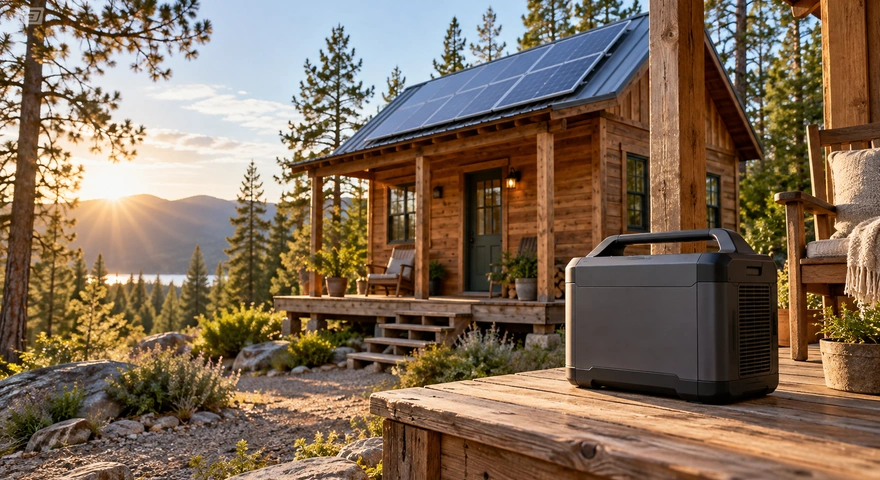
In this article, “solar generator” refers to a portable power station paired with solar panels, not a fuel-powered generator.
These units typically combine a battery, battery management system (BMS), inverter, charging electronics, and output ports in one enclosure. Check the package details to confirm whether solar panels are included in the price.
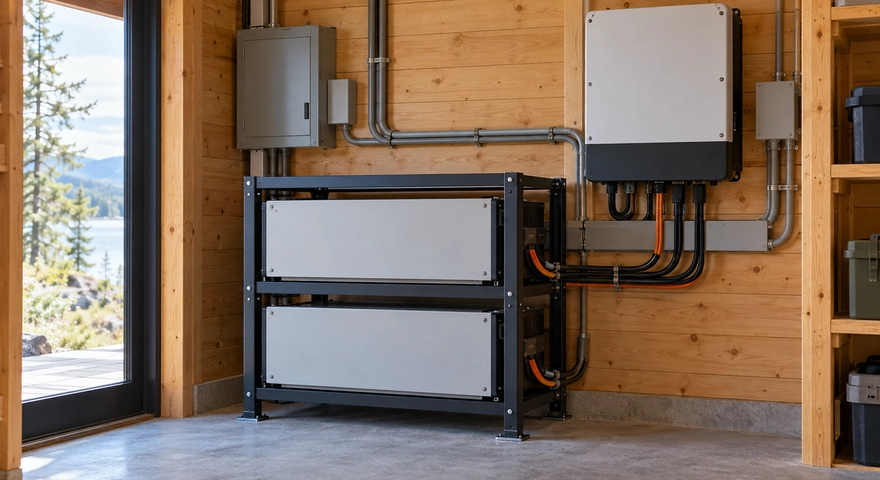
A LiFePO4 battery bank stores energy and supplies DC power. It does not replace a complete AC power system. Running AC appliances in a cabin usually also requires an inverter, solar charge controller, protective devices, and electrical distribution equipment. Some of these functions can be combined in a hybrid inverter.
| Comparison | Solar Generator Setup | Separate-Component LiFePO4 System |
| Basic design | Battery, inverter, and charging functions are usually integrated | Battery, inverter, charging, and distribution equipment are configured separately |
| Battery chemistry | May use LiFePO4 or another lithium-ion chemistry | Uses LiFePO4 batteries |
| Power connections | Loads connect through the unit’s built-in outlets and ports | Can be designed to supply permanent electrical circuits |
| Installation work | Usually limited when using built-in outlets | Requires system design, wiring, and commissioning |
| Portability | Depends on total weight, dimensions, and handling features | Generally better suited to permanent installation |
| Expansion | Limited by approved expansion batteries, ports, and supported quantities | Limited by battery, BMS, inverter, and wiring specifications |
| Repairs | Depend on the manufacturer’s service policy and replaceable modules | Individual components, such as batteries and inverters, may be replaced separately |
The choice between a solar generator and a LiFePO4 battery bank is therefore a comparison of system designs, not simply two battery chemistries.
How Much Power Does a Cabin Need? Start With Your Loads
Size a cabin energy storage system around actual electricity use rather than floor area alone.
A small cabin with electric heating, an electric water heater, and an induction cooktop may consume substantially more energy than a cabin using only lighting, refrigeration, and internet equipment.
Use this preliminary daily energy calculation:
Daily energy use (kWh) = average appliance power (W) × hours of use per day ÷ 1,000
The following example uses assumed values, not guaranteed consumption figures for specific appliances:
| Appliance | Assumed Average Power | Daily Operating Time | Daily Energy Use |
| LED lighting | 30W total | 5 hours | 0.15kWh |
| Refrigerator | 40W averaged over the day | 24 hours | 0.96kWh |
| Router and communications equipment | 15W | 24 hours | 0.36kWh |
| Laptop | 60W average | 3 hours | 0.18kWh |
| Water pump | 300W | 0.3 hours total | 0.09kWh |
| Total | — | — | 1.74kWh |
A refrigerator’s compressor does not run continuously all day. The 40W figure is an assumed daily average; multiplying the nameplate running wattage by 24 hours may misrepresent consumption. Use the appliance’s energy label or readings from a plug-in energy meter when possible.
Also check simultaneous running loads and startup surges separately. A refrigerator and water pump starting together may place greater demands on the inverter and battery than average consumption suggests.
Comparing Costs: Evaluate Complete Systems, Not Battery-Only Prices
A solar generator’s price usually includes some power conversion and control equipment. A LiFePO4 battery quote may cover only the battery pack. Comparing these prices directly can understate the cost of a separate-component system.
A more useful comparison starts with equivalent usable energy, continuous AC output, solar charging capability, and installation scope. Then request quotes for both complete setups.
| Cost Item | What to Check for a Solar Generator | What to Check for a Separate-Component LiFePO4 System |
| Energy storage | Main unit and any required expansion batteries | Battery bank, BMS, and connection hardware |
| Power conversion | Built-in inverter output rating and specifications | External inverter or hybrid inverter |
| Solar charging | Whether a controller is included and its input limits | MPPT controller or the equivalent hybrid inverter function |
| Solar panels | Whether panels, mounts, and cables are included | Modules, mounting hardware, combining equipment, and connections |
| Protection and distribution | Extra equipment needed for permanent circuit connections | Fuses, disconnects, cables, and distribution equipment |
| Installation and commissioning | Costs differ between plug-in use and permanent connection | Design, installation, configuration, and commissioning |
| Future repairs | Whole-unit service, shipping, and downtime | Component replacement and recommissioning |
| Expansion | Approved expansion batteries and connection costs | Additional batteries and potential wiring or equipment upgrades |
Initial complete-system cost = energy storage + inverter and charging equipment + solar panels + protection and distribution + installation and commissioning
If you already own compatible solar panels, an inverter, or an MPPT charge controller, the cost of adding a LiFePO4 battery bank will differ. Existing equipment still needs to be checked for voltage, charging settings, and communication compatibility.
For long-term use, consider maintenance, replacement, and downtime as well. Cell cycle-life ratings alone do not establish the service life of the whole system. Inverters, fans, connectors, and control modules have their own operating and service requirements.
Comparing Runtime: Equal Rated Capacity Does Not Guarantee Equal Operating Time
When comparing cabin battery runtime, distinguish nominal energy from the energy your loads can actually use.
A preliminary calculation is:
Usable AC energy ≈ nominal battery energy × planned usable fraction × inverter efficiency
Then account for equipment self-consumption over the operating period and any losses not already included. Avoid subtracting losses twice if the manufacturer’s published usable-energy figure already includes them.
For a system with 5.12kWh of nominal battery energy, assume:
-
A planned usable fraction of 90%.
-
Inverter efficiency of 90%.
-
An inverter operating continuously with assumed average self-consumption of 15W.
The preliminary usable AC energy is:
5.12 × 90% × 90% = 4.15kWh
Daily equipment self-consumption is approximately:
15 × 24 ÷ 1,000 = 0.36kWh
Using this simplified accounting method, estimated runtime without recharging is:
| Daily AC Load Energy | Daily Energy Including Assumed Self-Consumption | Estimated Runtime Without Recharging |
| 1.0kWh | 1.36kWh | About 3.1 days |
| 1.74kWh | 2.10kWh | About 2.0 days |
| 3.0kWh | 3.36kWh | About 1.2 days |
These figures illustrate the calculation method only. Results depend on whether self-consumption is measured on the DC or AC side, how inverter efficiency changes with load, battery temperature, and aging.
Both solar generators and separate-component systems have losses. Compare measured usable energy under similar loads, temperatures, output modes, and shutdown conditions rather than relying only on the Wh rating on the packaging.
Can Solar Panels Keep an Off-Grid Cabin Powered Continuously?
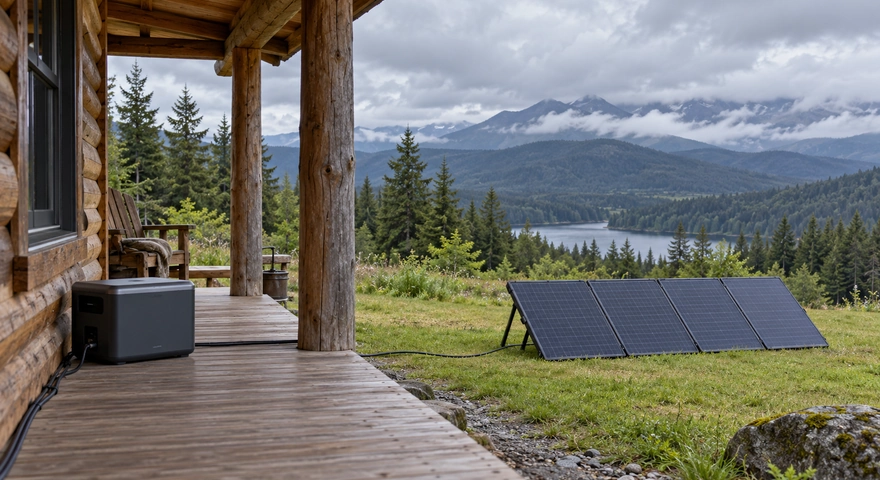
A solar panel’s rated output is not the power it delivers continuously throughout the day. Daily energy production depends on sunlight, season, panel angle, shading, temperature, and system losses.
The U.S. Department of Energy’s Solar Energy and Storage Basics explains how storage saves solar energy for later use. For a cabin, this means calculating both how much energy can be replenished during the day and how long stored energy can last without effective charging.
For a preliminary estimate:
Daily replenished energy ≈ rated solar array power × equivalent peak sun hours × overall derating factor
For an 800W array with an assumed overall derating factor of 0.75:
| Assumed Equivalent Peak Sun Hours | Estimated Daily Replenished Energy | Implications for Cabin Power |
| 1.5 hours | About 0.90kWh | Battery charge will decline from day to day if consumption exceeds this amount |
| 3 hours | About 1.80kWh | Check loads, equipment self-consumption, and charging losses |
| 5 hours | About 3.00kWh | Surplus energy may be available, subject to battery charging capability and remaining storage capacity |
Equivalent peak sun hours are not the same as daylight hours. The 0.75 factor is also an assumption. If your energy production estimate already includes a particular loss, do not deduct it again.
For full-time off-grid living, check energy balance during the lower-sunlight season and extended cloudy periods. More battery capacity can extend runtime without charging, but it cannot resolve a persistent shortfall between generation and consumption.
For critical loads that must keep running, plan backup charging or a way to reduce nonessential electricity use.
Comparing Expandability: More Batteries Do Not Automatically Mean More Power
Evaluate storage capacity, output power, and solar charging capability separately. These are three different aspects of expansion.
| Expansion Goal | Solar Generator Setup | Separate-Component LiFePO4 System |
| Longer runtime | Check support for approved expansion batteries and permitted quantities | Check permitted parallel configurations, capacity limits, and communication requirements |
| More appliances running at once | Adding batteries usually does not increase inverter rated output | May require an inverter upgrade and changes to electrical distribution |
| More solar panels | Limited by solar input voltage, current, and power ratings | Additional controller capacity may be possible, subject to system design |
| Permanent circuit connection | Check manufacturer support and connection requirements | Circuits and protection can be designed around the intended loads |
| Batteries from another manufacturer | Usually restricted by proprietary ports and protocols | Charging settings, communication, and protection coordination still need verification |
| Future maintenance | Depends on available modules and service policies | Components may be serviced separately, with appropriate technical expertise |
For example, adding batteries to a system with a 2kW continuous-output inverter may extend runtime. It does not establish that the system can continuously supply a 3kW load.
Likewise, parallel battery expansion involves more than connecting positive terminals together. Battery model, condition, voltage difference, branch protection, cable length, and communication settings must meet the manufacturer’s requirements.
Which Specifications Matter From a Battery Manufacturing Perspective?
Whether you choose an integrated or separate-component system, design and validation from the cell level through the finished pack affect real-world performance.
Continuous Battery Discharge Capability
For a 3kW AC load, assuming 90% inverter efficiency and a battery operating voltage of 48V, estimated DC current is:
3,000 ÷ 90% ÷ 48 ≈ 69A
At 44.8V, current rises to about 74A. Battery and BMS selection should therefore account for low state of charge and temperature-dependent output limits, not just current calculated at nominal voltage.
Cold-Weather Charging and Temperature Management
Cabins in mountain regions or cold climates need particular attention to battery location and winter charging conditions.
LiFePO4 charging and discharging temperature limits often differ. Verify low-temperature charging protection, heating features, and heater energy use. An insulated enclosure can slow temperature changes, but it cannot continuously warm a battery without a heat source.
BMS and Inverter Protection Coordination
The BMS needs to monitor individual cell voltage, temperature, and current. For systems using communication, verify protocol compatibility between the BMS and inverter.
Where supported, the system should provide warnings or limit power as it approaches protection thresholds, reducing the chance of a battery disconnect during normal operation. Do not disable protection to keep power flowing.
Test Documentation and Warranty Terms
| Item to Review | What to Confirm With the Supplier |
| Capacity testing | Test temperature, charge and discharge rates, and cutoff conditions |
| Cycle life | Depth of discharge, temperature, cycling rate, and capacity-retention criteria |
| Continuous output | Applicable ambient temperature, operating duration, and derating conditions |
| Protection functions | Trip conditions, reset procedures, and fault logging capability |
| Warranty coverage | Duration, energy-throughput limits, capacity terms, and permitted applications |
| Test documents | Whether they cover the purchased model, configuration, and application |
Read cycle-life figures together with their test conditions. A high cycle count alone does not establish how many years a battery will serve a particular cabin.
Which Power Setup Fits Your Cabin?
| Cabin Use | Option to Evaluate | Key Considerations |
| Occasional weekend stays with light loads | Solar generator | Integrated equipment can simplify transport and temporary connections |
| Power shared between a cabin, vehicle, and outdoor activities | Solar generator | Check weight, handling, and available ports |
| Full-time occupancy with continuous refrigeration and internet | Separate-component LiFePO4 system | Can be designed around permanent loads and charging conditions |
| Compatible solar and inverter equipment already installed | Separate-component LiFePO4 system | Existing equipment may be reusable after compatibility checks |
| Future additions such as a water pump, tools, or more storage | A system with a defined expansion path | Check how storage capacity, output power, and solar input can each be increased |
| Cold winters or long unattended periods | A setup with appropriate environmental management and monitoring | Temperature protection, standby consumption, and fault response matter more than appearance |
The Australian government’s energy information platform explains in its solar system design considerations that batteries store solar energy for use when sunlight is unavailable. In practice, evaluate solar generation, storage, and loads together rather than simply buying a larger battery.
If the cabin uses electric space heating, electric water heating, or high-power cooking appliances, assess those loads separately. Better insulation, adjusted usage schedules, or alternative ways to meet some energy needs may help control system size more effectively than adding battery capacity alone.

Cabin Solar Power and LiFePO4 Battery FAQ
Do Solar Generators Use LiFePO4 Batteries?
Some do, while others use different lithium-ion chemistries. Check the specific model’s data sheet. “Solar generator” describes the product format, not its battery chemistry.
Is a 5kWh Battery Enough to Power a Cabin for One Day?
It depends on daily energy use. If appliances consume about 2kWh per day and the system meets running-power and startup requirements, a battery with 5kWh of nominal energy may be worth evaluating. Account for unavailable capacity, conversion losses, equipment self-consumption, and the required reserve.
Can a LiFePO4 Battery Bank Power a Refrigerator Directly?
An AC refrigerator generally needs a compatible inverter. A battery bank supplies DC power and cannot connect directly to a conventional AC refrigerator. For a DC refrigerator, verify input voltage range, circuit protection, and wiring requirements.
Will More Solar Panels Shorten Charging Time?
Additional solar capacity may improve charging when sunlight is adequate and controller voltage, current, and power limits are respected. Charging is also limited by allowable battery charging current, temperature, and state of charge. Do not assume charging speed increases in direct proportion to panel wattage.
Can I Connect Batteries of Different Capacities or Ages in Parallel?
Follow the manufacturer’s approved configurations. Differences in internal resistance, capacity, BMS design, and state of charge can affect current sharing and protection behavior. Verify compatibility before expansion; matching nominal voltage alone is not enough.
How Should I Store Cabin Batteries Over an Unoccupied Winter?
Follow the manufacturer’s storage state-of-charge guidance and check whether loads should be disconnected or periodic inspections and charging are required. Inverters, communications modules, and monitoring devices can continue consuming energy. Include these loads in any long-term unattended storage plan.
Can a Portable Solar Generator Connect Directly to a Cabin’s Electrical Panel?
Consider this only if the product supports the intended connection and the installation includes the transfer equipment, protection, and grounding required by local electrical rules. Do not backfeed permanent wiring through an ordinary wall outlet. Have permanent connections completed by a qualified electrical professional.
Can the System Supply Loads While Charging?
Many systems support this, but their capabilities differ. Check simultaneous input and output operation, continuous power limits, temperature behavior, and net battery charging power. If loads consume more than the incoming power, battery charge can still decline while the unit shows charging activity.
HiMAXBATT: Evaluate Battery Configurations Around Your Cabin’s Needs
HiMAXBATT focuses on matching batteries to their intended applications. When evaluating HiMAXBATT LiFePO4 batteries for an off-grid cabin, provide daily energy use, simultaneous running loads, refrigerator or pump startup requirements, target backup duration, solar configuration, inverter model, and installation temperatures. Use these details to review battery capacity, continuous discharge capability, BMS protection, communication interfaces, and expansion limits. This creates a clear basis for system configuration. Product compatibility, test documentation, warranty coverage, and supply scope are subject to the technical specifications and contract terms agreed upon by both parties.