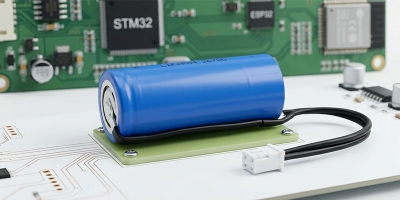
6.4V 9Ah LiFePO4 Battery Pack for Desert IoT Nodes
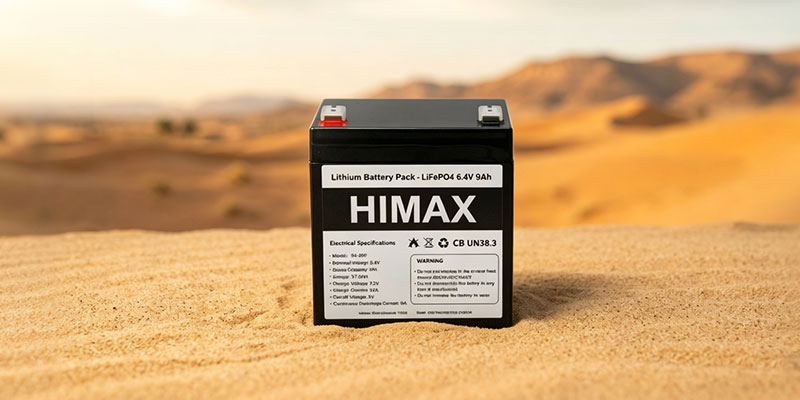
The Definitive Buyer’s Guide for B2B Engineers & Product Developers
Introduction: Why Power Is the Hardest Problem in Desert IoT
Deploying wireless sensor nodes in arid and desert environments — whether for soil moisture monitoring, groundwater level sensing, wildlife activity detection, or boundary fence status — is no longer a frontier challenge in connectivity or firmware. The hardest unsolved problem remains reliable, maintenance-free power.
Desert deployments face a brutal convergence of conditions: ambient temperatures that swing from below freezing at night to over 55 °C (131 °F) at noon, intense UV exposure, wind-blown particulates, and unpredictable solar irradiance. Standard lead-acid batteries fail within one or two seasons. Generic lithium cells with inadequate BMS protection enter thermal runaway. Alkaline primary cells make remote firmware updates uneconomical.
This guide is written for B2B engineers, hardware product managers, and IoT terminal developers who need a battery solution — not a battery datasheet. We cover the chemistry, the design rationale, real-world failure modes, integration considerations, and the specific advantages of a purpose-built 6.4V 9Ah LiFePO4 pack optimized for desert field deployments.
Why LiFePO4 — and Not NMC, LCO, or Lead-Acid?
Battery chemistry is not one-size-fits-all. Here is a direct comparison relevant to outdoor IoT applications:
| Chemistry | Cycle Life | Thermal Stability | Voltage Stability | Cost/Wh |
| LiFePO4 (LFP) | 2,000–4,000+ | Excellent (no thermal runaway) | Flat plateau | Moderate |
| NMC / NCA | 500–1,500 | Poor (runaway risk >60 °C) | Sloping | Moderate–High |
| LCO (phone cells) | 300–500 | Very Poor | Sloping | High |
| Lead-Acid (SLA) | 200–500 | Good but heavy | Sloping | Low |
| Alkaline Primary | N/A (one-use) | Good | Declining | High (TCO) |
| Key Insight: LiFePO4’s olivine crystal structure is inherently stable at elevated temperatures. Even at 60 °C — a realistic internal temperature in a sealed enclosure under direct desert sun — LFP cells do not enter thermal runaway. NMC cells in identical conditions can enter runaway above 150–200 °C internal cell temperature, which can be reached far faster than most engineers expect in a poorly ventilated housing. |
Product Specifications: Himax 6.4V 9Ah LiFePO4 Pack
The following specification table reflects the exact configuration available from Himax Electronics (Pack Model: 2S2P, Cell: 26700-B400 / 32700-B000 series):
| Nominal Voltage | 6.4 V (2S configuration) |
| Capacity | 9 Ah (57.6 Wh) |
| Cell Configuration | 2S2P |
| Cell Model | 26700-B400 (LiFePO4) |
| Max Charge Current | 1.8 A (solar MPPT compatible) |
| Max Continuous Discharge | 9 A |
| Protection Board (BMS) | Standard PCB protection included |
| Connector Type | 2-terminal (positive + negative) |
| Max Dimensions | 90 × 72 × 109 mm |
| Operating Temperature | –20 °C to +60 °C discharge; 0 °C to +45 °C charge |
| Label / Branding | HIMAXBATT | LiFePO4 6.4V 9Ah 57.6Wh | Made in China 32580001 |
| Enclosure | Black ABS housing with waterproof vent |
| Cell Support Frame | Optional |
| Waterproof Rating | IP rating per waterproof vent design |
| Application | Desert IoT / Remote Sensor Nodes |
| Target Region | USA |
| MOQ / Lead Time | Contact Himax Electronics for pricing |
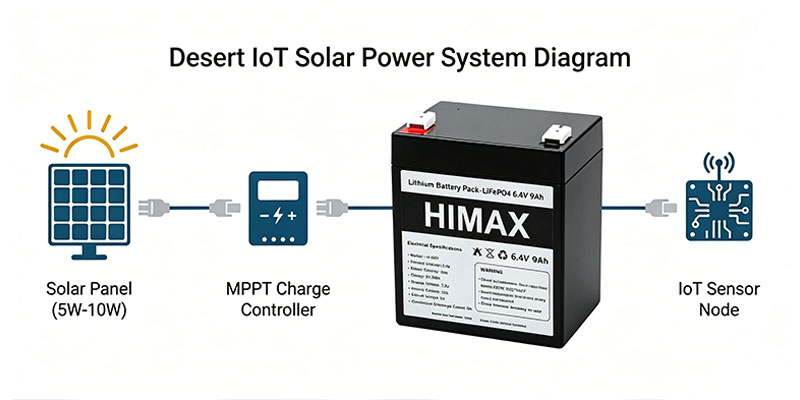
Solar Panel Integration: Matching the Charge Current
The majority of desert IoT deployments use small-format solar panels (5W–20W) with an MPPT charge controller. The 6.4V 9Ah pack is designed for direct compatibility with these systems.
Important design parameters to communicate to your solar system vendor:
- Max charge current: 1.8 A. Do not exceed without confirming with Himax Electronics.
- Charge voltage cutoff: 7.3 V (2 × 3.65 V per LFP cell). Overvoltage protection is built into the BMS, but your charge controller should be set correctly.
- Float / maintenance voltage: 6.6–6.8 V is typical for LFP 2S in field use.
- Low-temperature charge cutoff: The BMS will block charging below 0 °C to prevent lithium plating. Ensure your controller handles this gracefully.
| Engineer’s Note: LFP’s flat discharge curve (approximately 3.2V per cell across 90% of capacity) is a significant advantage for IoT devices that rely on battery voltage for power-good or low-battery signals. Unlike NMC or SLA, the voltage reading is not a reliable state-of-charge proxy; use coulomb counting in your firmware if fuel gauging is required. |
Real-World Application Scenarios
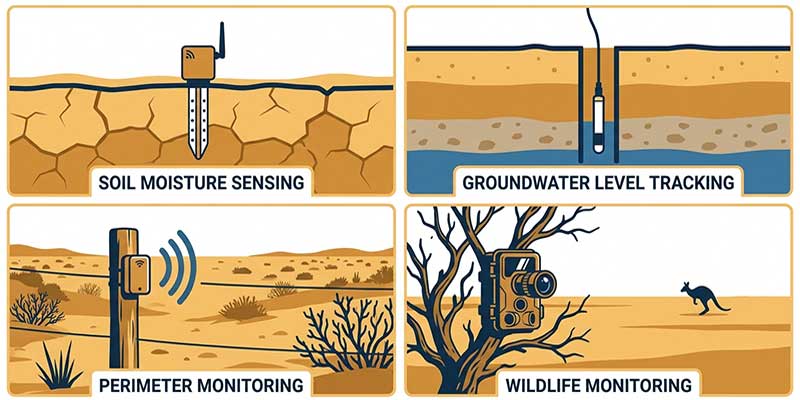
Below are four representative use cases that Himax’s 6.4V 9Ah LiFePO4 pack is actively supporting or qualified for:
- Soil Moisture & Agricultural Monitoring
Remote precision agriculture operations in arid regions (US Southwest, California Central Valley, Australian outback) require soil moisture, temperature, and EC sensors that report every 15–60 minutes over LoRaWAN or NB-IoT. Typical node power draw: 2–8 mA average. At 5 mA average, a 9 Ah pack provides over 1,800 hours (75 days) of runtime without solar. With a 5W solar panel and 4 peak-sun-hours/day, nodes run indefinitely.
- Groundwater & Water Table Level Monitoring
Hydrogeological monitoring for aquifer depletion, irrigation compliance, or flood early-warning requires sensors placed in wells and boreholes — often in desert or semi-arid terrain. These nodes typically transmit once per hour or less. The key challenge is zero-maintenance operation for 3–5 year cycles. LFP’s 2,000+ cycle life at 80% depth of discharge maps to over 5 years of daily solar charge/discharge cycling.
- Boundary & Fence Status Monitoring
Ranch and wildlife reserve operators in the US are deploying wireless fence integrity sensors across thousands of kilometers of boundary. A 6.4V pack can power a sub-GHz wireless node (Semtech SX1276 LoRa class) with periodic tamper/open-circuit detection at under 10 mA average draw. With the integrated waterproof housing and desert-rated LFP cells, these nodes survive seasons without intervention.
- Wildlife Activity & Camera Trap Systems
Camera trap and PIR-based wildlife monitoring systems require burst discharge capability — a flash or cellular uplink can draw 1–3 A for 1–5 seconds, dozens of times per day. The 9 A maximum discharge rating of this pack handles these loads with significant margin while the average daily energy use remains low. LFP’s discharge plateau also ensures the MCU and modem receive stable voltage during transmission bursts.
Thermal Engineering Considerations for Desert Enclosures
A battery is only as good as its thermal environment. Placing a 6.4V LFP pack inside a sealed junction box under direct sun in the Mojave can expose it to 70–80 °C — exceeding safe charging limits. Here is what Himax recommends for thermal management:
- Enclosure color: Matte white or light gray reduces solar absorption by 30–40% vs. black.
- Orientation: Orient the enclosure so battery faces north (Northern Hemisphere) or away from the sun’s path.
- Ventilation: The Himax pack includes a waterproof breathable vent. Use an enclosure with passive convection vent panels on the underside to allow rising hot air to escape while excluding dust and insects.
- Thermal mass: Avoid thin-walled aluminum enclosures which heat and cool rapidly. Polycarbonate or GRP (fiberglass-reinforced polyester) provides better thermal buffering.
- BMS over-temperature protection: The included PCB protection will disconnect the battery if internal temperature exceeds safe limits. Design your firmware to handle unexpected power-off gracefully.
Connector, Wiring, and Integration Notes
The 6.4V 9Ah pack ships with a 2-terminal connector. The following wiring specifics apply:
- Lead wire: 100 mm from the connector to terminal end. Specify extension length at order if needed.
- External connector: One Anderson-style red (+), one 2-pin female terminal black (–). Confirm pinout with Himax before PCB layout.
- Wire gauge: Sized for up to 9 A continuous. Do not use a wire gauge lighter than the factory harness in any field extension.
- Polarity protection: The BMS includes reverse-polarity protection, but always verify polarity at integration.
- Ground plane: In LoRaWAN or NB-IoT nodes, ensure the battery negative is not connected to antenna ground without appropriate RF isolation.
How to Source the Himax 6.4V 9Ah LiFePO4 Pack
Himax Electronics is a Shenzhen-based battery manufacturer with over a decade of experience in custom lithium packs for industrial, IoT, and renewable energy applications. The 6.4V 9Ah LiFePO4 pack is available as:
- Standard product (MOQ applies): Shipped with the exact BMS, connector, label, and housing described above.
- Custom configuration: Modified cell grade, connector type, wire length, enclosure color, or BMS parameters available with engineering discussion.
- Private-label / OEM: HIMAXBATT label or customer brand print available at volume.
Explore the full IoT battery portfolio: himaxelectronics.com/iot-battery/
Smart plant sensor battery solutions:
himaxelectronics.com/smart-plant-sensors-battery/
Product page — 6.4V 9Ah custom monitoring system pack:
himaxelectronics.com/product-item/6-4v-9ah-custom-lithium-battery-pack-for-monitoring-system/
Get a quote or technical consultation: himaxelectronics.com/contact/
Conclusion: Power Your Desert IoT Deployment Right — the First Time
Selecting the wrong battery chemistry or a poorly engineered pack for a desert IoT deployment is a costly mistake — not at unboxing, but six to eighteen months into the field when cells degrade prematurely, BMS faults trigger silent data loss, or a maintenance visit costs more than the entire original hardware budget.
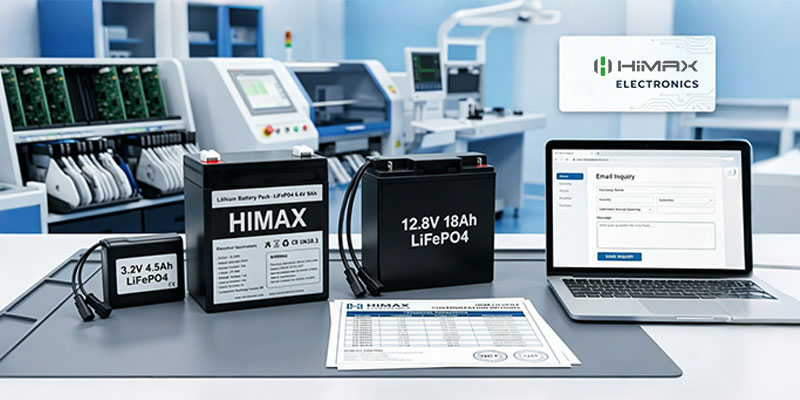
The 6.4V 9Ah LiFePO4 pack from Himax Electronics is engineered to solve exactly this problem. Designed for 2S2P LFP cells, matched to solar charge constraints, housed in a waterproof black ABS enclosure with a breathable vent, and built to the HIMAXBATT standard — this pack is the right specification for soil monitoring, groundwater sensing, fence detection, and wildlife IoT nodes operating in the US desert environment.
If you are designing a product or deploying a network that needs this level of power reliability, contact the Himax engineering team. We work directly with B2B customers to validate specifications, support firmware integration, and scale from prototype to production.