
When to Replace Golf Cart Batteries: Testing and Diagnosis Guide
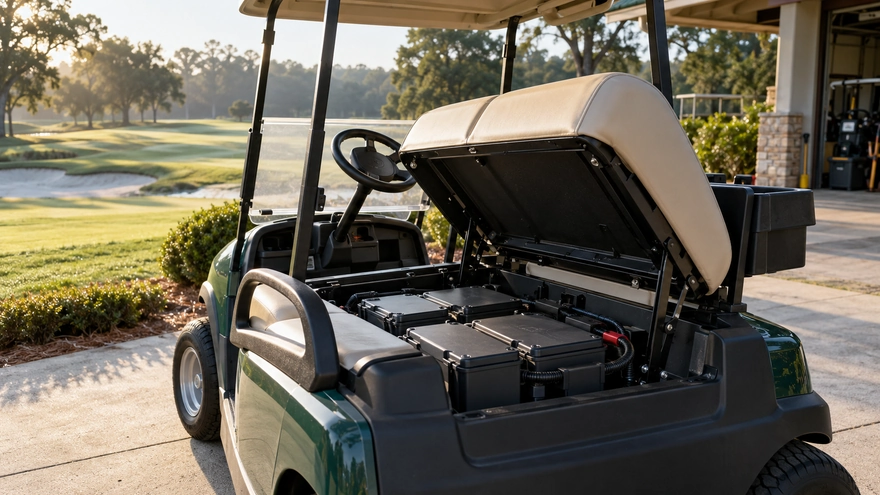
Commercial Summary: HiMAXBATT presents a manufacturing-informed framework for evaluating golf cart batteries. This guide separates measurable battery deterioration from charging and vehicle faults, supporting evidence-based replacement decisions and careful system compatibility checks.
Key Takeaways
-
Reduced range, weak hill-climbing performance, and charging problems do not automatically mean golf cart batteries need replacement. Check the charger, electrical connections, and vehicle loads as well.
-
Evaluate battery condition using service history, visual checks, charging behavior, voltage under load, and capacity testing—not age or the dashboard battery gauge alone.
-
Lead-acid and lithium iron phosphate batteries require different diagnostic methods. Electrolyte specific gravity testing does not apply to sealed lead-acid or lithium batteries.
-
For lithium batteries, battery management system (BMS) fault logs, individual cell voltages, and temperature readings help distinguish deterioration, imbalance, and protection events.
-
Replacement decisions should account for safety, measured performance, operating needs, and repair feasibility. There is no single service-life limit or voltage threshold that applies to every cart.
-
When replacing batteries, verify system voltage, charger and controller compatibility, continuous and peak current requirements, and mounting conditions.
A golf cart that once handled a full day’s work on one charge now needs a midday top-up. It runs normally on level ground but struggles on hills. Or the charger quickly reports a full charge, yet the cart barely makes it around the course. These situations often lead owners and fleet operators to consider replacing the batteries.
From a battery manufacturing and vehicle power-system perspective, however, similar symptoms can have different causes. Capacity loss, increased connection resistance, incomplete charging, low tire pressure, and dragging brakes can all affect performance. This guide covers practical checks for common lead-acid and lithium iron phosphate (LiFePO4) batteries to help you determine when repair, continued monitoring, or replacement makes sense.
Which Golf Cart Battery Symptoms Call for Inspection?
A single symptom rarely establishes the cause of a battery problem. A more useful approach is to record the state of charge, temperature, payload, and driving conditions when the issue occurs, then compare those observations with test results.
| What You Notice | Possible Causes | What to Check |
| Range keeps dropping on the same route | Capacity loss, incomplete charging, cold weather, or increased vehicle energy use | Charging records, measured capacity, operating conditions, and vehicle condition |
| Weak acceleration or hill-climbing performance | Higher battery internal resistance, connection voltage drop, or BMS/controller current limiting | Voltage under load, connections, current, and fault records |
| Sudden shutdown despite a substantial charge reading | A cell reaching its undervoltage limit, BMS protection, a poor connection, or inaccurate state-of-charge estimation | Cell data, protection logs, wiring, and gauge calibration |
| Charging takes noticeably less time | Reduced actual capacity, early charge termination, or charger malfunction | Charge delivered, termination reason, and charger output |
| Charging takes noticeably longer | Low charging current, equipment derating, or loads operating during charging | Actual charging current, temperature, and auxiliary loads |
| Charge drops quickly while parked | Vehicle standby loads, abnormal self-discharge, or a gauge error | Standby current, storage conditions, and readings recorded over time |
| Cracked casing, unusual swelling, or localized overheating | Mechanical damage, an internal fault, or a connection problem | Stop using the battery and arrange a professional inspection |
If a battery produces smoke, a sharp chemical odor, unusual heat, or severe enclosure damage, stop charging and discharging it, keep people away, and follow the vehicle and battery manufacturers’ emergency instructions. Do not continue load testing.
Should Golf Cart Batteries Be Replaced After a Certain Number of Years?
Age can indicate when an inspection is appropriate, but it should not determine replacement on its own.
Batteries of the same model can age differently depending on temperature, depth of discharge, charging practices, and maintenance. A manufacturer’s cycle-life rating also typically reflects specific test conditions. It cannot be directly converted into a guaranteed number of service years for every golf cart.
| Factor | Why It Matters | Useful Records |
| Daily driving and charge/discharge intensity | Batteries of the same age may have delivered very different amounts of energy | Mileage, operating hours, and cumulative discharged energy |
| Depth of discharge | Deeper discharges can affect aging and the frequency of protection events | Typical state-of-charge range and undervoltage records |
| Ambient temperature | Cold can temporarily limit output, while heat can accelerate aging | Operating, charging, and storage temperatures |
| Charging settings | An incompatible charge profile can cause incomplete charging or abnormal behavior | Charger model, settings, and charging logs |
| Maintenance and connections | Corrosion, loose connections, and improper maintenance can affect power delivery | Terminal inspections and maintenance history |
| Long-term storage practices | Standby loads and unsuitable storage can leave the battery deeply discharged | Storage duration, isolation method, and periodic inspection records |
A practical assessment combines how long the battery has been in service with how much energy it can still deliver, whether it can support working loads, and whether it shows any safety concerns.
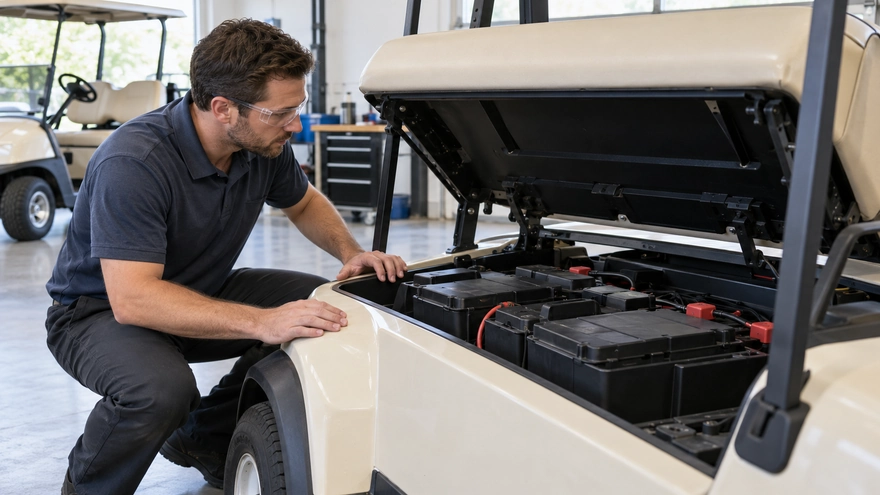
How to Test Golf Cart Batteries: Five Diagnostic Steps
Identify the Battery Type and Vehicle Configuration
Before testing, check the battery label and vehicle documentation to confirm:
-
Whether the batteries are flooded lead-acid, AGM, gel lead-acid, or LiFePO4.
-
The bank’s nominal voltage, rated capacity, and series/parallel configuration.
-
Whether the charger is approved for the battery model and chemistry.
-
Controller and motor requirements, including any modifications.
-
Whether the lithium battery supports access to BMS data and fault logs.
A cart’s designation as a “48V system” does not establish that every battery and charger marketed for that voltage class is interchangeable. Charging voltage, operating range, and communication requirements still need to be verified.
Inspect the Enclosure, Terminals, and Wiring
Loose terminals, corrosion, and poor electrical connections can create additional voltage drop and heat, producing symptoms that resemble battery aging.
Inspect the enclosure, mounting brackets, terminal insulation, and cable condition. Look for discoloration or melted material at connection points. If a connection needs tightening, use the manufacturer’s specified torque rather than continuing to tighten it by feel.
A battery bank with normal voltage can still fail to power the vehicle reliably if a connection has excessive resistance. Rule out connection problems before deciding the entire bank has reached the end of its useful service.
Work involving terminal removal or high-current circuits should be performed by qualified personnel. Do not bridge terminals with metal tools or connect a multimeter set to current mode directly across the battery terminals.
Check the Charging Process, Not Just the “Full” Indicator
A charger indicating completion only confirms that its control sequence has ended. It does not establish that the battery has recovered its rated capacity.
Assess the battery’s condition before and after charging alongside actual current, charging time, and the reason charging stopped:
| Charging Behavior | What to Distinguish | Further Checks |
| The charger quickly indicates a full charge | A battery that was already nearly full, reduced capacity, or early termination | Initial state of charge, actual charge delivered, and termination reason |
| The charger produces no output | A power-supply problem, poor connection, failed battery detection, or a protection state | Input power, plugs, fuses, communication, and alerts |
| Charging repeatedly starts and stops | An intermittent connection, temperature protection, or cell overvoltage | Connections, temperature, and BMS logs |
| Charging continues without reaching completion | Insufficient charging capability, power consumed by other loads, or a battery problem | Charging current, auxiliary consumption, and cell behavior |
Do not continue charging a damaged or frozen battery, or one outside its permitted charging temperature range. Do not bypass the BMS, raise charging voltage, or use an unapproved “activation” method to recover a lithium battery.
Compare Resting Voltage With Voltage Under Load
Resting voltage provides some information about battery condition, but it does not establish that capacity is normal.
For lead-acid batteries, surface charge after charging, rest time, and temperature affect the reading. LiFePO4 batteries have a relatively flat voltage curve, so voltage may change only modestly across a broad state-of-charge range.
A useful diagnostic test records load, current, voltage at the battery terminals, and voltage at the vehicle’s power input under comparable conditions.
| Observation | Possible Meaning | Limitations |
| Resting voltage appears normal, but drops substantially under load | Low state of charge, increased internal resistance, or a connection problem | Interpret alongside load current and temperature |
| One series-connected lead-acid battery drops noticeably below the others under load | That battery may be the weak link | Confirm its charging state and connections |
| One lithium cell reaches the undervoltage protection threshold first | Capacity differences, imbalance, or abnormal internal resistance may be involved | A single voltage-difference reading does not identify the cause |
| Battery-terminal voltage remains relatively stable, but controller-input voltage falls | Wiring, a contactor, or a connection may be causing the drop | Measure individual circuit sections to locate the problem |
Avoid using one generic voltage chart to diagnose every golf cart battery. Test current, temperature, rest time, and manufacturer thresholds all affect how readings should be interpreted.
Arrange a Controlled Capacity or Energy Test When Needed
If visual checks, connections, and charging equipment show no clear problems but range remains inadequate, a capacity test can help.
Battery Council International (BCI) describes developing and updating battery test specifications and procedures as part of its technical committee’s work. In practical diagnostics, this reinforces the need to define test methods and conditions rather than directly comparing readings taken under different conditions. Reference: BCI Committees
Follow the product’s requirements for charging, test temperature, discharge current, and discharge cutoff. For lead-acid batteries, also check the discharge-hour rate used for the capacity rating; testing at a higher current may produce a different amp-hour result.
Capacity retention = measured capacity under the specified comparable conditions ÷ reference rated capacity × 100%.
For example, a battery rated at 100Ah that delivers 78Ah under comparable specified conditions has 78% capacity retention. That does not mean every battery at this level must be replaced, nor does it establish that the battery can still meet the vehicle’s peak-current demand.
Amp-hour capacity measures electrical charge. To evaluate usable energy, record voltage throughout discharge and calculate watt-hours delivered. Perform testing under controlled conditions rather than repeatedly driving the cart until it shuts down.
How Do Lead-Acid and Lithium Battery Diagnostics Differ?
| Check | Lead-Acid Batteries | LiFePO4 Batteries |
| Electrolyte inspection | Only for serviceable flooded products | Not applicable |
| Specific gravity testing | Applicable to flooded batteries, with temperature and manufacturer guidance considered | Not applicable |
| Resting-voltage assessment | Account for surface charge, rest time, and temperature | The flat voltage curve limits voltage-only estimates of remaining capacity |
| Cell or module comparison | Compare series-connected batteries under the same load | Read individual cell voltages and temperatures through the BMS |
| Protection records | Depends on the monitoring equipment installed | Check undervoltage, overvoltage, overcurrent, temperature, and communication alerts |
| Equalization or maintenance | Whether equalization charging is permitted depends on the product | Follow the manufacturer’s cell-balancing procedure; do not use lead-acid desulfation programs |
From a manufacturing perspective, pack performance depends on more than individual cell capacity. Cell consistency, connection quality, thermal management, and protection settings also matter. One lithium cell reaching a protection threshold early can limit the entire pack, but data analysis is needed to determine why.
Users should not open lithium battery packs, replace individual cells, or bypass the protection board to continue operation.
When Do Test Results Support Replacing Golf Cart Batteries?
Use the following findings to guide the next step:
| Finding | Suggested Action | Basis for the Decision |
| Damage, abnormal heating, or another safety concern | Stop use and arrange professional evaluation for replacement or an approved repair | Safety condition and manufacturer guidance |
| A charger, wiring, or vehicle fault explains the symptoms | Repair the fault, then retest the battery | Avoid mistaking a system problem for capacity loss |
| Cold temperatures temporarily reduce performance | Retest within the permitted temperature range | Distinguish temperature effects from irreversible deterioration |
| Measured usable energy cannot support daily work | Evaluate a replacement sized for the duty cycle | Work requirements, charging opportunities, and reserve needs |
| A lithium battery repeatedly enters protection and an internal fault is confirmed | Repair or replace according to the manufacturer’s procedure | BMS logs, cell tests, and repair feasibility |
| Performance has declined but still meets demand without abnormal behavior | Continue monitoring and schedule a reassessment | Operating requirements and the rate of deterioration |
Some specifications or test programs define a particular capacity-retention level as an end-of-life evaluation criterion. That does not make it a universal replacement threshold for every golf cart. A battery with substantial remaining capacity may still struggle on hills if its power-delivery capability has declined. A lightly loaded cart used for short trips may have different range requirements.
Can You Replace Just One Battery or Switch From Lead-Acid to Lithium?
Check the Whole Bank Before Replacing One Series-Connected Lead-Acid Battery
If the bank has been in service for a long time, replacing only one battery can introduce differences in capacity, internal resistance, and charge acceptance between old and new units.
Whether a single-battery replacement is appropriate depends on the remaining batteries’ condition, manufacturer requirements, and test results. If the bank shows widespread deterioration, replacing the set generally makes it easier to manage matching concerns.
Treat a Lead-Acid-to-Lithium Conversion as a System Upgrade
Replacing lead-acid batteries with LiFePO4 requires checking more than physical dimensions.
| Compatibility Item | What to Verify |
| Voltage range | Full-charge voltage, operating voltage, and the controller’s permitted range |
| Current capability | Acceleration, hill-climbing, continuous operation, and BMS current limits |
| Charger | Charge profile, voltage, current, and communication compatibility |
| Battery gauge | Whether its state-of-charge estimation method supports lithium batteries |
| Power distribution and protection | Cables, contactors, fuses, and precharge requirements |
| Mounting | Dimensions, weight changes, brackets, and vibration protection |
| Operating environment | Water and dust protection, temperature range, and low-temperature charging limits |
After replacement, verify charging, acceleration, hill operation, and protection functions to confirm that the system works as designed.
FAQ: Golf Cart Battery Replacement and Testing
Why Is My Golf Cart’s Range Short Even Though Battery Voltage Looks Normal?
Resting voltage does not directly indicate remaining capacity. The battery may have lost capacity, experience excessive voltage drop under load, or have a cell that reaches a protection threshold early. Use controlled capacity testing and load data to investigate.
Does a Full-Charge Indicator Mean the Battery Is Healthy?
No. A charger may stop because it reaches a voltage setting, a protection event occurs, or battery detection fails. Check the actual charge delivered, the reason charging ended, and discharge performance afterward.
Can an Automotive Starting-Battery Tester Tell Me Whether Golf Cart Batteries Need Replacement?
Confirm that the tester supports the battery type and test objective. A test centered on cold cranking amps does not replace deep-cycle capacity testing. Some short-duration tests also do not show how much usable energy the battery can deliver over a full duty cycle.
Does a Sudden Lithium Battery Shutdown Mean a Cell Has Failed?
Not necessarily. Undervoltage, overcurrent, temperature, wiring, and communication problems can all cause a shutdown. Read fault logs first, then investigate cell voltages, temperature, and load conditions.
Must I Replace a Battery Below 80% Capacity Retention?
Do not treat that percentage as a universal rule. Review the product’s life-evaluation criteria, warranty terms, and your vehicle’s needs. Also assess current-delivery capability and safety condition.
Does Reduced Winter Range Mean I Need New Batteries Right Away?
Cold can temporarily reduce available energy and power. Check battery temperature and the product’s permitted operating range, then retest under appropriate conditions. Follow the specific LiFePO4 model’s low-temperature charging limits.
Can I Keep Using a Battery That Will Not Charge After Long-Term Storage?
The depth of discharge, storage duration, protection state, and battery condition need to be evaluated. Do not repeatedly force charging or bypass protection. Ask the manufacturer or a qualified service technician to follow the prescribed assessment procedure.
How Should I Dispose of Replaced Golf Cart Batteries?
Use a qualified battery recycling service and follow requirements for packaging, terminal insulation, and transportation appropriate to the battery type. Do not discard batteries in general waste or dismantle packs yourself.

Choose HiMAXBATT Batteries to Match Your Golf Cart’s Requirements
HiMAXBATT is a lithium battery manufacturing brand. When selecting a replacement golf cart battery, evaluate the model against vehicle voltage, daily driving needs, continuous and peak current, charging conditions, and installation space. Share your cart model, original battery configuration, controller and charger information, and diagnostic findings with HiMAXBATT to discuss product compatibility and replacement options. Confirm capacity, BMS features, communication, temperature limits, and relevant test documentation in the model-specific specifications and agreed technical plan, so battery selection aligns with actual operating needs.