
| Alden · Battery Engineer — Manufacturing & Quality Control
With hands-on experience in battery pack manufacturing, Alden oversees production processes, aging tests, and quality inspections — ensuring consistent performance, low defect rates, and stable supply for OEM customers. |
Choosing the wrong battery for a large robot does not usually result in a dead unit during testing. It results in a unit that runs 40% shorter than planned, throws BMS communication errors the controller cannot parse, or fails mechanically because the wire egress is on the wrong side of the enclosure. This guide covers everything a hardware engineer or procurement manager needs to evaluate a 36V 50Ah lithium pack for a large robot platform — before the first prototype is ordered.
| KEY TAKEAWAYS
• 36V (10S lithium) is the dominant voltage tier for robots drawing 500W–2,000W — wide motor driver support, no exotic BMS hardware required. • Samsung INR21700-50E cells in a 10S10P configuration deliver 50Ah / 1,800Wh with over 500 full cycles at 80% depth of discharge. • CAN BMS communication is not optional for autonomous platforms — it enables real-time SoC, fault reporting, and automated return-to-base triggers. • 60A continuous discharge supports most robot actuator and compute loads without thermal stress at nominal voltage. • Wire egress position, connector orientation, and cell bracket geometry must be locked before tooling — they drive form-factor compatibility. • Shipping at 50% SoC is a regulatory requirement for air freight under IATA DGR — verify this with your supplier before placing import orders. |
What Does a Large Robot Need from a 36V Lithium Battery for Robots?
A large mobile robot needs a battery that matches its motor voltage tier, sustains its peak actuator current without BMS throttling, communicates real-time state-of-charge to the controller, and fits mechanically inside the chassis bay. Getting any one of these wrong delays integration by weeks.
Voltage and capacity: why 36V is the industrial sweet spot
Most large mobile robots — AMRs, service robots, patrol units, and inspection platforms — run their drive systems at 24V to 48V nominal. The 36V tier (10S lithium = 42V fully charged, 30V cutoff) sits at the mechanical and thermal sweet spot: high enough to drive brushless motors efficiently, low enough to remain within common MOSFET and BMS component ratings without exotic hardware.
At 50Ah, this pack stores 1,800Wh of usable energy. That is enough to power a 500W robot platform for approximately 3 hours, or a 1,200W platform for roughly 90 minutes per charge — figures that match standard shift-length requirements in industrial deployments.
Continuous vs. peak discharge: why the numbers are not interchangeable
Robot actuators draw very differently from a steady load. Idle compute may pull 30–50W; a 6-axis arm accelerating under full load can spike to 8–10 times that figure for 200–400ms bursts. A 60A continuous rating from this pack means the BMS does not clip short burst events, while the cell chemistry handles transient demand without accelerated degradation. Always confirm that the continuous C-rate matches your worst-case actuator draw — not your average draw.
Why CAN bus BMS communication is non-negotiable for autonomous platforms
A battery without real-time communication is opaque to the robot controller — you get power and nothing else. CAN-enabled BMS allows the host system to read state-of-charge, state-of-health, individual cell voltages, pack temperature, charge/discharge current, and fault codes over a single two-wire bus. This is the foundation of any intelligent power management strategy, including dynamic throttling when pack temperature rises and automatic return-to-base when SoC drops below a configured threshold.
Form factor and mechanical fit: the constraints engineers underestimate
Unlike consumer electronics, robot battery packs must fit a defined chassis bay — often with a customer-supplied enclosure. Wire egress location, connector orientation, and cell bracket rigidity all drive compatibility. A pack that is electrically correct but mechanically incompatible adds weeks to integration. Lock these parameters in the mechanical drawing before any hardware is built.
What Are the Key Parameters for This 36V 50Ah Pack?
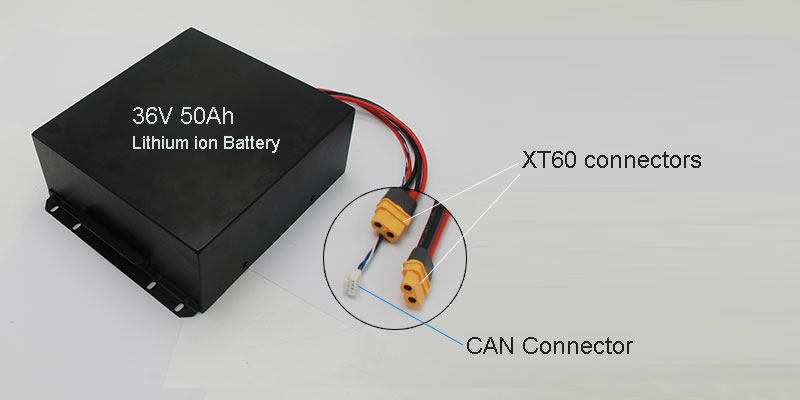
This pack uses Samsung INR21700-50E cells in a 10S10P configuration, delivering 36V nominal, 50Ah capacity, 60A continuous discharge, and CAN BMS communication. All specifications below are drawn from the verified production sheet for Himax order reference.
| Nominal voltage
36V 10S configuration |
Capacity
50Ah 1,800Wh usable energy |
Cell model
Samsung INR21700-50E Genuine, traceable batch |
Configuration
10S10P 10 series, 10 parallel |
| Max charge current
≤ 30A Solar MPPT compatible |
Continuous discharge
60A 2,160W at nominal V |
Peak discharge
No special req. BMS does not hard-clip bursts |
BMS protocol
CAN bus Real-time communication |
| Power connector
XT60 × 2 Separate charge/discharge |
Comms connector
YEONHO SMH200-04 CAN interface |
Wire length
350 ± 5.0mm Exposed from enclosure |
Shipping SoC
50% IATA DGR compliant |
| Enclosure
Customer-supplied Potted internally; top-lid fixed |
Cell bracket
Required Structural cell support |
Waterproofing
Not specified Confirm for outdoor use |
Application region
International Asia-Pacific / Korea market |
Note on solar charging: The ≤30A charge limit is directly compatible with standard 30A MPPT solar charge controllers at 36V. A 400–600W solar array can charge this pack from 20% to 100% in approximately 4–5 hours under full sun, with no additional DC-DC conversion hardware required.
How Does This Battery Perform in Real Robot Applications?
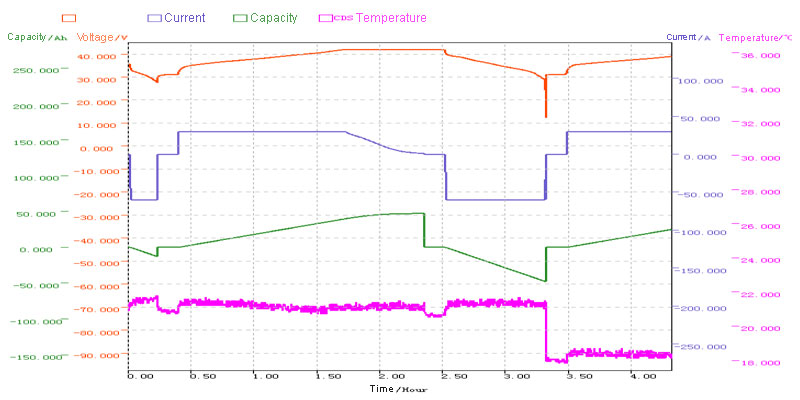
Runtime, cycle life, and charge behavior vary significantly by robot type and duty cycle. The four scenarios below use the 1,800Wh capacity of this pack against real power draw profiles, with estimated figures an engineer can plug directly into a system power budget.
Warehouse AMR and AGV robots
A mid-size autonomous mobile robot carrying 200–500kg payloads typically draws 300–600W in continuous motion. At 60A / 36V, this pack sustains full payload transport without BMS throttling. Estimated runtime is 3.0–6.0 hours per charge, supporting full shift coverage in a two-pack rotating system.
Power draw: 300–600W Runtime: 3–6 hrs Cycle life: 500+ full cycles (~18 months daily) Recommended rotation: 2 packs per unit
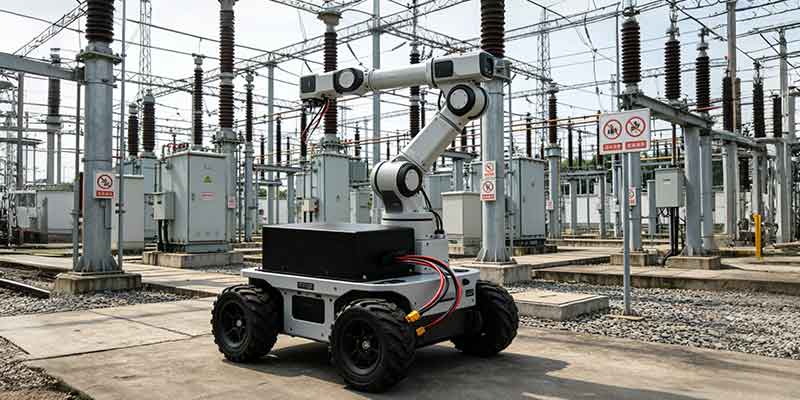
Outdoor patrol and security robots
Outdoor patrol robots running navigation, LiDAR, cameras, and 4G/5G comms typically consume 150–300W. At that draw, this 1,800Wh pack delivers 6–12 hours of autonomous patrol — well beyond a standard security shift. CAN BMS allows the central monitoring system to trigger an automatic low-battery return-to-base event, eliminating the risk of a unit stranding mid-route.
Power draw: 150–300W Runtime: 6–12 hrs Key integration: CAN auto return-to-base trigger
Industrial inspection robots (solar-charged field deployments)
Pipe, tank, and structural inspection robots often operate in burst-charge environments where a solar panel tops up the pack between inspection cycles. The ≤30A charge limit on this pack is directly compatible with common 30A MPPT solar controllers at 36V, meaning field charging with a 400–600W solar array is feasible without additional conversion hardware.
Max charge current: ≤ 30A (MPPT direct) Charge time 0→100%: ~1.8 hrs at 30A Solar array: 400–600W at 36V MPPT
Service and hospitality robots
Delivery, reception, and guidance robots in commercial environments consume 100–200W and demand near-silent operation with no thermal incidents. Samsung 50E cells maintain stable chemistry across 0–45°C ambient. The CAN BMS provides thermal fault reporting before any condition escalates, and the XT60 connector system enables sub-60-second manual pack swaps for high-uptime hospitality deployments.
Power draw: 100–200W Runtime: 9–18 hrs Pack swap time: < 60 seconds (XT60)
Which Battery Chemistry Is Right for Your Robot?
36V NMC lithium is the right choice for large mobile robots requiring high energy density, real-time BMS communication, and a compact form factor. LiFePO4 suits safety-critical outdoor deployments where cycle life outweighs weight. Lead acid is not viable for any autonomous platform with a runtime or uptime requirement.
| Battery type | Voltage | Energy density | Cycle life | CAN BMS | Best for |
| 36V Li-ion NMC ★ This pack | 36V | High | 500+ cycles | Standard | AMR, service, patrol, inspection robots |
| 24V Li-ion | 24V | Medium | 500+ cycles | Partial | Small robots, cobots |
| 48V Li-ion | 48V | High | 500+ cycles | Varies | Heavy AGV, forklift AMR |
| 36V LiFePO4 | 36V | Lower | 2,000+ cycles | Varies | Safety-critical, outdoor fixed |
| 36V Lead Acid | 36V | Low | 200–300 cycles | None | Not recommended for autonomous robots |
What Are the Most Costly Mistakes When Sourcing Robot Batteries?
The most common — and expensive — sourcing mistakes are not electrical. They are specification mismatches discovered after tooling is committed: wrong BMS protocol, wrong egress position, wrong discharge rating for the actual duty cycle. Each adds two to eight weeks to a program.
- Specifying capacity without checking continuous discharge rating. A 50Ah pack rated for only 20A continuous will BMS-throttle under a 720W load, even though the energy is present. Always confirm the C-rate against your worst-case actuator current draw, not your average system power.
- Assuming all BMS units support the same communication protocol. CAN, SMBus, RS485, and proprietary UART are not interchangeable. Lock in your robot controller’s communication stack before specifying the BMS. Retrofitting protocol adapters adds cost and latency.
- Ignoring wire egress position and connector orientation. A pack where cables exit from the bottom instead of the side can make a chassis bay completely unusable. Confirm egress point and wire direction in the mechanical drawing — not after prototypes arrive.
- Skipping cycle-life validation at your actual duty cycle. Manufacturer cycle-life specs are measured at standard discharge rates. A robot that repeatedly pulse-discharges at 3C–5C for arm movements ages cells faster. Request test data at your real duty cycle profile before volume commitment.
- Ordering at 100% SoC for international air freight. Most jurisdictions restrict lithium packs above 30–50% SoC for air cargo under IATA DGR. This pack ships at 50% SoC by default — confirm this configuration with your supplier before placing any import order.
Frequently Asked Questions
The questions below reflect what hardware engineers and procurement managers most commonly ask when evaluating a 36V 50Ah lithium pack for a large robot platform. Each answer is written to be self-contained and directly citable.
What voltage is best for large industrial robots?
For robots drawing 500W–2,000W, 36V nominal (10S lithium configuration) is the most widely supported and cost-effective voltage tier. It offers sufficient motor efficiency without the higher component cost and safety overhead of 48V or 72V systems. Smaller robots under 300W typically use 24V; heavy AGVs above 3kW move to 48V or 72V.
Can this 36V 50Ah pack be charged by a solar panel?
Yes. The maximum charge current of ≤30A at 36V is directly compatible with standard 30A MPPT solar charge controllers. A 400–600W solar array with a 36V MPPT controller can charge this pack from 20% to 100% in approximately 4–5 hours under full sun. No additional DC-DC conversion hardware is required if the controller output is matched to 36V nominal lithium chemistry.
What does CAN BMS communication enable in practice?
CAN BMS allows the robot’s main controller to continuously read: state-of-charge (SoC), state-of-health (SoH), individual cell voltages, pack temperature, charge/discharge current, and fault codes. This enables automatic return-to-base on low SoC, thermal throttling of high-current loads when pack temperature rises, and remote fleet monitoring of battery health across multiple robot units from a central dashboard.
Can Himax customize the connector type, wire gauge, and egress position?
Yes. Connector type, wire gauge, wire length, and egress position are all configurable at the design stage. The standard configuration uses XT60 for power (two connectors for separate charge and discharge lines) and YEONHO SMH200-04 for CAN communication, with 350±5mm of exposed wire. Alternatives are accommodated through a revised production drawing before tooling is committed.
How long does this battery last in a real robot deployment?
Samsung INR21700-50E cells are rated for over 500 cycles at 80% depth of discharge to 80% remaining capacity. In a robot running one full discharge cycle per day, this translates to approximately 18 months before a capacity maintenance service. In less aggressive duty cycles — for example a service robot that discharges to 40% before recharging — calendar life extends to 3 or more years.
What is the minimum order quantity for a custom pack?
Please contact Himax Electronics directly for current MOQ and lead time for your specific configuration. Custom pack projects typically begin with an engineering sample phase of 1–5 units, followed by a production run. Volume pricing tiers are available for recurring OEM orders.
Why Do Robot OEM Teams Choose Himax Electronics?
Himax Electronics combines genuine Samsung cell supply, in-house CAN BMS development, and custom mechanical form-factor capability under one roof — with manufacturing quality controlled at the engineer level, not just final inspection. The result is consistent performance, low defect rates, and stable supply for OEM customers.
- Genuine Samsung cells, traceable to batch. Every production lot uses verified Samsung INR21700-50E cells. Cell authenticity documentation is available for OEM customers on request.
- In-house BMS development with CAN protocol. BMS firmware is designed and validated internally. Protocol customization — message IDs, data frame structure, baud rate — is available without third-party dependency or additional NRE cost.
- Custom form-factor from customer CAD. We work from customer-supplied enclosure drawings to define cell layout, bracket geometry, wire routing, and connector placement before any tooling is committed.
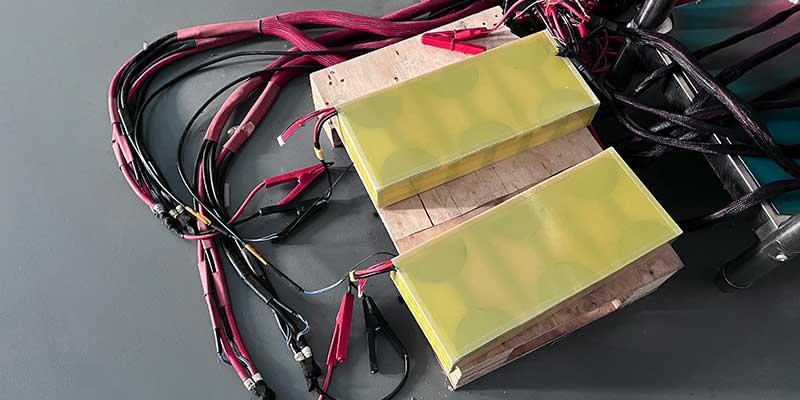
- Engineer-level manufacturing quality control. Our battery engineering team runs aging tests, capacity checks, and full BMS communication validation on every production batch — not statistical sampling. Low defect rates and reliable supply are the outcome.
- Proven international OEM supply experience. Himax serves B2B customers across Asia-Pacific with established export documentation, IATA-compliant SoC shipping, and responsive engineering support through the integration process.
| Ready to spec your robot battery?
Share your voltage, capacity, discharge, and form-factor requirements. We will respond with a technical proposal within one business day. |