
Commercial Disclosure: The Himax Electronics Editorial Team brings together expertise in battery products, power technologies, engineering applications, and global customer support to share practical information about battery technology, custom battery solutions, and power applications. Our content covers lithium-ion batteries, LiFePO4 batteries, battery pack design and selection, charging and power solutions, industry application guides, product updates, and official Himax Electronics news. Our goal is to help engineers, procurement professionals, and businesses better understand battery technologies and make informed decisions based on their specific application requirements. All content reflects the official editorial perspective of Himax Electronics and our commitment to providing reliable, flexible, and professional custom battery and power solutions for complex applications worldwide.
Key Takeaways
- Grade A, Grade B, and Grade C cells should not be interpreted without reference to the supplier’s written grading criteria, and these labels should not be used directly for cross-brand quality comparisons.
- A “Grade A” label does not prove original manufacturer sourcing, nor does it independently verify capacity, cycle life, or safety performance.
- Cell quality verification should combine source traceability, visual inspection, capacity, internal resistance, self-discharge, and batch consistency. No single test is sufficient to determine overall cell quality.
- Test temperature, state of charge, charge and discharge conditions, and measurement methods can all affect results. Acceptance criteria should therefore define both the required values and the corresponding test conditions.
- A reliable custom battery pack requires more than qualified cells. Proper cell matching, interconnection processes, BMS protection, and pack-level validation are also necessary.
Introduction
When purchasing lithium batteries, “Grade A cells” is a common product description. For OEMs and purchasing teams, however, more important questions are: What standard is being used to define Grade A? Who determines the grade? Are inspection records available for the specific cell model and production batch?
From a battery manufacturing perspective, cell grading is only a starting point for communication. What ultimately affects battery pack performance is whether the cells meet the agreed specifications, whether their origin can be traced, and whether products from the same batch maintain reasonable consistency under actual operating conditions.
- What Do Grade A, Grade B, and Grade C Cells Actually Mean?
In procurement, Grade A, Grade B, and Grade C should not be treated as universal quality certification grades that can be directly compared across manufacturers. Different manufacturers, distributors, and sales channels may use different grading criteria, and some may not provide sufficiently clear definitions at all.

The following table summarizes some grading descriptions that may be encountered in the market. These descriptions do not represent a universal industry standard.
| Grade | What the Supplier May Mean | What Buyers Should Verify |
| Grade A Cells | Cells that meet the supplier’s defined shipment criteria or specific customer requirements | Which specification applies? Which parameters have been tested? |
| Grade B Cells | Cells that did not meet one or more original requirements or were placed into another sales category | Does the deviation involve appearance, capacity, internal resistance, or another parameter? |
| Grade C Cells | A lower internal classification, clearly nonconforming products, products awaiting disposition, or other categories | What is the actual condition? Are there safety defects or usage restrictions? |
It should not be assumed that all Grade B cells differ only in appearance, nor should Grade C be interpreted as simply meaning lower capacity. If the supplier cannot explain why a cell was downgraded, there is insufficient information to determine whether it is suitable for a particular application.
Likewise, the letter “A” or “B” in a cell model number may simply be part of the manufacturer’s product naming convention and should not automatically be interpreted as a quality grade.
- Why Is the Term “Original Grade A” Still Not Enough?
“Original manufacturer sourcing,” “new condition,” and “compliance with specifications” are separate issues that require different forms of evidence.
Original manufacturer sourcing primarily concerns supply-chain traceability. New condition concerns whether the cell has previously been used, removed from another product, or reprocessed. Compliance with specifications must be determined using technical documentation and test results. These three concepts cannot substitute for one another.
Buyers should consider reviewing the following information:
- Manufacturer name, complete cell model, and the applicable version of the specification sheet;
- Batch number, production date, and individual cell identification code;
- Supply-chain records and verifiable sourcing documentation;
- Shipment inspection records for the relevant batch;
- Inventory age, storage conditions, and any re-screening records;
- The supplier’s written explanation of cell grade, product condition, and procedures for handling abnormalities.
QR codes or laser markings can assist with traceability, but the ability to scan a code does not by itself confirm the source of a cell. The encoded information, packaging labels, transaction documents, and physical product should be cross-checked for consistency. If questions remain, verification should be conducted through a channel recognized by the cell manufacturer.
- How Can Grade A Cells Be Verified? Turn Procurement Descriptions into Acceptance Criteria
“Grade A cell” is not a measurable parameter that can simply be entered into a testing instrument. Battery manufacturers need to translate this type of procurement description into specific technical requirements.

| Verification Area | Recommended Checks | What It Helps Determine |
| Identity and Source | Model, batch, identification codes, and supply documentation | Whether the physical cells match the purchased product |
| Appearance and Structure | Case, seals, insulation, terminals, and dimensions | Whether damage or assembly risks are present |
| Capacity and Energy | Ah and Wh measured under specified conditions | Whether the cells meet agreed output requirements |
| Internal Resistance and Power | ACIR, DCIR, or voltage response under load | Current-output capability and electrical losses |
| Self-Discharge | Energy loss or related measurements under specified conditions | Whether abnormal differences in energy loss are present |
| Batch Consistency | Data distribution, variation, and outliers | Whether the cells are suitable for consistent pack matching |
| Cycle-Life Performance | Changes in capacity and internal resistance under agreed cycling conditions | Whether the cells can support the project’s service-life target |
Each of these checks serves a different purpose. Passing a single capacity test does not simultaneously prove that the cell’s origin, service life, and internal condition all meet the required specifications.
- Why Is Batch Consistency More Important Than the Data from a Single Sample?
Good performance from a sample only demonstrates how that particular sample performed under the specified test conditions. For production-scale purchasing, it is also necessary to understand the data distribution across the entire batch.
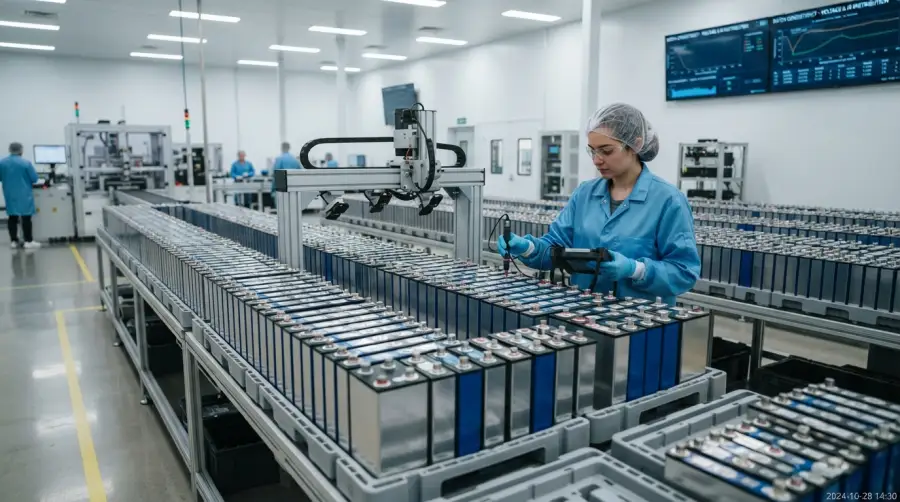
For example, two batches may have the same average capacity, while one has a tightly clustered distribution and the other contains a larger number of low-capacity cells. Looking only at the average could therefore hide differences that affect cell matching and finished battery pack performance.
The distributions of capacity, internal resistance, self-discharge, and other relevant parameters should be reviewed together. Abnormal results should also be investigated to determine whether they are concentrated within a particular production batch, storage batch, or testing channel.
Sampling plans should be developed according to order volume, the supplier’s historical performance, and application risk. Critical appearance and identity checks, electrical-performance screening, and periodic cycle-life validation may use different inspection frequencies rather than relying on a single sampling inspection to represent the entire quality-management process.
- Can Grade B Cells Be Used in Custom Battery Packs?
A decision cannot be made based solely on the term “Grade B.” The key questions are what requirement the cells failed to meet and whether the intended application can accept that deviation.
If the deviation involves electrolyte leakage, abnormal self-discharge, structural damage, or an unverified source, the cells should first be isolated and evaluated. Reducing output power, adding a BMS, or shortening the warranty period should not be used as substitutes for evaluating the underlying defect.
For clearly defined and measurable specification deviations that do not involve safety concerns, the allowable application boundaries still need to be reassessed, necessary validation should be completed, and the actual product condition should be accurately documented in the procurement agreement.
A BMS can provide monitoring and protection, but it cannot repair internal cell defects or make significantly mismatched cells behave as though they are in the same condition.
- Turning Cell Grades into an Actionable Procurement Agreement
Rather than simply specifying “Grade A cells,” a more practical approach is to define the following requirements:
| Agreement Item | Recommended Information to Specify |
| Product Identity | Manufacturer, model, specification-sheet revision, and permitted substitution rules |
| Product Condition | Whether cells must be new and whether aged inventory or reprocessed products are permitted |
| Performance Requirements | Capacity, internal resistance, self-discharge, and corresponding test methods |
| Cell Matching Requirements | Project-specific variation limits and screening procedures |
| Storage Requirements | Production-date range, storage conditions, and retesting requirements |
| Change Management | Notification and approval requirements for changes in cell model, source, or manufacturing process |
| Nonconformance Handling | Isolation, retesting, returns or replacement, and batch-traceability procedures |
If a supplier uses its own Grade A/B/C classification system, the definition of that system should be included as an attachment to the agreement. This allows both parties to resolve disputes using actual specifications and records rather than repeatedly debating what a particular “grade” is supposed to mean.
FAQ: Common Questions About Cell Grades and Quality Verification
Do Grade A Cells Always Have a Longer Cycle Life?
Not necessarily. Cycle life depends on cell design, temperature, charge and discharge rates, operating voltage range, and storage history. Buyers should review cycle-life data with clearly defined test conditions and validate it against the actual operating conditions of the equipment.
If a Cell Delivers Its Rated Capacity During Testing, Does That Prove It Is Grade A?
No. Capacity is only one parameter and cannot independently verify source, internal resistance, self-discharge, batch consistency, or cycle life. The supplier’s written grading criteria and other acceptance requirements should also be considered.
Can QR Codes Be Used to Distinguish Grade A Cells from Grade B Cells?
Not universally. Coding systems are defined by individual manufacturers, and third-party scan results also need to be verified. QR codes should be treated as one source of traceability information and cross-checked against the physical product, documentation, and manufacturer information.
Are Cells That Have Been in Storage for a Long Time Automatically Considered Grade B?
Not necessarily. Storage duration does not automatically determine cell grade, although storage temperature, state of charge, and storage time can affect cell condition. Storage records should be reviewed, and the cells should be retested according to project requirements.
Can Grade A Cells from Different Production Batches Be Mixed Directly?
They should not be mixed solely because they share the same grade. Even cells of the same model from different batches may differ in capacity, internal resistance, and storage history. Whether they can be matched within the same battery pack should be determined using test results and pack design requirements.
If the Cells Meet Specifications, Does That Guarantee a Qualified Battery Pack?
No. Cell matching, welding, insulation, thermal management, BMS functionality, and complete pack performance still need to be verified. Cells provide the foundation, but manufacturing processes and system design also have a significant impact on finished-product reliability.
Himax Electronics Cells
Himax Electronics specializes in custom battery and power solutions for complex applications worldwide, providing application-specific lithium-ion battery packs, power supplies, chargers, and accessories for a range of industry requirements.
For OEMs and purchasing teams that require custom battery packs, customers are welcome to provide load requirements, runtime targets, operating conditions, and service-life expectations to Himax Electronics. These inputs can be used to define appropriate cell-selection and validation requirements, helping ensure that procurement decisions are based on traceable documentation and measurable performance criteria.