Fall Road Trip Battery Care: Keep Your Vehicle and Devices Powered

Commercial Summary: This editorial guide from Himax Electronics examines fall travel power needs through battery engineering principles. It distinguishes battery types, explains operating limits, and outlines maintenance practices to support informed equipment selection and use.
Key Takeaways
-
Understand the differences between starter batteries, EV traction batteries, and portable power station batteries, and maintain each according to its intended use.
-
Check battery health, terminals, and charging systems before leaving. A charge indicator alone does not tell you the battery’s overall condition.
-
Plan power use around the actual energy needs of your portable refrigerator, lighting, and electronics, with a reserve for changes in your itinerary.
-
Account for overnight temperature drops, cold-weather charging, condensation, and heat buildup inside a parked vehicle.
-
Use compatible chargers, cables, and protective devices, then inspect and store your batteries properly after the trip.
Introduction
Fall is a great time for a road trip, but chilly mornings, mountain temperature swings, and overnight camping can put added demands on your power setup. Slow engine cranking, a portable refrigerator shutting off overnight, or intermittent phone charging may point to battery aging, insufficient capacity, loose connections, or incompatible charging conditions.
From a battery manufacturing and system design perspective, effective fall road trip battery care involves more than keeping batteries charged. Cell performance, the battery management system, charging controls, and connected loads all affect the result. This guide covers what to check before departure, how to manage power on the road, and what to do when you get home.
Know Which Battery Powers What
Batteries labeled “12V” are not necessarily interchangeable. Likewise, maintenance practices for a vehicle’s starter battery should not automatically be applied to a portable power station. Battery designs differ in their intended loads, charging requirements, and discharge capabilities.
| Battery or Power System | Typical Uses | Fall Travel Considerations | Maintenance Focus |
| Low-voltage starter or auxiliary battery | Engine starting in gas-powered vehicles, low-voltage accessories, and vehicle controls; some EVs also have a low-voltage auxiliary battery | Output in cooler weather, parked-vehicle power draw, and aging | Check battery health and avoid prolonged undercharging |
| EV traction battery | Vehicle propulsion and, on supported models, power for external equipment | Temperature, route energy demand, charging access, and external power settings | Use the vehicle’s built-in charging and thermal management functions |
| Portable power station or separate house battery | Portable refrigerators, lights, laptops, and camping equipment | Usable energy, continuous output, and charging temperature | Match the system to the loads and use compatible charging methods |
| Batteries inside phones, cameras, and other devices | Communication, navigation, and photography | Cold-weather runtime changes, charging protocols, and moisture at connectors | Use compatible accessories and avoid excessive heat or charging through damp ports |
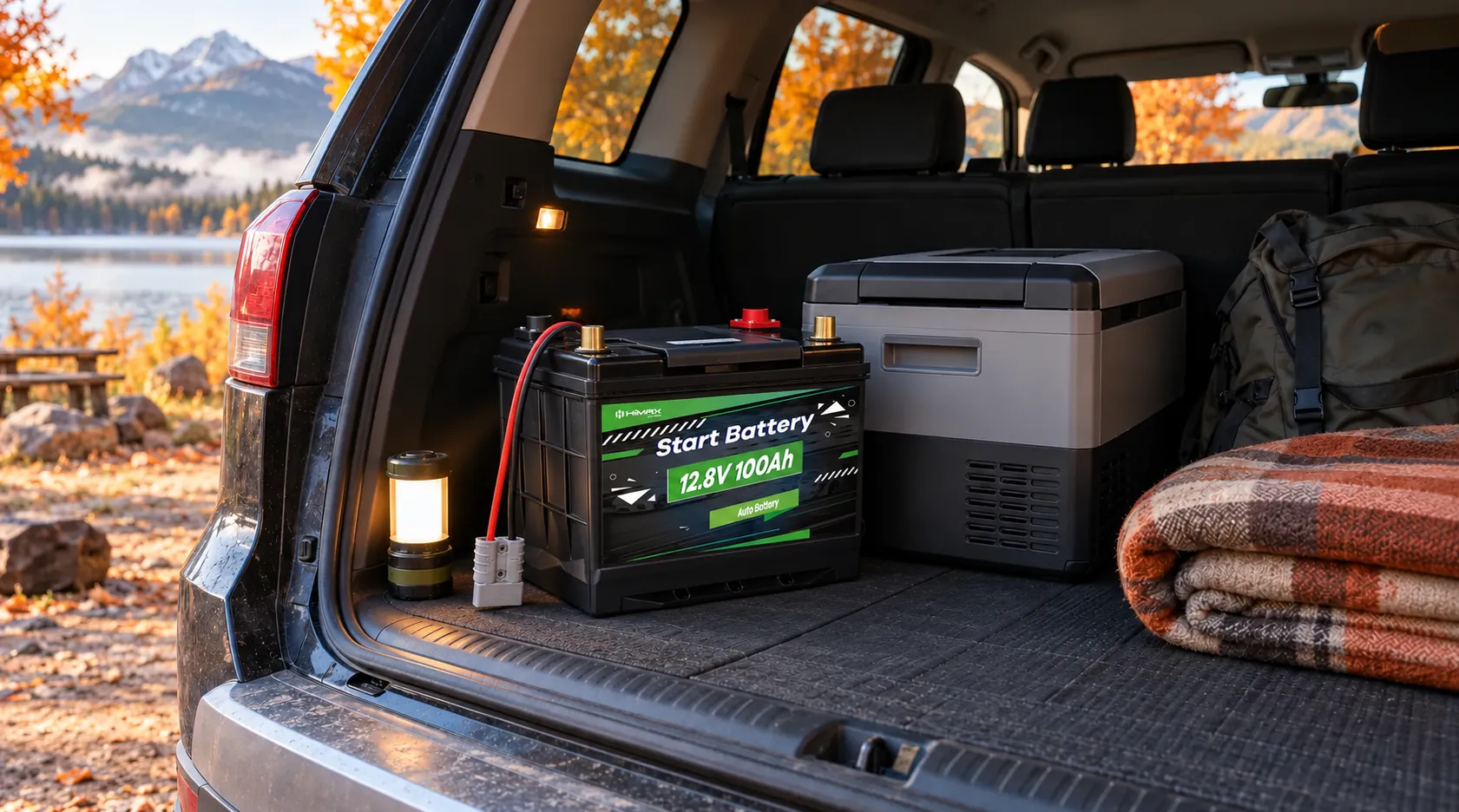
Starter batteries are designed primarily to deliver high current for short periods. They generally are not intended for repeated deep discharges from camping equipment. For extended use while parked, consider a separate power source that preserves the energy needed to start or wake up the vehicle.
Before You Leave: Look Beyond the Charge Indicator
Inspect the Battery and Connections
Check for a swollen or cracked case, leakage, loose mounting hardware, and visible terminal corrosion. For portable power stations, also inspect outlets, charging ports, and cables for damage, scorching, or loose connections.
Stop using a battery that shows swelling, an unusual odor, or persistent abnormal heating, and contact a qualified service provider. Do not open a battery pack yourself or remove the covers from a vehicle battery labeled maintenance-free.
Check Both Charge Level and Battery Health
State of charge, or SOC, describes how much charge is currently available. State of health, or SOH, reflects aging-related changes in characteristics such as capacity and output capability. A battery may show a full charge yet struggle to start an engine because its internal resistance has increased.
If your vehicle has been cranking slowly, repeatedly losing charge, or has an uncertain battery history, arrange a pre-trip inspection. A technician can assess starting performance, the charging system, and abnormal key-off current draw using procedures appropriate for the battery type.
A single resting-voltage measurement does not provide a complete picture of battery health.
Consider the Effects of Frequent Short Drives
Frequent starts, short commutes, and parking-mode recording can affect the balance between energy used and energy replaced. AAA’s automotive guidance identifies short trips that do not adequately recharge the battery as a contributing concern. Its battery replacement guidance also emphasizes matching the battery to the vehicle’s required type, dimensions, and electrical specifications. Reference: AAA Automotive Battery Guidance
A short drive should not be treated as confirmation that a depleted battery has been fully recharged. If external charging is needed, use a charger compatible with the battery type and follow the vehicle manual’s connection points and procedures.
How Fall Temperature Swings Affect Batteries
As temperatures drop, electrochemical reactions and ion transport can slow down. Depending on the battery, this may increase internal resistance, reduce voltage under load, and decrease available energy. These effects can become more noticeable in an aging battery during a morning start or a high-power load.
Discharging a battery in cold weather and charging it in cold weather are different operating conditions. A battery that can supply power at a given temperature may not be approved for charging at that same temperature.
Research involving Argonne National Laboratory examines the relationship between low temperatures, higher charging rates, and lithium plating on graphite anodes. The practical implication is that lithium-ion charging controls need to account for both temperature and current. A battery accepting current does not, by itself, establish that the charging conditions are appropriate. Reference: Research on Graphite Electrode Charging in Lithium-Ion Batteries
| Common Fall Travel Scenario | Possible Effects | Recommended Response |
| Cold mornings in mountainous or high-elevation areas | Reduced output, available energy, or charging speed | Check the product’s operating limits and allow additional energy reserves |
| Charging a portable power station in cold conditions | Low-temperature protection may limit or stop charging | Follow the manual and let the battery reach its permitted charging temperature |
| Leaving a power station in a closed vehicle on a sunny day | Heat buildup may affect cooling and battery life | Keep it out of direct sunlight and maintain ventilation clearance |
| Rain, fog, or moving cold equipment into warm, humid air | Damp connectors or condensation | Confirm that the equipment and connectors are dry before connecting power |
| Extended camping while parked | Ongoing energy use may trigger low-voltage protection | Reduce nonessential loads and plan separate power and recharging options |
Charging and discharging temperature limits, recovery conditions, and protection behavior vary by model. Follow the applicable manual. Do not heat a battery with an open flame, heat gun, or another unapproved method, and do not bypass low-temperature protection.
Plan Power for Your Devices: Calculate Energy, Then Check Output
Comparing capacity numbers alone can overlook important operating requirements. Energy capacity helps estimate runtime. Continuous output, startup demand, and port limits determine whether a power source can run a device.
Estimate Daily Energy Use in Watt-Hours
Use this basic calculation:
Energy Use (Wh) = Average Power (W) × Operating Time (h)
The following example illustrates the calculation. It does not represent the actual consumption of every device in these categories.
| Device | Example Assumption | Usage | Estimated Energy Use |
| Portable refrigerator | Measured average power of approximately 20W | 10 hours | Approximately 200Wh |
| LED lighting | 8W | 4 hours | Approximately 32Wh |
| Laptop | Average input power of 45W | 2 hours | Approximately 90Wh |
| Phone and camera charging | Approximately 40Wh delivered in total | Daily total | Approximately 40Wh |
| Total | — | — | Approximately 362Wh |
A compressor refrigerator typically cycles on and off. Its energy use depends on ambient temperature, the temperature setting, the initial temperature of its contents, and how often it is opened. Its nameplate power should not automatically be used as its all-day average.
For example, suppose a power station has a rated energy capacity of 500Wh. If you assume an overall usable-energy factor of 85% under a particular set of conditions, it would deliver approximately 425Wh to connected loads.
That percentage is an illustration, not a product specification. Actual usable energy depends on conversion losses, standby consumption, temperature, aging, and protection settings. With an estimated daily demand of 362Wh, you should still consider a longer stay or uncertain access to charging the next day.
Check Ports and Startup Requirements
Devices such as compressor refrigerators may briefly draw more current when starting. A power station can shut down because of insufficient output capability even when it still has energy remaining.
Before buying or connecting equipment, check:
-
Output voltage, polarity, and connector compatibility.
-
Individual-port limits and shared limits when multiple ports are used.
-
Device startup requirements and the power source’s permitted surge output.
-
Cable current rating, length, and connection quality.
-
Supported charging protocols and power profiles for interfaces such as USB-C.
Using DC power may reduce some conversion steps, provided the voltage range, regulation, and connectors are compatible. A plug fitting into a socket does not establish electrical compatibility.
On the Road: Reduce Battery Drain and Power Interruptions
Identify What Stays Powered After Parking
Depending on the vehicle, accessory sockets, USB ports, and cargo-area outlets may turn off with the ignition or remain active. Check the owner’s manual and confirm how your dash cam’s parking mode, refrigerator, and other connected equipment operate.
A low-voltage disconnect can help limit discharge, but its cutoff setting may not suit every vehicle, battery condition, or ambient temperature. It should not be treated as a guarantee that the vehicle will start.
Do Not Rely on a Fixed Idling Time to Recharge
Charging at idle depends on alternator controls, vehicle electrical loads, and battery condition. There is no single idling duration that reliably indicates how much energy has been restored.
Never run an engine in an enclosed or poorly ventilated space, and do not rely on overnight idling to power camping equipment.
Secure Equipment and Manage Moisture and Heat
Secure battery packs and portable power stations so they cannot slide or become impact hazards during sudden braking. Keep cables clear of door pinch points and prevent metal objects from contacting exposed terminals.
Leave ventilation openings unobstructed. Do not cover operating power equipment with clothing or sleeping bags.
If your EV supports external power output, use approved accessories, check the output limits, and set an appropriate discharge cutoff to preserve energy for the next leg of your trip.
After the Trip: Maintain and Store Each Battery Correctly
Post-trip care affects how your equipment performs the next time you use it. Inspect for moisture, cable wear, unusual heating, and noticeable changes in runtime.
| Battery Type or Condition | Post-Trip Maintenance |
| Undercharged lead-acid starter battery | Recharge promptly using a compatible method and avoid leaving it depleted |
| Lithium-ion portable power station going into extended storage | Follow the manual’s storage charge guidance, check periodically, and avoid prolonged storage at very low charge |
| Equipment exposed to rain, fog, or condensation | Confirm it is dry and free of abnormalities before use; seek professional service if internal water intrusion is suspected |
| Repeated protective shutdowns or noticeably reduced capacity | Record temperature, connected loads, and fault behavior, then contact support for diagnosis |
Storage charge levels and inspection intervals vary with cell chemistry and battery management design. Avoid assuming that every battery should be stored fully charged or recharged on the same schedule.
Fall Road Trip Battery Care FAQ
Does slow engine cranking in fall mean the battery needs replacement?
Not necessarily. Low charge, battery aging, poor terminal connections, charging-system problems, and starter-system faults can all contribute. Use diagnostic results to guide the decision rather than replacing the battery based on a single slow start.
Can lithium iron phosphate batteries charge in cold weather?
Check the specific product’s charging temperature range, low-temperature protection, and heating design. Lithium iron phosphate, or LiFePO4, is a lithium-ion chemistry; its name alone does not establish its cold-weather charging capability.
Products with self-heating features still require the correct preheating and charging sequence.
Can I run a portable refrigerator from my vehicle’s starter battery overnight?
That depends on refrigerator consumption, parking duration, battery health, and ambient temperature, among other factors. Extended use may consume the reserve needed for starting.
For repeated overnight operation, evaluate a separate house battery or portable power station and calculate the refrigerator’s actual energy use.
Why does a device shut off when the power station still shows charge remaining?
Possible causes include excessive continuous power demand, high startup current, cold-related voltage sag, cable voltage drop, loose connections, or a battery management system protection event.
Turn off the load and check the fault indication. Address the cause before restoring operation according to the manual.
What is the difference between Ah and Wh when choosing a portable power station?
Amp-hours, or Ah, measure charge capacity. Watt-hours, or Wh, measure energy. Wh is more useful for estimating runtime when comparing products with different battery voltages.
A rough calculation using rated values is:
Wh = Nominal Voltage × Ah
Still, distinguish between the battery’s rated energy and the energy actually available at the output.
Can a standard lithium battery pack replace a vehicle’s starter battery?
Matching nominal voltage is not enough. Starting current, charging-system compatibility, battery management behavior, operating temperatures, mounting requirements, and vehicle specifications also matter.
Some vehicles require battery registration or system adaptation after replacement. Have the work performed by someone qualified for the vehicle and battery system.
About Himax Electronics
Himax Electronics focuses on custom battery and power solutions for complex applications worldwide. The company also provides proprietary lithium-ion battery packs, power supplies, chargers, and accessories to address specific industry requirements.
For vehicle accessories, outdoor equipment, and other professional applications, share your operating temperatures, supply voltage, continuous and peak loads, target runtime, and available installation space with Himax Electronics to discuss a battery and power solution suited to your operating conditions.