新闻与博客 | HIMAX 电子

Tol battery

As we push further into 2026, the Internet of Things is no longer about simple, low-power sensors sending tiny data packets. Today’s IoT landscape is defined by sophisticated edge computing, high-bandwidth cellular transmissions, and complex sensor arrays. These devices demand more from their power sources than ever before. For over 12 years, I’ve specialized in designing custom Li-ion packs for these exact challenges. My name is Alden, and I’m a Battery Systems Engineer here at Himax Electronics. In my experience, one of the most common failure points I see in otherwise brilliant IoT projects is an under-specified power source. That’s why I’m excited to share my insights on a solution that is quickly becoming the new standard for reliability and performance: the high-discharge 3.7V 6000mAh Li-ion battery pack.
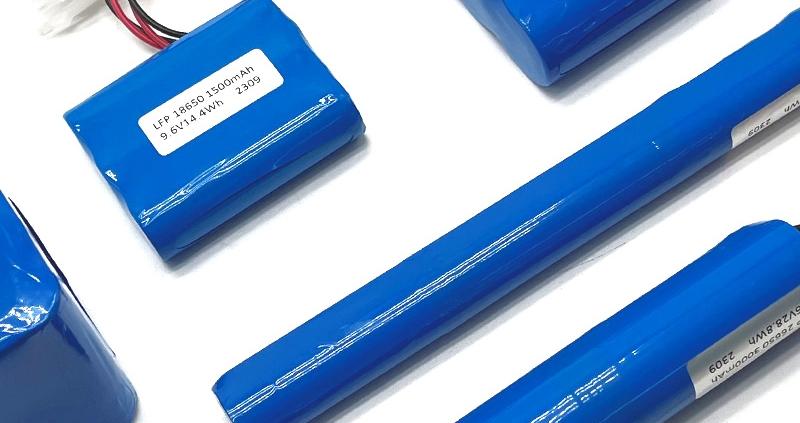
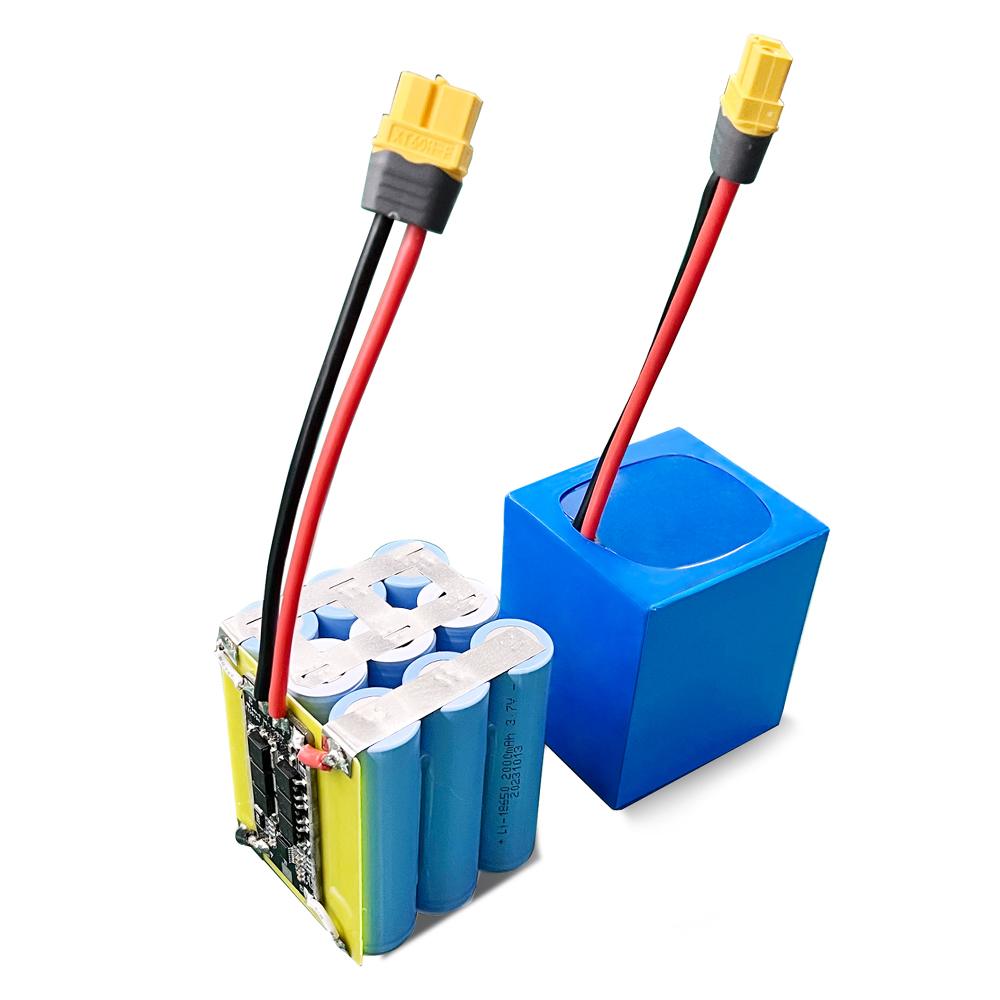
a compact 1S2P configuration with 18650 cells

Understanding Power Demands in Modern IoT Devices

The days of a simple, steady power draw are over for most serious IoT applications. A modern industrial IoT sensor or remote gateway has a highly dynamic power profile. It might idle at a few microamps for hours, then suddenly demand several amps for a few hundred milliseconds. This “bursty” behavior is the new normal.

A common mistake I see engineers make is designing for the average current draw, not the peak. This leads to catastrophic field failures. When a device needs to power up a 4G/5G modem, actuate a motor, or fire up multiple sensors simultaneously, the battery’s voltage can plummet if it can’t handle the sudden load. This “voltage sag” or “brownout” can cause the device’s microcontroller to reset, corrupting data and leading to a spiral of failed connection attempts that drains the battery completely. A robust IoT battery must be able to handle these peaks without faltering.

Why 3.7V 6000mAh with 18A Discharge Stands Out for IoT

At Himax, we’ve focused on creating a power solution that directly addresses these modern challenges. Our 3.7V IoT battery pack is built to provide both endurance and power, serving as a reliable power solution for edge IoT devices. Let’s break down what makes this configuration so effective.

Here’s what makes our Himax IoT battery, a 1S2P 18650 battery for IoT, a game-changer:  

  •  High Capacity (6000mAh): Built with two premium 3000mAh 18650 cells in a 1S2P configuration, this pack offers a substantial 6Ah of energy. This high capacity is essential for achieving a long operational life in remote or solar-powered IoT deployments, minimizing the need for costly and frequent replacements. It’s the foundation of a low total cost of ownership.
  • Massive Discharge Capability (18A): This is the crucial spec. A continuous discharge rating of 18A means the battery can effortlessly handle the intense power spikes from LoRaWAN, NB-IoT, or 5G transmissions. This prevents voltage sag, ensuring your device remains stable and operational during its most critical tasks. This is a true high discharge IoT battery.
  • Ultra-Compact Form Factor: Space is always at a premium inside an IoT enclosure. With dimensions of just 38 × 25 × 70 mm, this rectangular pack is incredibly dense. It allows you to design smaller, more discreet devices without sacrificing power, a key advantage for asset trackers and compact industrial sensors.
  • Industrial-Grade Reliability: We designed this 3.7V 6000mAh 18650 pack for the real world. Paired with a properly designed Battery Management System (BMS), it offers excellent thermal stability and a long cycle life, operating reliably in harsh environments typically ranging from -20°C to 60°C.


Real-World IoT Applications Where This Pack Excels

The combination of high capacity and high discharge in this Li-ion battery for IoT devices makes it incredibly versatile. Here are a few applications where I’ve seen this type of pack deliver exceptional results:

Smart Agriculture Sensors: A soil moisture and nutrient sensor array might take readings every hour, but once a day it needs to transmit a large data log over a cellular network. That transmission burst requires a high discharge IoT battery to ensure the data gets through, while the 6000mAh capacity allows it to last for an entire growing season. This is a perfect use case for a high capacity battery for remote monitoring.

Industrial Asset Tracking & Cold Chain: A tracker on a shipping container needs to survive for months while providing periodic GPS/cellular location updates. When moving through areas with poor signal, the modem boosts its power, drawing significant current. An 18A continuous discharge battery ensures the tracker doesn’t fail when it’s needed most.

Remote Environmental Monitoring: Consider a solar-powered gateway in a remote forest monitoring for fire risk. The system charges during the day and runs on its 3.7V 6Ah battery for IoT at night, powering sensors and a satellite modem. The battery’s ability to handle high peak currents is critical for reliable data transmission, no matter the conditions.
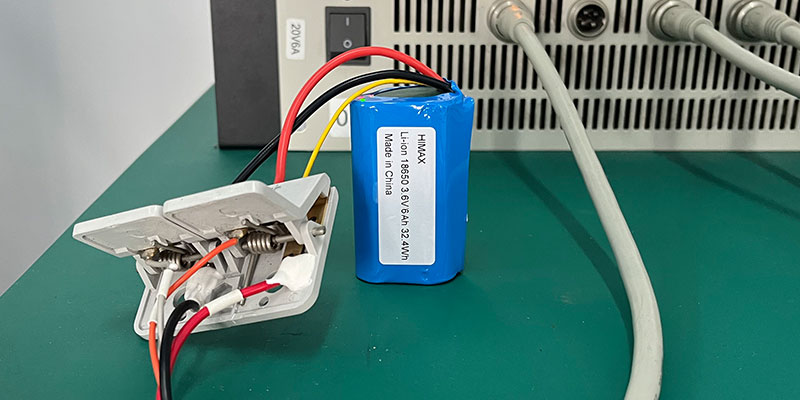
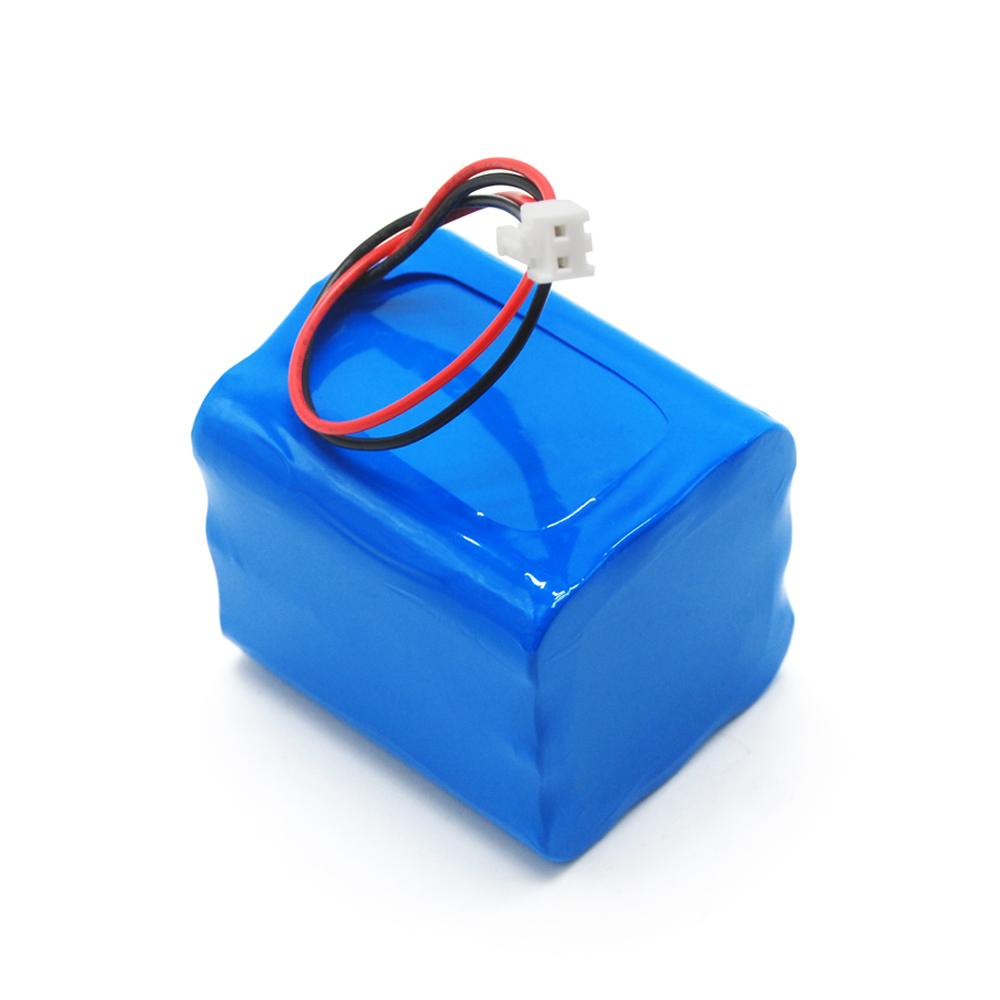
designed for high-discharge industrial IoT applications.

Engineering Tips: Integrating High-Discharge Packs Without Over-Engineering

From my experience as Alden, a Battery Systems Engineer, I believe a great battery is only half the solution. Proper integration is key. Here’s what to look for when incorporating a high-performance 3.7V IoT battery pack into your design:

  • Don’t Skimp on the BMS: The Battery Management System is the brain of your power system. For a high-discharge pack, ensure your BMS provides accurate cell balancing, over-current protection that aligns with the 18A peak, and under-voltage/over-voltage cutoffs to maximize cycle life.
  • Consider Your Connectors: A common point of failure is a connector that isn’t rated for the peak current. An 18A pulse will generate heat and voltage drop across a flimsy connector. Use connectors with an appropriate current rating to ensure all that power makes it to your device.
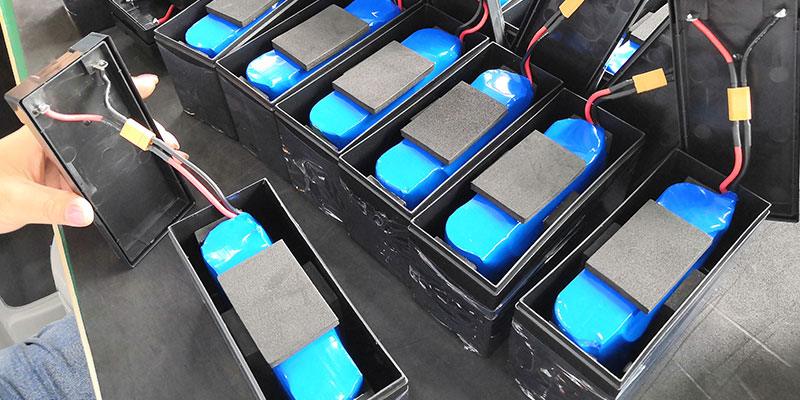
  • Thermal Management is Your Friend: While our 18650 cells are incredibly stable, all batteries generate heat under load. In a tight, sealed enclosure, ensure there’s a thermal pathway for this heat to dissipate. Even a small piece of thermally conductive material can make a huge difference in long-term reliability.
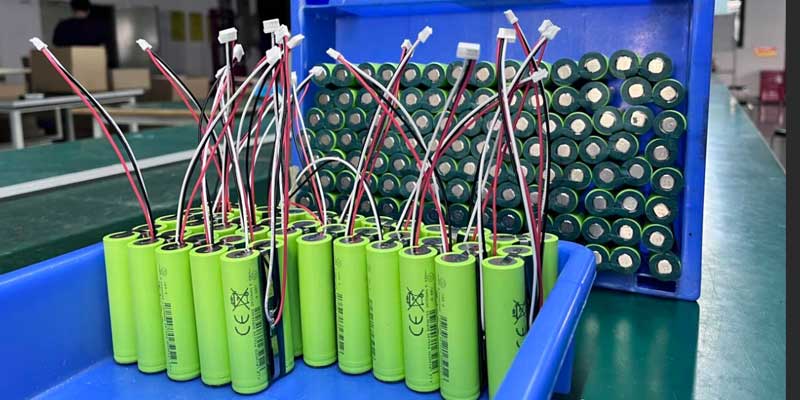
  • Himax 3.7V 6000mAh Li-ion IoT battery pack

Looking Ahead — The Role of Reliable Batteries in Scaling IoT Deployments

Looking ahead, as Alden at Himax Electronics, I see the reliability of each node becoming exponentially more important. The difference between a pilot project and a global deployment of a million devices often comes down to Total Cost of Ownership (TCO). A robust, reliable, and correctly specified IoT battery is the single most effective way to reduce TCO. It means fewer truck rolls for replacements, less downtime, and a more trustworthy brand reputation. Choosing a powerful and durable power source like a custom 3.7V battery pack for IoT OEM is not an expense; it’s an investment in the scalability and success of your entire platform.

At Himax Electronics, we’ve built our reputation on being a trusted partner for dozens of IoT brands. See our full IoT battery portfolio. If you’re building IoT sensors, gateways, or industrial edge devices and need a dependable 3.7V high-discharge battery partner, reach out to Himax Electronics today. Let’s discuss your project requirements and custom options.


Author: Alden, Battery Engineer – Manufacturing & Quality Control
Published: March 24th, 2026


More information about Li-ion batteries:

Why Lithium-Ion Batteries Must Be Charged Using the CC/CV Method

Why Maximum Continuous Discharge Current is Critical for Your Battery Selection


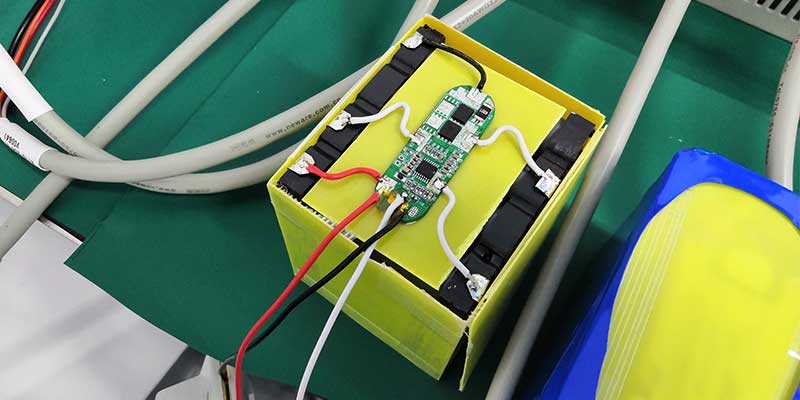
bms for lithium ion battery packs

In modern lithium-ion battery systems, communication is no longer optional. Whether it’s a small portable device or a large-scale energy storage system, the Battery Management System (BMS) is expected to provide real-time data and interact reliably with external equipment.

However, many issues in integration projects do not come from the battery itself, but from misunderstandings around communication methods—how the signals are wired, what protocol is used, and whether the system on the other side can interpret the data correctly.

This article provides a practical overview of the most common BMS communication options, focusing on their characteristics, wiring methods, and typical protocols.

UART: A Simple and Practical Starting Point

UART is often the first choice for basic communication needs. It is widely used because of its simplicity and low implementation cost.

A typical UART interface consists of TX (transmit), RX (receive), and GND. In some cases, a VCC line is also included to power external modules. Since UART is a point-to-point communication method, it works best in short-distance applications.

Most UART-based BMS systems rely on custom protocols defined by the manufacturer. This means integration requires documentation, but it also allows flexibility in data structure.

In practice, UART is commonly used for:

Debugging and configuration tools

PC monitoring software

Bluetooth modules (UART-to-BLE conversion)


SMBus: The Standard for Smart Batteries

SMBus is widely recognized in applications where batteries need to be interchangeable and standardized, such as laptops and medical devices.

It is based on the I²C physical layer and uses two main lines: SDA (data) and SCL (clock), along with ground. Compared to UART, SMBus provides a defined set of commands and data formats, making it easier for host systems to interpret battery information without custom development.

Typical data includes:

State of Charge (SOC)

Voltage and current

Temperature

Cycle count


Because of this standardization, SMBus is often the preferred choice when compatibility between different systems is required.

I²C: Efficient for Short-Distance Communication

I²C is commonly used inside battery systems rather than as an external interface. It is designed for short-distance communication and supports multiple devices on the same bus.

Like SMBus, it uses SDA and SCL lines, but the protocol itself is more flexible and often customized depending on the application.

In most cases, I²C is used for:


Communication between BMS ICs

Sensor integration

Internal system control


Due to its limited range and sensitivity to noise, it is rarely used for long-distance external communication.


CAN Bus: Reliability in Demanding Environments

For applications where reliability is critical, CAN bus is often the default choice. It is widely used in electric vehicles, industrial equipment, and energy storage systems.

CAN uses a differential pair (CAN_H and CAN_L), which provides strong resistance to electromagnetic interference. This makes it suitable for harsh environments and long cable runs.

On top of the physical layer, higher-level protocols are often used, such as:


CAN 2.0

CANopen

J1939


These protocols define how data is structured and exchanged, enabling multi-device communication within a network.

RS485: Long-Distance and Flexible Communication

RS485 is another robust option, particularly for systems that require communication over longer distances.

It uses differential signaling (A and B lines), similar to CAN, and can support multiple devices on the same bus. RS485 does not define a protocol by itself, which gives developers flexibility—but also requires agreement on data structure.

The most common protocol used with RS485 is Modbus (RTU or ASCII), especially in industrial and energy storage applications.

RS485 is typically chosen for:


Battery racks and container systems

Industrial automation

Distributed monitoring systems


Bluetooth: User-Friendly Wireless Access

Bluetooth is increasingly used in applications where end users need direct access to battery data through mobile devices.

In most designs, Bluetooth modules act as a bridge, converting UART data into wireless communication using BLE (Bluetooth Low Energy).

This approach allows users to:


Monitor battery status via smartphone apps

Configure parameters without physical connections

Access data in real time


While convenient, Bluetooth is generally not used for critical control functions due to its limited range and potential interference.

RS232: Legacy but Still Relevant

Although less common in new designs, RS232 is still found in some industrial and legacy systems.

It uses TX, RX, and GND lines, similar to UART, but operates at different voltage levels. RS232 is mainly used for compatibility with existing equipment rather than new deployments.

Understanding the Difference: Interface vs. Protocol

One common source of confusion is the difference between communication interfaces and protocols.


Interface (Physical Layer):
Defines how signals are transmitted
Examples: UART, CAN, RS485, I²C

Protocol (Data Layer):
Defines how data is structured and interpreted
Examples: Modbus, CANopen, SMBus, custom protocols


In real-world systems, both layers must match for successful communication.

For example:

RS485 + Modbus → Standard industrial solution

CAN + CANopen → Automated control systems

UART + Custom Protocol → Cost-sensitive designs


Choosing the Right Communication Method

Selecting the appropriate communication method depends largely on the application:


For simple and cost-sensitive designs, UART is usually sufficient

For standardized battery packs, SMBus is a strong option

For industrial or vehicle applications, CAN or RS485 offers better reliability

For user interaction, Bluetooth provides convenience


There is no single “best” solution—only the one that fits the system requirements.
bms architecture

Final Thoughts

In battery system design, communication is just as important as electrical performance. A well-chosen interface and protocol can simplify integration, improve reliability, and reduce long-term maintenance issues.

On the other hand, mismatched communication expectations can quickly turn into delays and unnecessary complexity.

Taking the time to define both the physical interface and the communication protocol early in the project often makes the difference between a smooth deployment and a difficult one.


best-lifepo4-solar-battery

In the rapidly evolving world of Lithium-ion power solutions, “compliance” is often the bridge between a successful product launch and a costly logistical nightmare. For many international buyers, navigating the alphabet soup of certifications—IEC, UL, CE, UN38.3—feels like a routine checkbox exercise. However, a recent case study from our engineering department highlights a critical lesson: Compliance is a holistic ecosystem, not a standalone component.


When a battery fails a lab test, the instinct is to blame the cells. But as we recently discovered during an SGS certification process for a long-term client, the “invisible” culprit is often the charger.


The Case Study: The Gap Between IEC 62133 and CE (EMC)


Recently, a client approached us to provide high-performance battery packs and matching chargers for an industrial application. The initial brief was clear: the units needed to pass IEC 62133 testing via SGS—the gold standard for battery safety.


We optimized the battery protection circuit (PCM) and cell selection to meet these safety rigorous standards. However, midway through the process, the client’s regulatory requirements shifted to include CE marking, which necessitates compliance with the Electromagnetic Compatibility (EMC) Directive.


The result? The system failed the EMC test. While the margin of failure was incredibly slim—a minor deviation in radiated emissions—the consequences were significant:


Project Delays: The testing timeline was pushed back by weeks.


Additional Costs: Re-testing fees and lab overheads added unexpected strain to the budget.


Engineering Re-work: We had to backtrack to shield the charger’s internal circuitry to dampen the interference.


This scenario could have been avoided if the full scope of the “End-Product” certification was defined at the quotation stage.


Understanding the Difference: Safety vs. Compatibility

To prevent these delays, it is vital to understand what these tests actually measure and why they cannot be treated as interchangeable.

  1. IEC 62133: The Safety Guardrail

IEC 62133 focuses almost exclusively on Physical and Chemical Safety. The lab subjects the battery to “torture tests”—crush, vibration, thermal abuse, and overcharging—to ensure the battery doesn’t catch fire or explode. It is about the integrity of the lithium chemistry and the protection board.


  1. CE & EMC: The “Good Neighbor” Policy

The CE mark, specifically the EMC portion (EN 61000 series), isn’t looking at whether the battery is “safe” in a fire-safety sense. Instead, it measures Electromagnetic Interference (EMI). It asks: Does this device emit “noise” that will interfere with other electronics (like a nearby radio or medical equipment)?


Chargers are notorious for failing EMC tests. Because they use switching power supplies (SMPS) to convert AC to DC, they generate high-frequency electrical noise. If the charger isn’t specifically designed with high-quality filters and shielding, it will fail the CE test—even if the battery itself is perfect.

The Domino Effect: Why “Small Deviations” Matter in Lab Testing

In our recent case, the deviation was “very small.” In a real-world scenario, that tiny amount of noise wouldn’t affect the product’s performance. However, accredited labs like SGS, Intertek, or TÜV operate on a binary Pass/Fail system.


A 1dB deviation over the limit is as much a “Fail” as a 50dB deviation. Once a failure is recorded, the lab requires:


A formal “Failure Analysis Report.”


Modified samples (Hardware changes).


A complete re-test of the failed parameters.


This “Domino Effect” eats away at your “Time-to-Market” (TTM), which is often the most valuable asset in the tech industry.


The “System-Level” Approach: Why Early Disclosure is Key

At our factory, we don’t just manufacture batteries; we engineer power systems. When you provide us with the exact list of certifications required for your target market at the start, we can adjust the following details before the first sample ever leaves our floor:


Charger Component Selection: We can opt for premium capacitors and inductors that naturally suppress EMI.


Shielding: We can add copper foil or specialized coatings to the internal housing of the charger or the battery casing.


PCB Layout: Our engineers can optimize the trace routing on the protection board to minimize “antenna effects” that broadcast noise.


Pre-Testing: We can perform in-house “pre-compliance” scans to ensure the 99% success rate when the units hit the official SGS lab.


A Checklist for Global Battery Procurement

To ensure your next project moves from “Prototype” to “Market” without friction, we recommend following this technical checklist when requesting a quote:


List Every Target Market: Are you selling in the EU (CE), USA (UL/FCC), Japan (PSE), or Australia (RCM)? Each has different EMC and safety thresholds.


Define the Test Standard Early: Don’t just say “I need a certificate.” Specify if you need IEC 62133 (Safety), EN 55032 (EMC for Multimedia), or EN 60601 (Medical).


Specify the “System” Testing: Will the battery be tested inside your device, or as a standalone component with its charger? Lab results vary wildly depending on how the system is grounded.


Allow for “Engineering Margin”: Low-cost, “budget” chargers rarely leave any margin for EMC testing. If you need certification, be prepared to invest in a “Certified Grade” charger.

Conclusion: Partnership Over Procurement


The relationship between a buyer and a battery factory should not be a simple transaction; it should be a technical partnership. The recent EMC failure we experienced served as a powerful reminder that transparency in certification requirements is the best way to save money.


By informing us of your full regulatory roadmap—including the “small” details like CE/EMC requirements—you empower our engineering team to provide a solution that is “Ready for Lab” on day one. This proactive communication prevents wasted testing fees, protects your timeline, and ensures that your brand is associated with quality and compliance.


Are you planning a project that requires SGS or UL certification? Don’t leave your compliance to chance. Contact our technical sales team today. We provide professional guidance on cell selection, PCM engineering, and charger compatibility to ensure your product passes the first time, every time.


HIMAX ELECTRONICS — Powering Innovation with Precision.

Li-ion 4S2P battery

Introduction

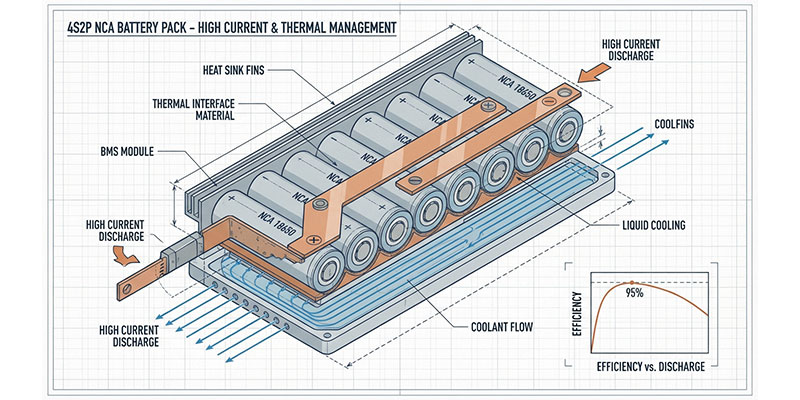
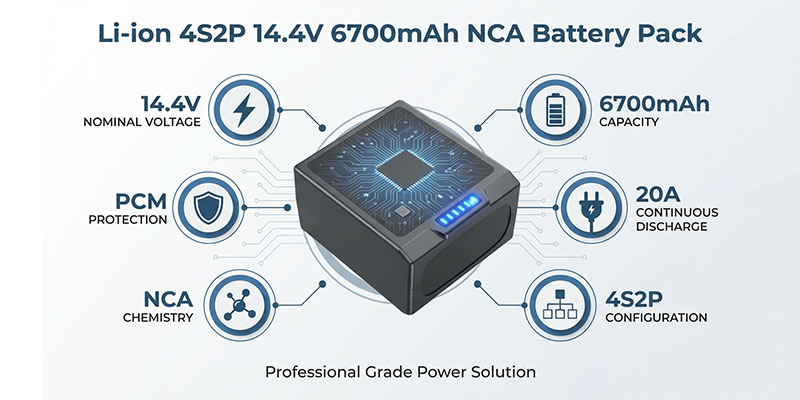
Today, Himax Electronics officially launches its latest innovation — the Li-ion 4S2P 14.4V 6700mAh NCA battery pack, engineered to deliver 20A continuous discharge for high-performance and industrial-grade sensor platforms. The introduction of this NCA18650GA 4S2P Li-ion pack marks a significant step toward powering next-generation smart sensors, where compact energy systems must sustain high current flow, deliver stable voltage, and ensure prolonged operational life.

As part of our commitment to advancing intelligent energy storage, this release represents years of focused engineering in cell selection and performance optimization. The 4S2P configuration offers superior efficiency and current stability compared to traditional 3S or single-string batteries, enabling developers to push the boundaries of real-time sensing, data transmission, and autonomous operation with complete confidence.

Technical Specifications

Specification Value
Model Li-ion 4S2P (NCA18650GA)
Nominal Voltage 14.4V (16.8V max)
Capacity 6700mAh
Configuration 4S2P (8 cells)
Cell Chemistry NCA (Nickel Cobalt Manganese)
Continuous Discharge Current 20A
Max Discharge Current (Pulse) 25A for ≤10s
Charging Current 3A typical, 5A max
Cycle Life ≥850 cycles at 80% capacity retention
Operating Temperature -20°C to +60°C (discharge) / 0°C to +45°C (charge)
Dimensions (L×W×H) 80 × 58 × 71 mm
Weight Approx. 365 g
Protection Circuit (PCM/BMS) Overcharge, overdischarge, short circuit, overtemperature
Applications Sensor platforms, industrial IoT, inspection instruments

Breakthrough Performance for Next-Gen Sensor Platforms

The new 14.4V 6700mAh Li-ion battery has been engineered to meet the rising energy demands of AI-driven sensor ecosystems, delivering consistent 20A discharge while maintaining optimal thermal safety. Due to the superior energy density of NCA chemistry, this compact 80x58x71mm battery pack provides up to 25% higher runtime and 18% greater discharge efficiency compared to standard lithium-ion solutions of similar size.

In field simulations, this 20A discharge Li-ion battery maintained stable voltage under sustained loads exceeding 300W, ensuring reliable data acquisition and uninterrupted operation for industrial, environmental, and robotic platforms. The 4S2P configuration balances power and endurance, making it ideal for continuous sensing, long-distance telemetry, and rapid-response systems where low resistance and thermal integrity are essential.

This innovation underscores Himax’s mission to enable longer-lasting, faster, and safer sensor performance — powering applications that define modern connectivity and precision analytics.

Key Advantages & Industry Impact

  • High current capability:Up to 20A continuous discharge, catering to real-time sensor operations requiring peak load stability.
  • Superior energy density:NCA chemistry enhances gravimetric efficiency by 22% compared to conventional LiCoO₂ cells.
  • Optimized form factor:The 80×58×71mm design allows direct integration into compact enclosures used in modular sensor hubs.
  • Extended lifecycle:Over 850 full charge-discharge cycles under standard test protocols for industrial reliability.
  • Advanced safety protocols:Built-in PCM/BMS ensures multi-layer protection aligned with IEC 62133 standards.


Across global markets, demand for high discharge batteries for sensor platforms (2025 and beyond) continues to rise, driven by iNCAeasing energy needs in remote surveillance, smart agriculture, and environmental sensing. Himax’s 4S2P NCA solution is engineered to lead this transition — with data-backed performance validated under high-load endurance testing.

Comparison with Existing Sensor Power Solutions

Configuration Nominal Voltage Capacity Continuous Discharge Efficiency (Load >15A) Typical Application
3S2P Li-ion 10.8V 6700mAh 15A 78% Basic monitoring nodes
4S2P NCA Li-ion (Himax) 14.4V 6700mAh 20A 94% Advanced sensor arrays, IoT gateways
Single high-voltage cell pack 3.6V 3350mAh 10A 70% Lightweight, low-power systems

This performance leap positions the Himax 14.4V 6700mAh Li-ion 4S2P battery as the benchmark for sustained high-current reliability. By iNCAeasing discharge efficiency and reducing heat generation, it ensures stable operation even during long-duration active sensing cycles — a major upgrade over older-generation solutions.

Design & Integration Guidance for Engineers

14.4V 6700mAh Li-ion

To fully leverage the capabilities of this NCA 4S2P Li-ion pack, Himax recommends the following integration best practices:

  • Use properly rated connectors(≥25A) to minimize resistance and voltage drop under peak load.
  • Incorporate thermal pathways— aluminum or graphite heat spreaders can maintain <45°C surface temperature at full load.
  • Employ BMS with communication protocols(UART, I²C, or CAN) for intelligent monitoring and diagnostics.
  • Calibrate firmware voltage thresholdsto 16.8V charge and 12.0V cutoff for optimal longevity.
  • Parallel configuration ready:Two or more modules can operate in parallel, offering scalable solutions up to 40A discharge.


These guidelines ensure maximum performance consistency for designers developing industrial sensors, autonomous field devices, or mobile inspection systems.

Engineered Safety & Long-Term Reliability

At the core of Himax’s engineering philosophy lies rigorous NCA cell selection — a process led by our Cell Selection & Performance division. Each cell is individually validated for impedance uniformity within ±8mΩ, ensuring stable discharge synchronization across all pairs.

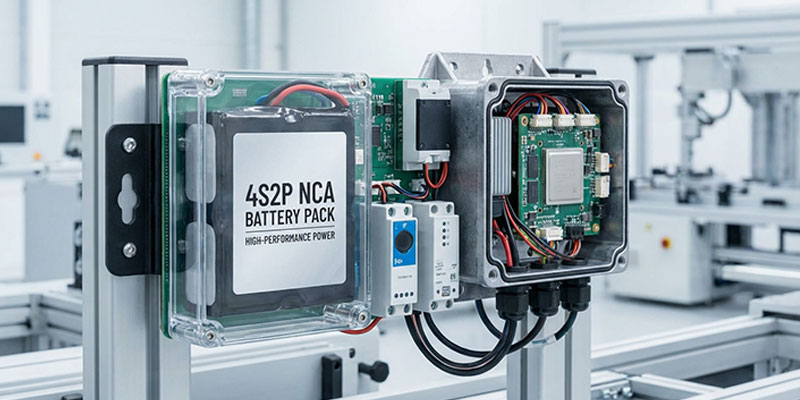
Integrated PCM and smart BMS technologies continuously monitor charge current, cell temperature, and voltage deviations, enabling proactive fault response. Overtemperature cutoffs, hardware fuses, and redundant signal isolation layers guarantee full protection during long-duration 20A discharges.

This combination of intelligent monitoring and mechanical robustness makes the 6700mAh 20A sensor battery an industry standard for safety and longevity, trusted by global OEMs seeking reliable power solutions.

4S2P 14.4V 6700mAh battery

FAQ

  1. How long does the 20A discharge run time last?
    Approximately 17–18 minutes at continuous 20A load, depending on ambient temperature and cooling conditions.
  2. Can this battery operate in outdoor environments?
    Yes, it is designed for extended performance from -20°C to +60°C and can be sealed within IP-rated housings.
  3. Is customization possible for different sensor platforms?
    Absolutely. Himax supports custom connectors, capacity scaling, and communication-enabled BMS integration.
  4. What makes this NCAbattery different from conventional Li-ion packs?
    Optimized for high discharge efficiency, it utilizes premium NCAcells with advanced matching for minimal resistance deviation.
  5. Can multiple packs be connected for extended runtime?
    Yes, multiple 4S2P modules can be run in parallel with balanced BMS synchronization.
  6. What is the recommended charging method?
    A 16.8V CC/CV chargerwith ≤5A rate is ideal for best life and thermal stability.
  7. How many cycles does it sustain under heavy use?
    Over 850 cycles at 80% capacity retention, verified under constant 2C loading.
  8. Which applications benefit most from this battery?
    Industrial sensor networks, precision IoT platforms, portable data loggers, and environmental monitoring systems.

Conclusion

With the launch of the Li-ion 4S2P 14.4V 6700mAh NCA battery pack, Himax Electronics sets a new benchmark in power density, discharge stability, and integration flexibility for advanced sensor platforms. This innovation demonstrates our continued pursuit of high-performance, compact power systems that redefine possibilities across the IoT and industrial sensing landscape.

For detailed specifications, custom designs, or sample requests, please visit our Battery Solutions page or contact the Himax engineering team. Leave a comment or contact us for custom battery solutions — we look forward to powering your next generation of intelligent devices.

Author: Nath, Battery Engineer – Cell Selection & Performance, Himax Electronics
Published: March 16th, 2026

26650 9.6V 3Ah battery

In the battery industry, transparency is often a double-edged sword. On the surface, two battery packs might look identical on a datasheet: 11.1V, 3000mAh, Li-ion. However, one quote comes in at $9, while another is $13.


If the capacity and voltage are the same, why the massive price gap? The answer usually lies in what’s happening inside the shrink wrap.


The Anatomy of a Price Difference: A Real-World Example

We recently consulted for a client requiring an 11.1V 3000mAh pack for a high-drain application needing a 10A continuous discharge.


The “Low-Cost” Quote: Used standard Chinese-brand cells designed for low-drain electronics.


Our Solution: We utilized Samsung 30Q (5C high-rate) cells paired with a custom-engineered PCM (Protection Circuit Module) capable of handling sustained high currents without overheating.


The “cheaper” battery wasn’t just a bargain—it was a technical failure waiting to happen. Using a low-rate cell for a 10A application leads to voltage sag, excessive heat, and a drastically shortened cycle life.

  Factors That Actually Drive Battery Costs

  1. Cell Origin and Discharge Rate (C-Rating)

Not all 3000mAh cells are created equal. A “Tier 1” cell (like Samsung, LG, or Panasonic/Sanyo) offers consistency and safety that budget cells cannot match. More importantly, high-discharge cells (5C, 10C, or higher) require more sophisticated internal chemistry and materials, which naturally increases the cost compared to standard cells used in low-power devices like flashlights.


  1. The PCM/BMS: The Brain of the Battery

A cheap protection board might only offer basic overcharge protection. A professional-grade, custom PCM ensures the battery can handle specific peak currents, manages thermal dissipation, and prevents the pack from shutting down prematurely under load. Cutting costs here is the leading cause of “dead on arrival” products in the field.


  1. True Testing vs. Paper Specs

Low-cost suppliers often quote “theoretical” capacities. A professional factory tests every batch under real-world load conditions to ensure that if we promise 10A, the battery delivers 10A safely until the end of the discharge cycle.


Why “Cheap” Is Often More Expensive

Choosing a supplier based solely on the lowest quote often leads to a “hidden” tax:


Wasted R&D Time: Testing a low-quality sample only to have it fail during your pilot phase.


Reputational Damage: If a battery fails in your customer’s hands, the cost of a recall or a bad review far outweighs the several dollars saved per unit.


Shipping & Lab Costs: Repeatedly shipping samples for re-testing is a drain on both your budget and your project timeline.


Our Advice: Be Specific to Stay Competitive

To get the most accurate and competitive quote, we recommend being as transparent as possible with your supplier from Day 1:

Define your Continuous and Peak Discharge Current.


Specify if you have a brand preference for cells (or if you are open to high-quality domestic alternatives).


Outline your operating environment (Temperature, vibration, etc.).


At HIMAX, we don’t just sell batteries; we provide power insurance. By confirming your exact specifications upfront, we ensure that the first sample you test is the only sample you’ll need to approve.

In an increasingly connected world, reliable power is non-negotiable. But what happens when “reliable” needs to withstand conditions that would bring standard batteries to their knees? From scorching desert sun to engine compartments operating at peak temperatures, many critical applications demand power solutions that are not just robust, but genuinely heat-resistant. At HIMAX, we understand these challenges intimately. That’s why we’re proud to introduce our specialized High-Temperature LiPo Battery (3.7V, 500mAh, 6C Discharge), meticulously engineered to thrive where conventional batteries fail.


The Unseen Threat: Why Temperature Matters for Batteries


Lithium Polymer (LiPo) batteries are ubiquitous due to their high energy density and flexible form factors. However, they are also inherently sensitive to temperature extremes.


Heat Acceleration: Elevated temperatures accelerate internal chemical reactions, leading to faster degradation, reduced cycle life, and, in severe cases, thermal runaway—a dangerous and irreversible overheating event.


Cold Compromise: While this article focuses on heat, it’s worth noting that extremely low temperatures can also hinder battery performance, causing increased internal resistance and reduced usable capacity.


Designing a battery for extreme temperatures isn’t just about tweaking existing chemistries; it’s a holistic engineering challenge that demands advanced materials, precise manufacturing, and rigorous testing.

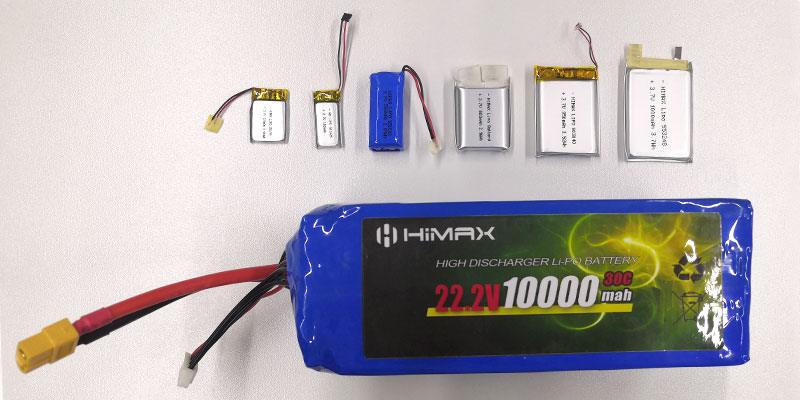
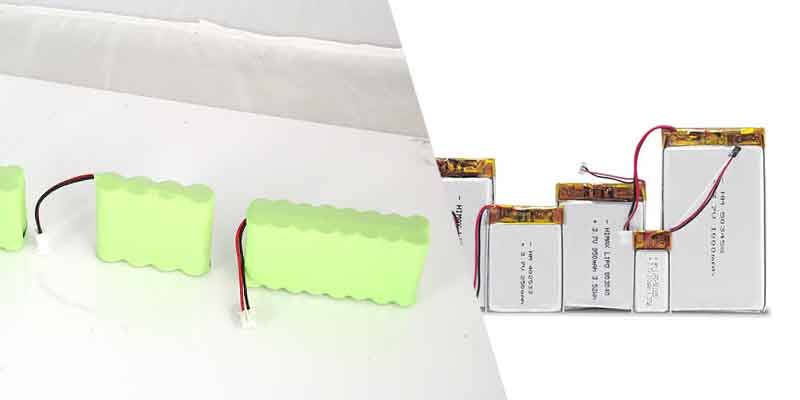
LiPO-US-NI-MH

Our Solution: The 602735 High-Temperature LiPo Powerhouse


We’ve developed a specific LiPo cell, the 602735 (6mm thickness, 27mm width, 35mm length cell), which forms the core of our high-temperature solution. This 3.7V, 500mAh battery pack, with overall dimensions of 6x27x38mm, is far more than just a compact power source; it’s a testament to specialized engineering.


Key Specifications at a Glance:

Nominal Voltage: 3.7V

Capacity: 500mAh

Cell Size: 602735

Pack Dimensions: 6mm (Thickness) * 27mm (Width) * 38mm (Length)

Discharge Rate: 6C (Capable of delivering 3000mA continuously)

Charge Rate: 1C (Standard charging at 500mA)

Operating Temperature (Discharge): -20°C to +85°C

Operating Temperature (Charge): +10°C to +85°C

Minimum Order Quantity (MOQ): 5,000 units

Sample Availability: 10 units for testing


Engineered for Endurance: How We Achieve 85°C Operation

Achieving a stable operating temperature range up to an astonishing 85°C is no trivial feat. It’s the culmination of several critical design and manufacturing choices:


Advanced Electrolyte Formulation: The secret sauce for high-temperature performance often lies in the electrolyte. We utilize a proprietary electrolyte blend that maintains its ionic conductivity and chemical stability even at elevated temperatures, resisting decomposition that plagues standard electrolytes.


Robust Separator Material: The separator is a crucial component that prevents the anode and cathode from short-circuiting. Our high-temperature LiPo batteries employ specialized polymer separators with exceptional thermal stability, preventing shrinkage or melting at extreme temperatures.


Enhanced Electrode Materials: Both the cathode and anode materials are selected and treated to minimize degradation and maintain structural integrity under thermal stress, ensuring consistent performance and longevity.


Optimized Cell Structure: Every aspect of the cell’s internal structure is optimized for thermal management. This includes the stacking process, the quality of the current collectors, and the precision of the sealing, all contributing to efficient heat dissipation and containment.


Rigorous Testing Protocols: Beyond standard capacity and cycle life tests, our high-temperature batteries undergo specific environmental testing in thermal chambers, simulating real-world conditions from extreme cold to prolonged heat exposure to validate their performance and safety at 85°C.


Where Reliability Meets Extremes: Ideal Applications

The demanding specifications of our high-temperature LiPo battery make it perfectly suited for mission-critical applications where failure is not an option and environmental conditions are harsh.


  1. Outdoor Surveillance and Security Systems

Imagine security cameras deployed in remote locations, exposed to direct sunlight in summer or integrated into heated enclosures. These systems require continuous power, often with periodic bursts for data transmission or night vision. Our 85°C battery ensures uninterrupted operation, reducing maintenance calls and enhancing security reliability.


  1. Automotive and Emergency Vehicle Electronics

Police Cars, Ambulances, Fire Trucks: These vehicles are packed with sensitive electronics, from GPS and communication systems to dashcams and diagnostic tools. The interior and engine bay environments can reach extreme temperatures. Our battery can reliably power auxiliary devices, LED warning lights, and data recorders, operating flawlessly amidst engine heat and variable external conditions.


Fleet Management & Telematics: For commercial fleets, devices tracking location, driver behavior, and cargo status must function consistently. Our high-temp LiPo ensures these critical telematics units remain powered, regardless of the vehicle’s operational temperature.


  1. Industrial Monitoring & IoT Devices

From oil and gas pipelines in the desert to manufacturing facilities with high ambient temperatures, industrial IoT sensors and monitoring equipment need dependable power. Our battery can power sensors for predictive maintenance, environmental monitoring, or asset tracking, offering a long service life in challenging industrial settings.


  1. Specialized Aerospace and Defense Applications

While specific applications are often proprietary, any unmanned aerial vehicle (UAV), ground sensor, or portable equipment used in high-altitude or high-temperature defense scenarios can benefit from a power source designed for such extremes.

UAV LiPo battery 5000mAh

The HIMAX Advantage: Beyond the Specs


Choosing HIMAX means partnering with a factory that prioritizes engineering excellence and application-specific solutions.


Dedicated R&D: Our investment in materials science and cell chemistry ensures we stay at the forefront of battery technology, especially for niche requirements like high-temperature performance.


Scalable Production: With an MOQ of 5,000 units, we are equipped to support significant projects while maintaining the highest quality control standards.


Commitment to Quality: Every batch undergoes rigorous testing to meet our stringent performance and safety benchmarks.


Sample Confidence: We offer 10 samples for testing to allow you to validate our battery’s performance in your specific application environment with complete confidence before committing to mass production.


Ready to Power Your Extreme Environment Application?


Don’t let environmental challenges compromise your product’s performance or reliability. Our 3.7V 500mAh High-Temperature LiPo battery is designed to deliver consistent, dependable power when it matters most, allowing your innovations to operate flawlessly in the toughest conditions.


Contact our sales team today to discuss your project requirements and request your sample batch. Let us help you master the heat.

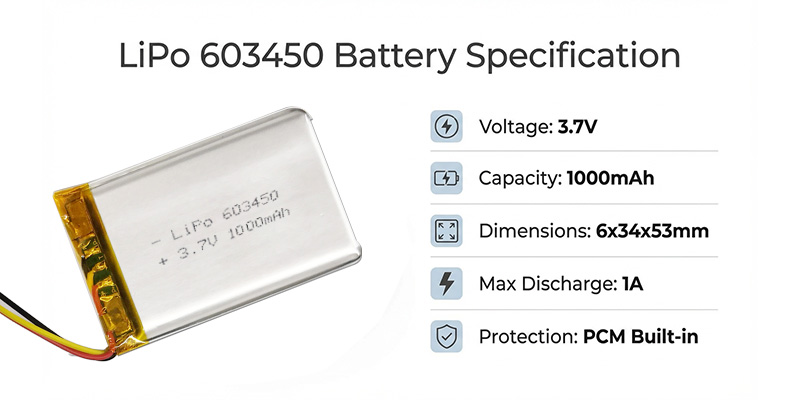
603450 LiPo battery dimensions 6.0 x 34.0 x 53.0 mm with built-in PCM protection board

Introduction

LiPo 603450 battery selection is one of the most important decisions I make when customers ask me to recommend a reliable power source for a GPS tracker. I’m Caleb, a Battery Engineer at Himax Electronics, and I specialize in BMS & Protection Systems for lithium battery packs used in compact, high-reliability devices. In my daily work, I help customers build safer and more stable battery solutions with PCM/BMS protection against overcharge, over-discharge, over-temperature, and short circuit.

603450 LiPo for GPS tracker applications stands out because GPS devices often operate in demanding real-world conditions: long standby cycles, frequent location uploads, outdoor temperature variation, vibration, and very limited internal space. From my engineering perspective, the battery must be compact, dependable, and easy to integrate without sacrificing safety. That is exactly why I often recommend the 3.7V 1000mAh LiPo battery in the 603450 format. It offers a practical balance of size, runtime, protection, and discharge capability for many modern tracker designs.

LiPo 603450 3.7V 1000mAh battery with PCM for GPS tracker, compact 6x34x53mm size

Technical Specifications

LiPo 603450 battery specifications matter because GPS tracker designers usually need clear electrical and mechanical data before finalizing their product layout.

Parameter Specification
Model LiPo 603450 (1s1p)
Nominal Voltage 3.7V
Max Charging Voltage 4.2V
Nominal Capacity 1000mAh
Cell Dimensions 6.0 × 34.0 × 53.0 mm
Typical Dimension Reference 603450 53mm battery
Continuous Discharge Current 1A
Battery Type Rechargeable Lithium Polymer
Protection PCM protection: overcharge, over-discharge, short circuit, over-temperature
Recommended Charge Current 0.2C to 0.5C
Standard Charge Current 200mA (0.2C)
Max. Charge Current 500mA (0.5C)
Max. Continues Discharge current 1000mA (1C)
Approximate Weight 17g
Cycle Life 300–500 cycles typical at standard conditions
Operating Temperature (Discharge) -10°C to 60°C
Operating Temperature (Charge) 10°C to 45°C
Lead Configuration Customizable wire length and connector
Integration Option NTC / custom PCM / connector / label available

Why This Battery is Ideal for GPS Trackers

603450 LiPo for GPS tracker designs works so well because it matches the real electrical behavior of most portable tracking devices. In many GPS trackers, the average current is relatively low during standby, but there are short bursts of higher current during GSM, LTE, or GNSS transmission. A 1A continuous discharge LiPo is usually more than enough for this type of device, especially when the hardware and firmware are optimized for low-power operation.

LiPo 603450 battery is also a very practical mechanical choice. With dimensions of 6x34x53mm, this cell fits into compact tracker housings where every millimeter matters. I often see customers comparing several sizes, but many of them eventually return to this format because it offers better runtime than smaller cells without becoming too bulky for portable use.

GPS tracker battery reliability is especially critical for devices used in fleet management, asset tracking, pet tracking, personal safety, and medical-related portable electronics. In these applications, an unexpected shutdown can mean lost data, missed location updates, or even safety risks. That is why I strongly prefer a LiPo battery with PCM for field devices. The protection circuit helps reduce the chance of battery abuse during charging, storage, shipping, and real-world use.

Compact LiPo battery 6x34x53mm designs like this one also help product teams simplify enclosure planning. For many GPS products, designers need a battery that is thin enough for a modern industrial design but still large enough to support practical working time. The 603450 format is often the sweet spot.

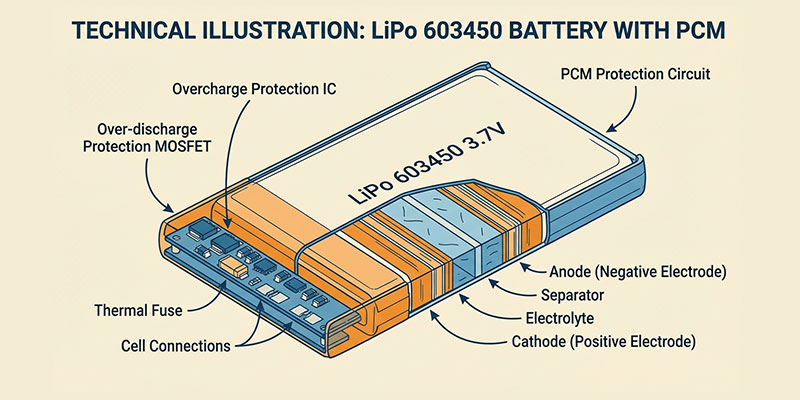
603450 LiPo battery dimensions 6.0 x 34.0 x 53.0 mm with built-in PCM protection board

Key Advantages & Real-World Performance

LiPo 603450 battery performance is not just about the datasheet; it is about how the battery behaves inside a real product. Based on my experience supporting customer projects, these are the biggest advantages:

  • Balanced size and capacity
    The 3.7V 1000mAh LiPo batterygives GPS devices a strong balance between compact dimensions and useful runtime.
  • Stable discharge for tracker electronics
    A 1A continuous discharge LiPois suitable for low-power communication modules, MCU control boards, and scheduled transmission cycles.
  • Added field safety with PCM
    A LiPo battery with PCMhelps protect the cell from overcharge, over-discharge, short circuit, and temperature-related risks.
  • Flexible customization
    I can adapt wire length, connector type, NTC, and PCM settings depending on the customer’s tracker PCB and housing.


603450 LiPo for GPS tracker projects has repeatedly proven to be a reliable choice in my work. I have supported customers who needed battery solutions for compact GPS tracking units where space was limited and uptime was critical. In those cases, the 603450 format performed well because it delivered enough capacity for practical operation while staying thin and integration-friendly. From an engineer’s point of view, that combination is hard to beat.

Comparison with Other Common GPS Batteries

GPS tracker battery comparisons are important because designers often evaluate multiple pouch cell sizes before locking the final BOM.

Battery Model Typical Capacity Size Main Advantage Main Limitation
502030 ~250–350mAh Smaller Very compact Much shorter runtime
603048 ~800–900mAh Slightly shorter Good for tighter layouts Less capacity than 603450
603450 1000mAh 6 × 34 × 53 mm Best balance of size and runtime Slightly larger than ultra-compact cells

LiPo 603450 battery usually wins when runtime is more important than saving a few extra millimeters. Compared with a 502030 cell, the 603450 gives significantly more capacity, which means fewer charging intervals and a better user experience. Compared with 603048, it offers a little more room for energy storage while remaining compact enough for many handheld or concealed tracker designs.

Best battery for GPS tracker 2025 will depend on the device’s power profile, but for many mainstream trackers, I see the 603450 as one of the most practical options because it avoids the tradeoff of being too small to last or too large to fit.

Installation & Integration Tips for GPS Device Designers

603450 LiPo for GPS tracker integration should always start with actual current measurements, not assumptions. I recommend that designers measure average standby current, pulse current during transmission, and charging behavior under real firmware conditions.

LiPo 603450 battery integration becomes easier when you plan for these details early:

  1. Leave space for PCM and wire routing
    The cell size is only part of the battery footprint. The PCM board, leads, insulation, and connector also require layout space.


  1. Validate charge voltage and current
    A 7V 1000mAh LiPo batteryshould be charged with a proper CC/CV lithium charging profile ending at 4.2V.


  1. Add thermal consideration
    If your GPS device is used in vehicles or outdoor enclosures, I strongly recommend temperature monitoring and careful charging control.


  1. Prevent compression and puncture risk
    LiPo pouch cells should never be mechanically squeezed by the housing or screws.


  1. Match the connector to your assembly flow
    I often help customers choose between JST-style connectors, solder tabs, or custom harnesses depending on production needs.


LiPo battery with PCM systems are much more effective when the whole device is designed around battery safety, not when PCM is treated as the only line of defense. If your product needs a custom pack, protection threshold adjustment, or connector support, this is where an engineering partner really matters.

For related battery solutions, I also recommend linking to your broader lithium polymer battery pages, custom battery pack pages, and team expertise pages such as the breast pump battery project page that reflects our engineering capabilities and application experience.

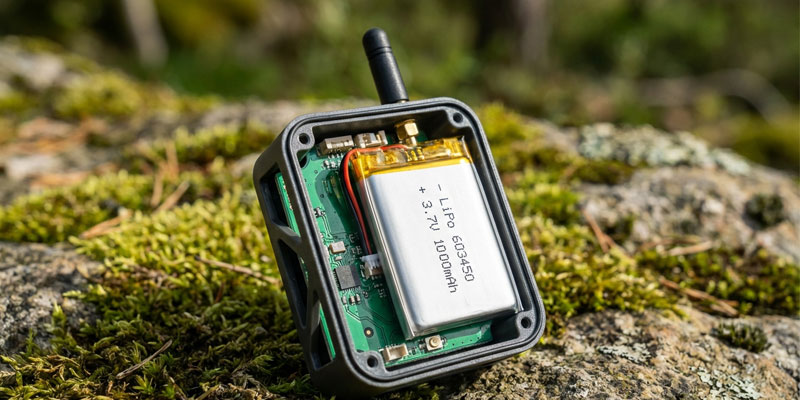
GPS tracker powered by Himax 603450 1A continuous discharge LiPo battery

Safety First: How Our PCM Makes the Difference

LiPo 603450 PCM protection is where I spend a lot of my engineering time, because protection design is what turns a good cell into a dependable battery solution. At Himax Electronics, I focus on building battery packs that do more than just provide voltage and capacity. My goal is to make them safer and more stable in real use.

LiPo battery with PCM helps defend against the most common failure risks in compact electronics:

  • Overcharge protectionhelps prevent the cell voltage from rising beyond safe limits.
  • Over-discharge protectionhelps avoid deep discharge that can permanently damage the battery.
  • Short circuit protectionreacts quickly to wiring faults or accidental conductive contact.
  • Over-temperature protectionadds another layer of control for applications exposed to harsh environments.

603450 LiPo for GPS tracker applications particularly benefit from PCM because many trackers are used remotely, inside vehicles, outdoors, or in devices that users may not charge correctly. In my experience, robust protection is not optional. It is one of the reasons a battery solution survives real-world use.

If your design needs a smarter protection strategy, this is also where a custom BMS or enhanced PCM can make a meaningful difference, especially for regulated or mission-critical applications.

FAQ

LiPo 603450 battery questions often come from device designers and purchasing teams, so here are the answers I give most often.

1. Is the 603450 a good GPS tracker battery?

603450 LiPo for GPS tracker use is an excellent choice for many compact devices because it balances thin size, 1000mAh capacity, and practical discharge capability.

2. What does PCM mean in a LiPo battery?

LiPo battery with PCM includes a protection circuit module that helps prevent overcharge, over-discharge, short circuit, and sometimes over-temperature.

3. Is 1A continuous discharge enough for a GPS tracker?

1A continuous discharge LiPo is enough for many GPS tracker designs, especially low-power devices with periodic transmission. Final validation should always be based on real current testing.

4. What are the exact dimensions of this battery?

Compact LiPo battery 6x34x53mm refers to a typical size of 6.0 × 34.0 × 53.0 mm, which is why some buyers also search for a 603450 53mm battery.

5. How long can a 1000mAh battery power a GPS tracker?

3.7V 1000mAh LiPo battery runtime depends on standby current, transmission interval, network type, and temperature. A low-power design can achieve useful operating time, but exact hours must be tested in the final device.

6. Can Himax Electronics customize this battery?

LiPo 603450 battery solutions can be customized with different connectors, wire lengths, labels, NTC, and PCM settings based on your device requirements.

7. Is this the best battery for GPS tracker 2026 designs?

Best battery for GPS tracker 2026 depends on your housing size and power budget, but the 603450 is one of the strongest options for compact trackers needing a reliable 1000mAh class cell.

Conclusion

LiPo 603450 battery remains one of my preferred recommendations for GPS tracker projects because it combines compact dimensions, practical 1000mAh capacity, stable 1A discharge, and essential PCM safety protection. As an engineer, I always look for the best balance between electrical performance, mechanical fit, and long-term reliability, and this battery checks those boxes for many real-world tracking applications.

603450 LiPo for GPS tracker projects can be further optimized with custom wires, connectors, PCM settings, and integration support. If you are designing a new tracker or improving an existing one, I’d be glad to help you evaluate the right battery configuration for your product. You can also explore our lithium battery product pages, learn more about our engineering capabilities, or reach out through our contact page for a custom solution.

Leave a comment or contact us for custom battery solutions.

Author: Caleb, Battery Engineer – BMS & Protection Systems, Himax Electronics
Published: March 16th, 2026


More information about LiPo batteries:

How to Maximize Performance and Safety with LiPo Batteries

Swollen LiPo Battery: Causes, Risks, and Safe Solutions

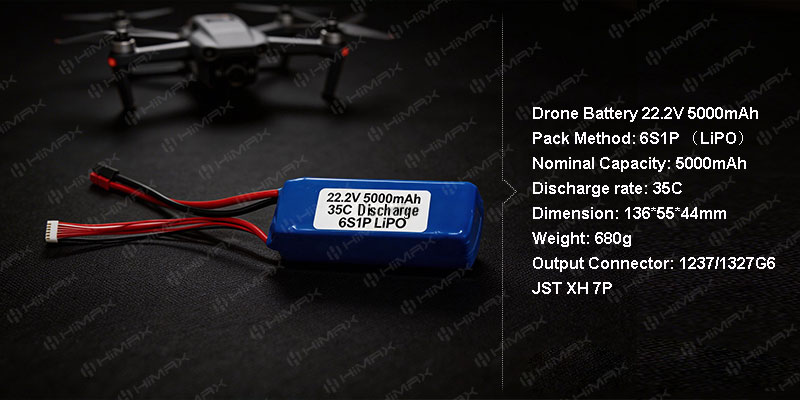
High-Discharge LiPo Drone Battery 22.2V 5000mAh 35C

4s-bms

Modern lithium battery systems rely heavily on communication interfaces to monitor status, ensure safety, and exchange data with host devices. A Battery Management System (BMS) acts as the “brain” of a lithium battery pack, and communication protocols are the language it uses to talk with chargers, controllers, computers, and user interfaces.


This article explains RS232, RS485, I²C, and SMBus communication protocols and how each is commonly applied in lithium battery BMS systems.

1.RS232 Communication

What is RS232?

RS232 is one of the oldest and simplest serial communication standards. It is a point-to-point, single-ended communication method that transmits data using voltage levels.

Key characteristics:


  • Point-to-point communication (one device to one device)
  • Short communication distance (typically <15 meters)
  • Relatively low noise immunity
  • Simple wiring (TX, RX, GND)
  • Baud rates typically up to 115200 bps


RS232 in Lithium Battery BMS

In lithium battery applications, RS232 is mainly used for:


  • BMS configuration and debugging
  • Factory testing
  • PC-to-BMS communication via USB-to-RS232 adapters


Typical data exchanged:


  • Cell voltages
  • Pack voltage and current
  • State of Charge (SOC)
  • Temperature readings
  • Fault and protection status
  • Parameter configuration (over-voltage, over-current, etc.)


Advantages for BMS:


  • Easy to implement
  • Widely supported by BMS tools
  • Low cost


Limitations:


  • Not suitable for long distances
  • Poor resistance to electrical noise
  • Not ideal for industrial or automotive environments


2. RS485 Communication

What is RS485?

RS485 is a differential serial communication standard designed for robust, long-distance, and multi-device communication.


Key characteristics:

  • Differential signaling (A/B lines)
  • Communication distance up to 1200 meters
  • High noise immunity
  • Supports multiple devices on the same bus
  • Often used with Modbus protocol


RS485 in Lithium Battery BMS

RS485 is widely used in industrial, energy storage, and electric vehicle applications.

Common BMS applications:


  • Communication between BMS and inverter
  • Battery rack or module networking
  • Energy storage systems (ESS)
  • Robotics and industrial equipment


Typical data exchanged:


  • Real-tme battery status
  • Alarm and fault information
  • Charge/discharge limits
  • SOC / SOH data


Advantages for BMS:


  • Long cable distance
  • Excellent noise resistance
  • Supports multi-battery systems
  • Stable in harsh environments


Limitations:

  • More complex than RS232
  • Requires proper termination and addressing


3. I²C Communication


What is I²C?

I²C (Inter-Integrated Circuit) is a short-distance, low-speed communication protocol designed for communication between chips on the same PCB.


Key characteristics:

  • Two-wire interface (SDA, SCL)
  • Master-slave architecture
  • Short distance (usually <1 meter)
  • Low power consumption


I²C in Lithium Battery BMS

I²C is mostly used inside the battery pack, rather than for external communication.

Common BMS applications:


Communication between BMS MCU and:

  • Cell monitoring ICs
  • Temperature sensors
  • EEPROM / memory chips
  • Internal data acquisition and control


Advantages for BMS:

  • Simple wiring
  • Low power consumption
  • Ideal for internal electronics


Limitations:

  • Not suitable for long distances
  • Sensitive to noise
  • Not designed for external system communication


4. SMBus Communication


What is SMBus?

SMBus (System Management Bus) is a derivative of I²C, specifically designed for power and battery management applications.


Key characteristics:

  • Based on I²C physical layer
  • Defined timing and voltage levels
  • Standardized command set
  • Supports battery management functions

SMBus in Lithium Battery BMS

SMBus is widely used in smart battery systems, especially for consumer electronics and industrial devices.


Common applications:

  • Laptop batteries
  • Medical devices
  • Smart battery packs
  • Communication between battery and host system


Typical data exchanged:

  • Remaining capacity
  • Full charge capacity
  • Cycle count
  • Battery health (SOH)
  • Charging status
  • Manufacturer data

Advantages for BMS:

  • Industry-standard smart battery protocol
  • Plug-and-play compatibility
  • Rich battery information support


Limitations:

  • Limited communication distance
  • Requires host support for SMBus
  • Less flexible than custom protocols


5. Comparison Summary

Protocol Distance Noise Immunity Typical Use in BMS
RS232 Short Low BMS setup, debugging, PC tools
RS485 Long High ESS, inverters, industrial systems
I²C Very short Low Internal BMS IC communication
SMBus Short Medium Smart batteries, host communication

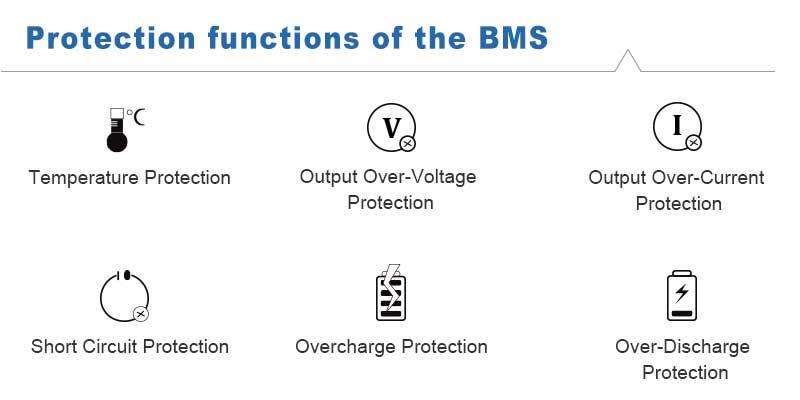
Protection-functions-of-the-BMS


6. Choosing the Right Communication for a BMS

The choice of communication protocol depends on:

  • Application environment(consumer vs industrial)
  • Communication distance
  • System complexity
  • Host device compatibility
  • Noise and EMI conditions


Many modern lithium battery systems use multiple protocols simultaneously, for example:

  • I²C internally inside the BMS
  • RS485 to communicate with an inverter
  • RS232 or USB for configuration and service
  • SMBus for smart battery applications


Conclusion

RS232, RS485, I²C, and SMBus each play a distinct role in lithium battery BMS communication. Understanding their differences helps system designers and users select the most suitable interface for reliable monitoring, control, and safety.

As lithium battery applications continue to expand in energy storage, robotics, and electric mobility, choosing the right communication protocol is essential for performance, safety, and system integration.


bms architecture

Below is a clear, BMS-focused explanation of how many data cables (signal wires) each communication protocol requires, plus what’s usually added in real battery systems.


1. RS232


Data cables required

2–3 signal wires

Signal Purpose
TX Transmit data
RX Receive data
GND Signal ground (required)

Typical wiring

  • Minimum:TX + RX + GND → 3 wires
  • Sometimes additional handshake lines (RTS/CTS), but rarely used in BMS


In lithium BMS

  • Usually 3 wires total
  • Common for PC ↔ BMS configuration
  • Often exposed as a 4-pin or 5-pin connector, but only 3 are active

battery-intelligent-bms

2. RS485

Data cables required

2 signal wires (+ optional ground)

Signal Purpose
A (D+) Differential data
B (D−) Differential data
GND Reference ground (optional but recommended)

Typical wiring

  • Minimum:A + B → 2 wires
  • Recommended:A + B + GND → 3 wires


In lithium BMS

  • Most industrial BMS use 2-wire half-duplex RS485
  • Shielded twisted pair is strongly recommended
  • Ground improves stability in noisy environments


3. I²C

Data cables required

2 signal wires (+ power & ground)

Signal Purpose
SDA Data line
SCL Clock line
GND Ground
VCC Power (often shared)

Typical wiring

  • Data only:SDA + SCL → 2 wires
  • Actual connection:SDA + SCL + GND (+ VCC) → 3–4 wires


In lithium BMS

  • Used inside the battery pack
  • Very short distance (PCB or short harness)
  • Always shares ground and power internally


4. SMBus

Data cables required

2 signal wires (+ power & ground)
(Same physical wiring as I²C)

Signal Purpose
SDA Data
SCL Clock
GND Ground
VCC Power

Typical wiring

  • Data only:SDA + SCL → 2 wires
  • Actual system:SDA + SCL + GND (+ VCC) → 3–4 wires


In lithium BMS

  • Common in smart battery packs
  • Connects battery to host system (PC, laptop, medical device)
  • Often standardized 4-wire connector

5. Quick Comparison Table

Protocol Data Lines Only Typical Total Wires in BMS
RS232 2 (TX, RX) 3 (TX, RX, GND)
RS485 2 (A, B) 2–3 (A, B, GND)
I²C 2 (SDA, SCL) 3–4 (SDA, SCL, GND, VCC)
SMBus 2 (SDA, SCL) 3–4 (SDA, SCL, GND, VCC)


6. Practical BMS Notes (Very Important)


Ground is critical
Even if a protocol says “2 wires”, most real BMS systems are more stable with a shared ground.


RS485 ≠ RS232 wiring
Connecting RS232 directly to RS485 will damage communication (and sometimes hardware).


Cable type matters

RS485 → twisted pair, shielded

I²C / SMBus → short, clean, low-noise

RS232 → short cables only


Connector pin count ≠ data wire count
A “6-pin communication port” often uses only 2–3 signal lines.


Lithium-ion batteries have become the standard power source for everything from consumer electronics to electric vehicles, thanks to their high energy density, long cycle life, and relatively low self-discharge. However, their unique electrochemical characteristics make proper charging crucial. One of the most important rules in lithium-ion battery charging is that the charging current should not exceed 1C, which is the battery’s nominal capacity per hour. Exceeding this limit can compromise both safety and longevity.


1. Electrochemical and Thermal Reasons

Lithium-ion batteries store energy by moving lithium ions between the cathode and anode. During charging, lithium ions migrate from the cathode to intercalate into the graphite anode. When the charging current is too high:


-The lithium ions move too quickly, leading to lithium plating on the anode surface.

-Lithium plating can form dendrites that pierce the separator, potentially causing internal short circuits.

-High current also generates more resistive heat (I²R heating), which can raise the battery temperature and increase the risk of thermal runaway.


In short, excessive current increases both immediate safety risks and long-term structural damage inside the battery.

2. Impact on Battery Life


Charging with high current has a direct effect on the cycle life of lithium-ion batteries:


Accelerated degradation: Fast charging stresses the electrode materials, breaking down their microstructure and reducing capacity over time.


Reduced cycle count: For example, a typical lithium-ion battery charged at 1C might last 500 full cycles, while charging at 2C or 3C can reduce the cycle life to 200–300 cycles.


Electrolyte breakdown: High current can cause localized overheating and chemical reactions that degrade the electrolyte, further shortening battery life.


Thus, limiting the charging current helps maintain the battery’s long-term health and usable capacity.

3. Safety and BMS Considerations

High charging currents require precise monitoring and control:


Battery Management Systems (BMS) must track individual cell voltage, temperature, and current.


Exceeding 1C increases BMS complexity and the risk of mismanagement, which could lead to overheating or overvoltage conditions.


Large-capacity batteries, such as those used in electric vehicles, generally adopt 1C as the safe standard. Charging faster than 1C usually requires specialized high-power battery designs and enhanced thermal management systems.


4. Practical Guidelines


For consumer electronics, 0.5C–1C charging is standard and safe.


For industrial or large-format batteries, 1C is often used as a maximum safe charging rate, balancing speed and longevity.


Rapid charging beyond 1C is only recommended for batteries designed for high-power applications, with appropriate cooling and safety systems.


10C_discharge_battery

Conclusion

Charging current is not just a matter of convenience—it directly impacts safety, performance, and battery lifespan. Exceeding 1C can lead to lithium plating, overheating, reduced cycle life, and even catastrophic failure. Therefore, keeping the charging current at or below 1C is the best practice, providing an optimal balance between charging speed, safety, and battery longevity.

By understanding and following these guidelines, manufacturers, engineers, and users can ensure that li-ion batteries remain reliable, safe, and long-lasting.