Strategic Decoupling: Why High-End Industrial Applications are Shifting Toward “BMS-less” Battery Modules Introduction: A New Paradigm in Battery Manufacturing
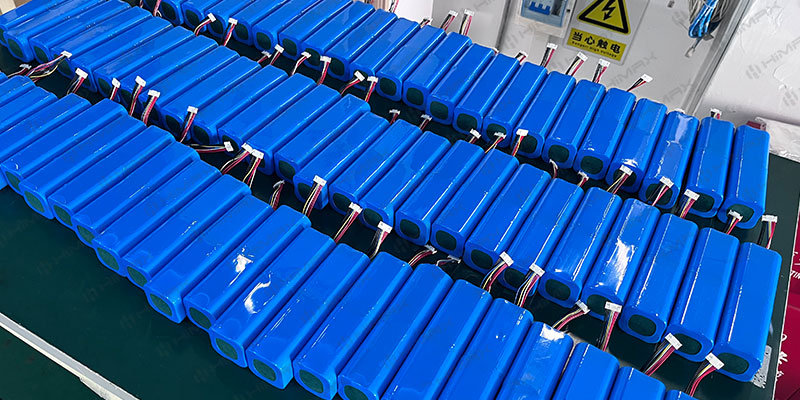
In the rapidly evolving world of custom energy storage, a significant change is taking place. While most users are familiar with “all-in-one” battery packs, a new manufacturing trend is emerging among high-end industrial clients and Electric Vehicle (EV) startups. This trend involves providing high-precision battery modules that do not include a built-in Battery Management System (BMS).
Traditionally, lithium-ion batteries are sold as integrated units. For consumer electronics or standard electric bikes, this “plug-and-play” convenience is ideal. However, as we move into 2026, sophisticated professional clients are choosing a different path. They are requesting “bare” battery modules—professionally welded and structurally reinforced—while choosing to integrate their own proprietary BMS. This separation of the chemical storage (the cells) from the digital intelligence (the BMS) is a strategic move designed to unlock maximum performance and system compatibility.
Understanding the Limits of “All-in-One” Systems
To understand why clients are moving away from integrated units, we must first look at the limitations of standard battery packs. Most off-the-shelf batteries are designed for “General Purpose” use. To ensure safety across many different environments, manufacturers often set very conservative limits on these packs.
Voltage and Capacity Ceilings: Standard integrated packs often have physical and electrical limits. For many manufacturers, a battery with a built-in protection board is typically restricted. These limits exist because the heat generated by the BMS electronics and the physical space inside a standard plastic shell make it difficult to scale up safely.
The “Black Box” Problem: For an advanced engineer, a standard BMS is a “black box.” Its internal logic, such as when it cuts off power or how it balances the cells, is “hard-coded” by the factory. If you are building a complex robot or a medical backup system, this lack of transparency can become a major obstacle to optimizing your machine’s performance.
The Power of Customization: Client-Led Integration
For specialized applications—ranging from agricultural robots to high-performance golf cart fleets—the client’s engineering team often understands the power needs of their machine better than the battery manufacturer does. By using their own BMS, they gain several critical advantages:
Advanced “Active” Balancing
Most standard batteries use “passive” balancing, which simply burns off excess energy as heat to keep cells equal. In contrast, high-end custom BMS units often use Active Balancing. This technology redistributes energy between cells during both charging and discharging. For large battery packs, this is a game-changer, as it significantly extends the total lifespan of the lithium-ion cells.
Real-Time Data and Predictive Maintenance
High-end industrial users need more than just a battery that “works.” They need a battery that “talks” to them. By using their own BMS, they can track:
Cell-level Internal Resistance: Monitoring how cells age over time.
High-Frequency Sampling: Detecting tiny electrical shifts to predict a failure before it happens.
Advanced Communication: Seamlessly syncing the battery data with the main computer using professional protocols like CANopen or Modbus.
By purchasing a BMS-less pack, these clients can connect their own highly calibrated sensors directly to the battery, ensuring the energy data is perfectly integrated into their own software ecosystem.
Breaking the Barrier
One of the most practical reasons for removing the internal BMS is scalability. When the BMS is moved outside the main battery module, the physical and electrical “bottlenecks” disappear.
High-Voltage Architecture: Without a “gatekeeper” inside the pack, engineers can easily connect modules in series to create 48V, 72V, 96V, or even 400V–800V systems. This allows the battery to match the peak efficiency of modern high-power motors.
Massive Capacity: Parallel configurations can exceed the standard limit, reaching hundreds of kilowatt-hours (kWh). By placing the BMS in a separate, temperature-controlled compartment, the heat generated by the electronics does not affect the delicate chemistry of the cells, improving both safety and efficiency.
Precision Manufacturing: Why the Build Quality Matters
Removing the BMS does not make the battery “simpler” to build. In fact, it requires higher precision from the manufacturing partner. Without a BMS to hide minor inconsistencies, the physical build must be perfect.
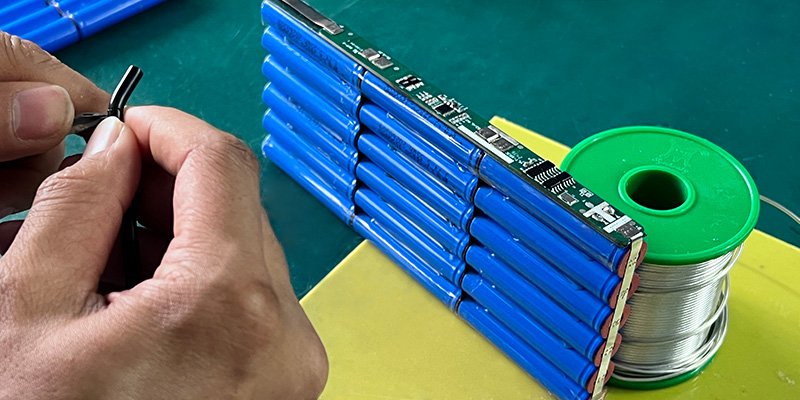
Zero-Resistance Welding: Because the client will connect their own sensitive wires to the battery, every weld must be flawless. We use CNC-controlled and laser welding to ensure that the junctions between cells have nearly zero resistance. This provides a “clean signal,” allowing the custom BMS to read voltages with extreme accuracy.
Industrial-Grade Structure: In a standard pack, the BMS circuit board often acts as a physical spacer. In our BMS-less modules, we replace this with custom-milled materials like G10 or FR4 (epoxy glass). These materials ensure the battery can survive the high vibrations of a golf cart or a factory floor without the connections breaking or wearing down.
A Collaborative Partnership
The “BMS-less” approach is built on a clear Responsibility Matrix. Our job is to ensure the mechanical and chemical stability of the battery cells and their connections. The client’s job is to manage the digital safety monitoring through their proprietary BMS.
To make this integration as easy as possible, we often provide “Pre-Wiring” services. We install a professional sensing wire harness during assembly. This allows the client to simply “plug in” their custom BMS into our standardized connectors. This reduces the risk of human error during the final assembly and ensures the BMS receives a noise-free, accurate signal from every single cell group.
Conclusion: Energy Storage as a Competitive Advantage
As industrial technology becomes more specialized, the demand for high-capacity, high-voltage battery modules is growing. Separating the battery pack from the BMS is not just a trend—it is a logical evolution for companies that view energy storage as a core part of their technology, rather than just a simple component.
By providing professionally assembled, BMS-less lithium-ion modules, we empower our clients to break through the traditional limits. This allows them to create products that are more powerful, more efficient, and more reliable than anything else in the market.