Security Patrol Robots Battery: 36V 15.6Ah Li-Ion Case Study
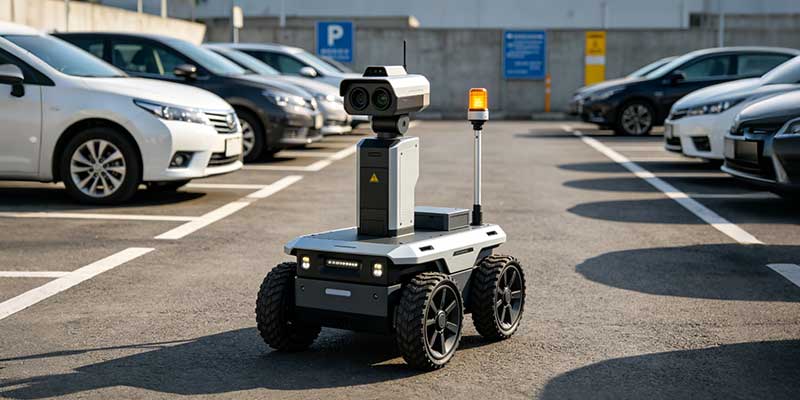
How Himax Electronics Battery Engineer Shawn evaluates long-endurance Li-ion packs for autonomous security robots – with real test data and BMS specifications
1. Introduction: Why Runtime Defines Autonomous Security Robots
When Daxbot deploys its security robots for 8 to 10 hours of continuous patrol at 3.7 mph, every watt-hour in the battery pack directly determines mission success. A robot that stops halfway through a patrol isn’t just an inconvenience – it creates a security gap.
I’m Shawn, a battery engineer at Himax Electronics. Over the past decade, I’ve designed Li-ion, LiFePO₄, and LiPo systems for medical devices, industrial equipment, and increasingly – autonomous robots.
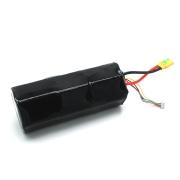
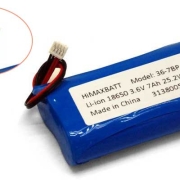
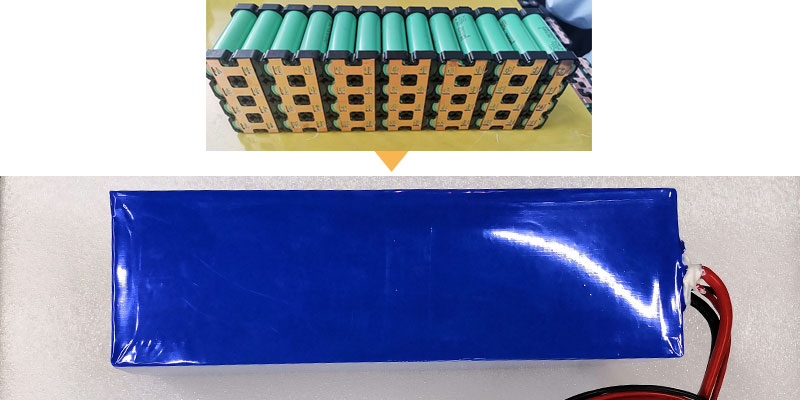
In this post, I’ll walk you through a real engineering case study: our 36V 15.6Ah
- long-endurance, medium-speed patrol scenarios
- Why capacity alone is misleading
Li–ion battery pack (spec sheet ref. 1488 Spe-Li-ion-36V-15.6Ah). You’ll see:
- How we test for for security robots
- What BMS parameters actually mean in the field
- How to move from a generic battery to a custom, production–ready solution
If you manufacture security patrol robots, inspection robots, or any autonomous mobile robot (AMR) that prioritizes runtime over peak power, this guide is for you.
2. What Security Patrol Robots Really Need from a Battery
Most battery discussions start and end with voltage and amp-hours. But for a security robot, the operating profile is very specific.
2.1 The Real–World Patrol Cycle (from Daxbot)
According to Daxbot’s published data, a typical autonomous security robot:
- Patrols randomized routesfor 8–10 hours
- Moves at a steady medium speed(~3.7 mph)
- Runs sensors (cameras, LiDAR, thermal) continuously
- Sends alerts and video streams back to a command center
- Only rarely needs a short burst of higher power (e.g., moving to an incident)
This is not a drone racer or a warehouse AGV that needs extreme acceleration. It’s a long-endurance, low-C-rate application.
2.2 Engineering Priorities for This Use Case
When I review battery requirements with robot manufacturers, I rank these three metrics above all others:
| Priority | Metric | Why It Matters for Security Robots |
| 1 | Energy density (Wh/kg) | Longer patrol time without adding excessive weight |
| 2 | Discharge voltage stability | Stable sensor readings and control signals throughout the shift |
| 3 | Cycle life @ 80% SOC | Lower total cost of ownership – fewer replacements over the robot’s life |
👉 Peak discharge current is often the wrong focus. A 50A burst rating means nothing if the battery can’t deliver 3A steadily for 9 hours.
3. Engineering Deep Dive: 36V 15.6Ah Li–Ion Pack for Security Robots
Let’s open the spec sheet. Below are the key parameters from our 36V 15.6Ah pack (Model 36-156BP). Every number comes from actual GB/T18287-2013, UL1642, and CE61960 testing.
3.1 Core Specifications
| Parameter | Value |
| Nominal Voltage | 36V |
| Nominal Capacity | 15.6Ah |
| Energy | 561.6Wh |
| Cell Type | 18650 – 2600mAh |
| Configuration | 10S6P |
| Standard Charge / Discharge Current | 3.12A |
| Max. Continuous Discharge Current | 8A |
| Cycle Life | ≥300 cycles @ 80% SOC |
| Charge Temperature | 0°C to 45°C |
| Discharge Temperature | -20°C to 60°C |
| Dimensions (max) | 198 × 130 × 70 mm |
| Weight | ~3.2 kg |
3.2 What These Numbers Mean for a Security Patrol Robot
561.6Wh energy
At a typical robot power draw of 60–70W (including sensors, drive motors, and telemetry), this pack provides 8+ hours of active patrol. In low-power standby or between patrol cycles, runtime extends further.
8A max continuous discharge
Enough to support all onboard systems simultaneously – but not over-spec’ed for unrealistic peak loads. This keeps the BMS and cells operating in a safe, efficient zone.
300 cycles @ 80% capacity
For a robot that runs one full patrol per day, 300 cycles equals roughly 10 months of daily use before capacity drops to 80%. Many customers choose to replace packs at this point, but the robot still runs – just with shorter patrols. For comparison, a generic pack might drop below 80% after 150–200 cycles.
Temperature performance (from spec sheet §7.5)
- At 55°C: ≥90% capacity retention
- At -10°C: ≥60% capacity retention
Why I mention this: If your robot patrols outdoor parking lots or construction sites in winter, you must account for cold temperature derating. This is a chemical limitation of Li-ion, not a defect. For extreme cold, we often recommend a heated battery box or a different cell chemistry (LiFePO₄).
4. BMS and Safety: The PCM Parameters That Matter
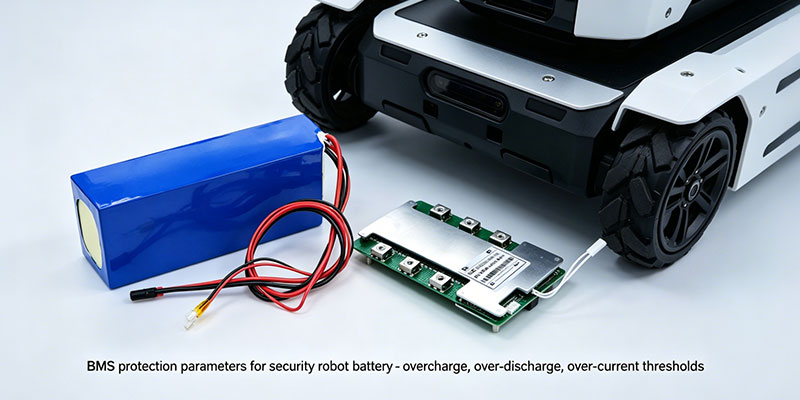
A battery pack without a robust protection circuit is a liability, especially for unattended security robots. Our pack uses a PCM (Protection Circuit Module) with the following thresholds (from spec sheet §5):
| Protection | Threshold | Delay | Reset |
| Over-charge | 4.25V ± 0.05V | 0.5-1 sec | 4.15V ± 0.05V |
| Over-discharge | 2.70V ± 0.05V | 0.5-1 sec | 3.0V ± 0.1V |
| Over-current | 33-55A | 0.5-1 sec | Release load |
| Short circuit | External short | Immediate | Release load |
4.1 Engineering Notes on These Settings
- Over–charge at 4.25V: We set this slightly below the cell’s absolute maximum (4.2V typical) to provide a safety margin while still allowing full charge.
- Over–discharge at 2.70V: This is conservative. Many Li-ion cells can go to 2.5V, but cutting off at 2.7V extends cycle life – exactly what long-endurance robots need.
- Over–current 33–55A: This range is well above the 8A max continuous discharge, so normal operation never trips it. But it will catch a stalled motor or a severe internal fault.
For robot manufacturers, this means you can deploy the pack in unattended charging stations or hot-swap scenarios with confidence that the BMS will handle abnormal conditions automatically.
5. Common Mistakes When Sourcing Security Robot Batteries
I review battery specs for robotics OEMs every week. Here are the three most frequent errors I see – and why they hurt your product.
❌ Mistake 1: Buying on Price Alone
A cheap pack might save $30 upfront. But if it fails after 150 cycles, you’ll face:
- Higher warranty returns
- Customer complaints about reduced patrol time
- Field replacement logistics
The real cost is rarely the battery itself – it’s the downtime and lost trust.
❌ Mistake 2: Focusing Only on Capacity (Ah)
Two packs can both be 15.6Ah, but one might have high internal resistance that causes voltage sag under a modest 5A load. The result: your robot’s motors starve for current halfway through a patrol, even though the “fuel gauge” still shows 40% remaining.
We measure internal resistance on every pack before shipping (spec sheet §7.2.3). Our target is ≤90mΩ for the assembled pack.
❌ Mistake 3: Using Off–the–Shelf Batteries Without Optimization
A standard “36V e-bike battery” might physically fit, but its BMS logic, connector, and discharge curve are tuned for a different load profile. This leads to:
- Premature BMS trip during normal operation
- Inefficient charging (wrong CC/CV profile)
- Poor thermal performance in your robot’s enclosure
My advice: Start with a reference design like our 36V 15.6Ah pack, then customize. It’s cheaper and faster than starting from zero.
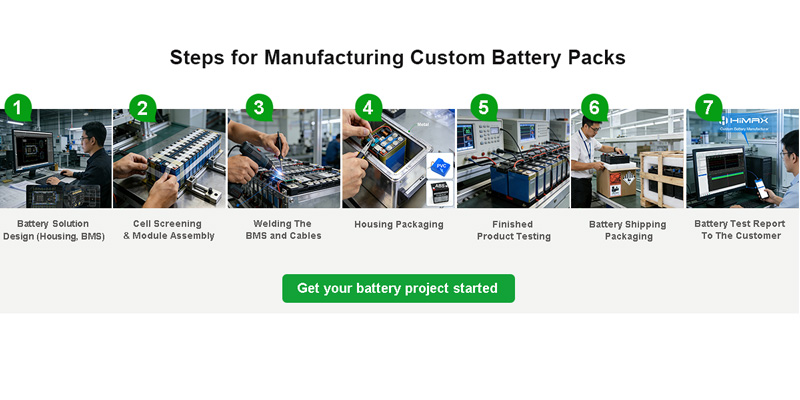
6. From Specification to Production: Our Engineering Support Process
When a robot manufacturer works with Himax, this is what the engineering workflow looks like.
Phase 1 – Requirements Analysis
You share:
- Robot power profile (typical current, peak current, duration)
- Desired patrol time (e.g., 10 hours)
- Operating environment (temperature, vibration, humidity)
- Mechanical constraints (size, weight, connector type)
Phase 2 – Prototype & BMS Tuning
We select cell configuration (e.g., 10S6P) and adjust BMS parameters (over-current, voltage thresholds) to match your robot’s real behavior. You receive 5–10 samples for in-house testing.
Phase 3 – Validation
We run the tests you see in this spec sheet: cycle life, temperature performance, crush, drop, vibration, and over-charge/over-discharge safety (see spec sheet §7–§9). You get a full test report.
Phase 4 – Mass Production
Each batch is inspected per AQL 0.65 (spec sheet §10.5). Shipment voltage is set to 37-39.5V (≈30-40% SOC) for safe transport, as required by UN38.3.
“The customer is requested to contact HIMAX in advance, if other applications or operating conditions than those described in this document.” – That’s not legal boilerplate. It’s an invitation to engineer together.
7. Real–World Validation: Daxbot and the Security Patrol Market
Daxbot’s deployment in parking lots, construction sites, and retail plazas confirms what we see in our test data: long-endurance Li-ion packs enable new use cases.
From their customer feedback: “They’re a deterrent for mischief. People see them, they’re less likely to do certain things.”
But a robot that runs out of battery at 2 AM stops being a deterrent.
Our 36V 15.6Ah pack is designed for exactly that: reliable energy from the start of patrol to the end, shift after shift.
8. Conclusion: Choose a Battery Partner, Not Just a Battery
For security patrol robots, inspection robots, and autonomous security platforms, the battery is not a commodity. It’s a system–level component that affects:
- Patrol time (directly tied to value delivered)
- Field reliability (warranty costs and brand reputation)
- Total cost of ownership (cycle life and maintenance)
At Himax Electronics, we provide more than cells and a BMS. We provide:
- Engineering support from prototype to production
- Consistent batch quality (tested per GB/T18287-2013)
- Long-term supply reliability for OEM customers
9. CTA – Start Your Custom Battery Project
If you are sourcing batteries for:
- Security patrol robots
- Inspection robots
- Autonomous mobile robots (AMRs)
- Any robot that prioritizesruntime over peak power
Share your robot’s power profile and operating environment with me.
I’ll personally review your specs and recommend the closest existing design – or work with you on a custom solution. You can reference our 36V 15.6Ah Li-ion pack (spec sheet 1488 Spe-Li-ion-36V-15.6Ah) as a baseline.
📩 Contact Himax Electronics
Attn: Shawn, Battery Engineer
Include: robot model, target patrol time, operating temperature range, estimated annual volume.
About the Author
Shawn – Battery Engineer, Power System Design
10+ years in lithium battery system design (Li-ion, LiFePO₄, LiPo). Specializes in BMS integration, thermal management, and custom power solutions for industrial robotics and medical devices.
Himax Electronics
ISO-compliant battery manufacturer with in-house engineering support.
📍 Shenzhen, China | 🌐 www.himaxelectronics.com
*Data sources: Internal test reports based on GB/T18287-2013, UL1642, CE61960 standards. Security robot patrol data referenced from Daxbot (daxbot.com/security-robots).*