
Introduction
LiPo 603450 battery selection is one of the most important decisions I make when customers ask me to recommend a reliable power source for a GPS tracker. I’m Caleb, a Battery Engineer at Himax Electronics, and I specialize in BMS & Protection Systems for lithium battery packs used in compact, high-reliability devices. In my daily work, I help customers build safer and more stable battery solutions with PCM/BMS protection against overcharge, over-discharge, over-temperature, and short circuit.
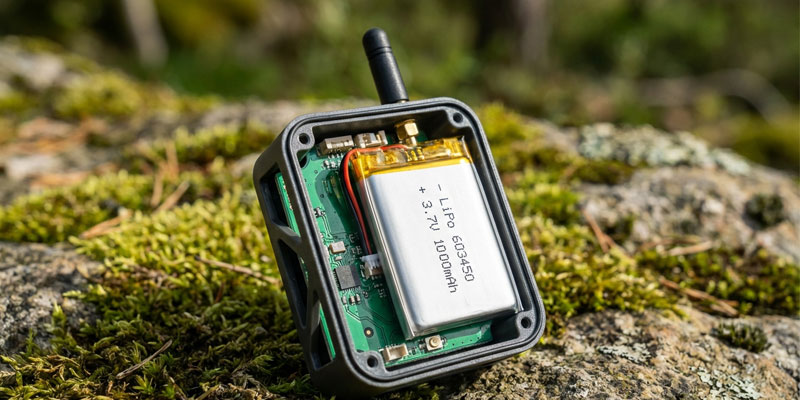
603450 LiPo for GPS tracker applications stands out because GPS devices often operate in demanding real-world conditions: long standby cycles, frequent location uploads, outdoor temperature variation, vibration, and very limited internal space. From my engineering perspective, the battery must be compact, dependable, and easy to integrate without sacrificing safety. That is exactly why I often recommend the 3.7V 1000mAh LiPo battery in the 603450 format. It offers a practical balance of size, runtime, protection, and discharge capability for many modern tracker designs.
Technical Specifications
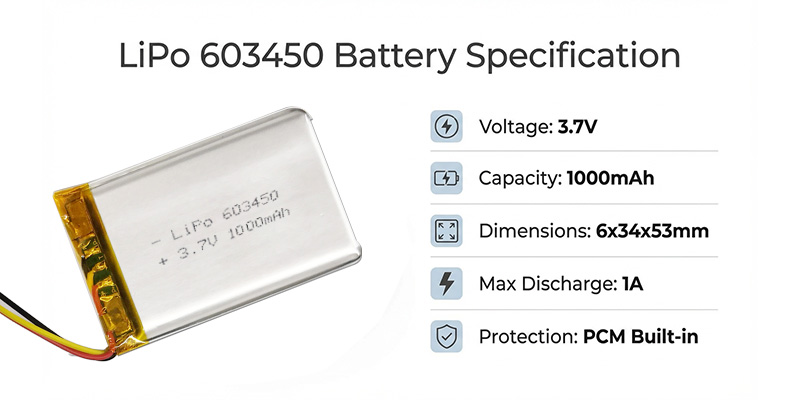
LiPo 603450 battery specifications matter because GPS tracker designers usually need clear electrical and mechanical data before finalizing their product layout.
| Parameter | Specification |
| Model | LiPo 603450 (1s1p) |
| Nominal Voltage | 3.7V |
| Max Charging Voltage | 4.2V |
| Nominal Capacity | 1000mAh |
| Cell Dimensions | 6.0 × 34.0 × 53.0 mm |
| Typical Dimension Reference | 603450 53mm battery |
| Continuous Discharge Current | 1A |
| Battery Type | Rechargeable Lithium Polymer |
| Protection | PCM protection: overcharge, over-discharge, short circuit, over-temperature |
| Recommended Charge Current | 0.2C to 0.5C |
| Standard Charge Current | 200mA (0.2C) |
| Max. Charge Current | 500mA (0.5C) |
| Max. Continues Discharge current | 1000mA (1C) |
| Approximate Weight | 17g |
| Cycle Life | 300–500 cycles typical at standard conditions |
| Operating Temperature (Discharge) | -10°C to 60°C |
| Operating Temperature (Charge) | 10°C to 45°C |
| Lead Configuration | Customizable wire length and connector |
| Integration Option | NTC / custom PCM / connector / label available |
Why This Battery is Ideal for GPS Trackers
603450 LiPo for GPS tracker designs works so well because it matches the real electrical behavior of most portable tracking devices. In many GPS trackers, the average current is relatively low during standby, but there are short bursts of higher current during GSM, LTE, or GNSS transmission. A 1A continuous discharge LiPo is usually more than enough for this type of device, especially when the hardware and firmware are optimized for low-power operation.
LiPo 603450 battery is also a very practical mechanical choice. With dimensions of 6x34x53mm, this cell fits into compact tracker housings where every millimeter matters. I often see customers comparing several sizes, but many of them eventually return to this format because it offers better runtime than smaller cells without becoming too bulky for portable use.
GPS tracker battery reliability is especially critical for devices used in fleet management, asset tracking, pet tracking, personal safety, and medical-related portable electronics. In these applications, an unexpected shutdown can mean lost data, missed location updates, or even safety risks. That is why I strongly prefer a LiPo battery with PCM for field devices. The protection circuit helps reduce the chance of battery abuse during charging, storage, shipping, and real-world use.
Compact LiPo battery 6x34x53mm designs like this one also help product teams simplify enclosure planning. For many GPS products, designers need a battery that is thin enough for a modern industrial design but still large enough to support practical working time. The 603450 format is often the sweet spot.
Key Advantages & Real-World Performance
LiPo 603450 battery performance is not just about the datasheet; it is about how the battery behaves inside a real product. Based on my experience supporting customer projects, these are the biggest advantages:
- Balanced size and capacity
The 3.7V 1000mAh LiPo batterygives GPS devices a strong balance between compact dimensions and useful runtime. - Stable discharge for tracker electronics
A 1A continuous discharge LiPois suitable for low-power communication modules, MCU control boards, and scheduled transmission cycles. - Added field safety with PCM
A LiPo battery with PCMhelps protect the cell from overcharge, over-discharge, short circuit, and temperature-related risks. - Flexible customization
I can adapt wire length, connector type, NTC, and PCM settings depending on the customer’s tracker PCB and housing.
603450 LiPo for GPS tracker projects has repeatedly proven to be a reliable choice in my work. I have supported customers who needed battery solutions for compact GPS tracking units where space was limited and uptime was critical. In those cases, the 603450 format performed well because it delivered enough capacity for practical operation while staying thin and integration-friendly. From an engineer’s point of view, that combination is hard to beat.
Comparison with Other Common GPS Batteries
GPS tracker battery comparisons are important because designers often evaluate multiple pouch cell sizes before locking the final BOM.
| Battery Model | Typical Capacity | Size | Main Advantage | Main Limitation |
| 502030 | ~250–350mAh | Smaller | Very compact | Much shorter runtime |
| 603048 | ~800–900mAh | Slightly shorter | Good for tighter layouts | Less capacity than 603450 |
| 603450 | 1000mAh | 6 × 34 × 53 mm | Best balance of size and runtime | Slightly larger than ultra-compact cells |
LiPo 603450 battery usually wins when runtime is more important than saving a few extra millimeters. Compared with a 502030 cell, the 603450 gives significantly more capacity, which means fewer charging intervals and a better user experience. Compared with 603048, it offers a little more room for energy storage while remaining compact enough for many handheld or concealed tracker designs.
Best battery for GPS tracker 2025 will depend on the device’s power profile, but for many mainstream trackers, I see the 603450 as one of the most practical options because it avoids the tradeoff of being too small to last or too large to fit.
Installation & Integration Tips for GPS Device Designers
603450 LiPo for GPS tracker integration should always start with actual current measurements, not assumptions. I recommend that designers measure average standby current, pulse current during transmission, and charging behavior under real firmware conditions.
LiPo 603450 battery integration becomes easier when you plan for these details early:
- Leave space for PCM and wire routing
The cell size is only part of the battery footprint. The PCM board, leads, insulation, and connector also require layout space.
- Validate charge voltage and current
A 7V 1000mAh LiPo batteryshould be charged with a proper CC/CV lithium charging profile ending at 4.2V.
- Add thermal consideration
If your GPS device is used in vehicles or outdoor enclosures, I strongly recommend temperature monitoring and careful charging control.
- Prevent compression and puncture risk
LiPo pouch cells should never be mechanically squeezed by the housing or screws.
- Match the connector to your assembly flow
I often help customers choose between JST-style connectors, solder tabs, or custom harnesses depending on production needs.
LiPo battery with PCM systems are much more effective when the whole device is designed around battery safety, not when PCM is treated as the only line of defense. If your product needs a custom pack, protection threshold adjustment, or connector support, this is where an engineering partner really matters.
For related battery solutions, I also recommend linking to your broader lithium polymer battery pages, custom battery pack pages, and team expertise pages such as the breast pump battery project page that reflects our engineering capabilities and application experience.
Safety First: How Our PCM Makes the Difference
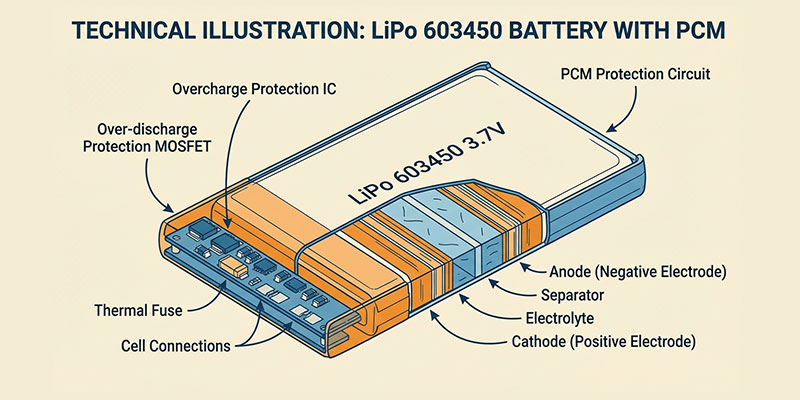
LiPo 603450 PCM protection is where I spend a lot of my engineering time, because protection design is what turns a good cell into a dependable battery solution. At Himax Electronics, I focus on building battery packs that do more than just provide voltage and capacity. My goal is to make them safer and more stable in real use.
LiPo battery with PCM helps defend against the most common failure risks in compact electronics:
- Overcharge protectionhelps prevent the cell voltage from rising beyond safe limits.
- Over-discharge protectionhelps avoid deep discharge that can permanently damage the battery.
- Short circuit protectionreacts quickly to wiring faults or accidental conductive contact.
- Over-temperature protectionadds another layer of control for applications exposed to harsh environments.
603450 LiPo for GPS tracker applications particularly benefit from PCM because many trackers are used remotely, inside vehicles, outdoors, or in devices that users may not charge correctly. In my experience, robust protection is not optional. It is one of the reasons a battery solution survives real-world use.
If your design needs a smarter protection strategy, this is also where a custom BMS or enhanced PCM can make a meaningful difference, especially for regulated or mission-critical applications.
FAQ
LiPo 603450 battery questions often come from device designers and purchasing teams, so here are the answers I give most often.
1. Is the 603450 a good GPS tracker battery?
603450 LiPo for GPS tracker use is an excellent choice for many compact devices because it balances thin size, 1000mAh capacity, and practical discharge capability.
2. What does PCM mean in a LiPo battery?
LiPo battery with PCM includes a protection circuit module that helps prevent overcharge, over-discharge, short circuit, and sometimes over-temperature.
3. Is 1A continuous discharge enough for a GPS tracker?
1A continuous discharge LiPo is enough for many GPS tracker designs, especially low-power devices with periodic transmission. Final validation should always be based on real current testing.
4. What are the exact dimensions of this battery?
Compact LiPo battery 6x34x53mm refers to a typical size of 6.0 × 34.0 × 53.0 mm, which is why some buyers also search for a 603450 53mm battery.
5. How long can a 1000mAh battery power a GPS tracker?
3.7V 1000mAh LiPo battery runtime depends on standby current, transmission interval, network type, and temperature. A low-power design can achieve useful operating time, but exact hours must be tested in the final device.
6. Can Himax Electronics customize this battery?
LiPo 603450 battery solutions can be customized with different connectors, wire lengths, labels, NTC, and PCM settings based on your device requirements.
7. Is this the best battery for GPS tracker 2026 designs?
Best battery for GPS tracker 2026 depends on your housing size and power budget, but the 603450 is one of the strongest options for compact trackers needing a reliable 1000mAh class cell.
Conclusion
LiPo 603450 battery remains one of my preferred recommendations for GPS tracker projects because it combines compact dimensions, practical 1000mAh capacity, stable 1A discharge, and essential PCM safety protection. As an engineer, I always look for the best balance between electrical performance, mechanical fit, and long-term reliability, and this battery checks those boxes for many real-world tracking applications.
603450 LiPo for GPS tracker projects can be further optimized with custom wires, connectors, PCM settings, and integration support. If you are designing a new tracker or improving an existing one, I’d be glad to help you evaluate the right battery configuration for your product. You can also explore our lithium battery product pages, learn more about our engineering capabilities, or reach out through our contact page for a custom solution.
Leave a comment or contact us for custom battery solutions.
Author: Caleb, Battery Engineer – BMS & Protection Systems, Himax Electronics
Published: March 16th, 2026
More information about LiPo batteries:
How to Maximize Performance and Safety with LiPo Batteries