
By Joan | Battery Engineer – Custom Pack Development · Himax Electronics
Specializing in custom battery pack development. Joan works closely with OEM clients to optimize voltage, capacity, and form factor. His work supports scalable mass production with strict quality control and long-term reliability.
Choosing the right battery for home alarm system is the first decision that determines long-term reliability. I have spent years on the factory floor and in client meetings. Yet one pattern never changes. Typically, security hardware engineers obsess over sensor accuracy, transmission range, and tamper detection. However, the battery gets selected last — almost as an afterthought.
Consequently, three months after deployment, the field service calls start. Sensors drop offline. Control panels beep every 30 seconds. Technicians drive out to swap batteries across dozens of locations. The product works perfectly. In contrast, the power solution does not.
If you are a security system manufacturer, OEM integrator, or large-scale procurement buyer, this guide is for you. We will break down exactly how alarm system power architecture works. We will show where standard batteries fail at scale. And we will explain what a properly engineered custom battery solution looks like in practice.
Understanding the Power Architecture of a Home Alarm System
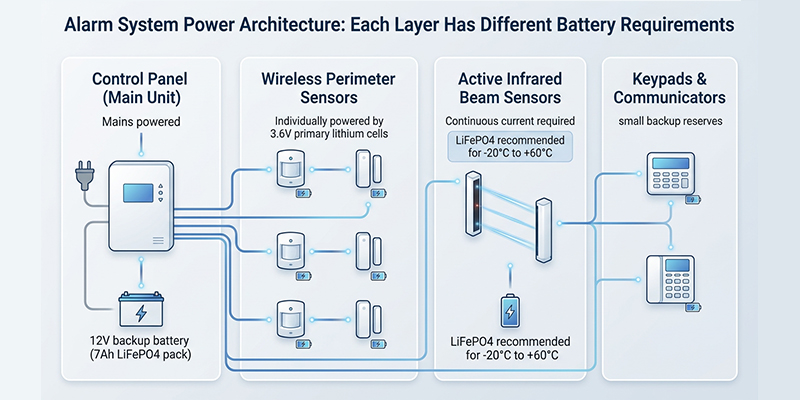
Before selecting any battery for home alarm system, you need to understand what you are actually powering. A modern home or commercial alarm system is not a single device. It is a distributed network of subsystems. Each subsystem has different power requirements.
The Control Panel (Main Unit)
The control panel is the brain of the system. It is typically mains-powered (AC). However, it requires a sealed backup battery — almost universally a 12V lead-acid or LiFePO4 pack — to maintain operation during a power outage. This is the battery most people think of when they hear “battery for home alarm system”. The most common specification is 12V 7Ah. Larger installations may call for 12V 12Ah or 17Ah packs. This battery must sustain the panel, sirens, and communication modules for a defined standby period — typically 24 to 72 hours per NFPA 72 and EN 50131 standards.
Wireless Perimeter Sensors (PIR, Door/Window, Infrared Beam)
These are the workhorses of perimeter security. Passive infrared (PIR) detectors, magnetic door/window contacts, and active infrared intrusion sensors are most often battery-powered. They use either primary lithium cells (3.6V LS14500, CR123A) or rechargeable packs. Their power consumption is ultra-low in standby mode (often under 1 µA). It spikes only during detection events and wireless transmission. Battery life for these sensors typically ranges from one to five years. The actual life depends on chemistry, trigger frequency, and ambient temperature.
Active Infrared (AIR) Beam Sensors for Perimeter Security
Active infrared intrusion sensors operate differently from passive PIR devices. The transmitter emits a continuous or pulsed infrared beam. The receiver monitors it constantly. This continuous operation demands more current — typically 1–10 mA in active mode. Therefore, battery selection becomes especially critical. Outdoor perimeter beam detectors operating at -20°C in a Nordic winter or +50°C in a Gulf Coast installation require a power source engineered for that environment. A standard AA cell will not work reliably.
Backup Power for Alarm Communicators and Keypads
Wireless communicators and remote keypads often carry their own small backup reserves. These are frequently overlooked in system-level power budgeting. However, a communicator that goes dark during a grid outage defeats the purpose of the entire installation.
Understanding this layered architecture is the starting point for any serious procurement decision. The battery for home alarm system in each layer has different chemistry, voltage, capacity, and environmental requirements.
Why Standard Batteries Fail at Scale: The Real Cost of Generic Power
In residential single-unit deployments, a standard 12V 7Ah SLA battery from a general distributor works well enough. You install it, forget it for three years, then replace it. That is fine.
But scale that to 500 sensor nodes across an industrial perimeter, or a portfolio of 2,000 alarm panels in a managed security service. The economics change completely.
The Beeping Problem
Walk into any forum where security installers and system integrators gather. The most discussed frustration is the same: alarm panels and wireless sensors start chirping every 30 seconds because of low battery warnings. This is not a nuisance — it is a service call. For large deployments, staggered battery degradation means you are perpetually dispatching technicians. When individual sensors in a large network reach end-of-life at random intervals, the maintenance overhead becomes a major hidden cost. That cost was not in the original project budget.
Temperature-Driven Capacity Loss
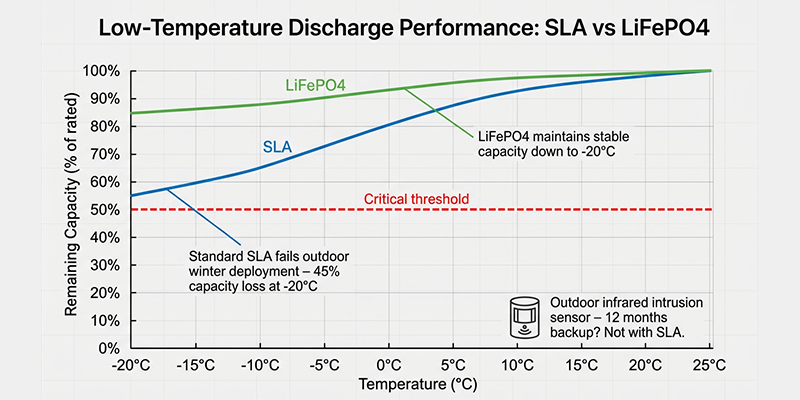
Standard sealed lead-acid batteries lose a significant portion of their rated capacity in cold environments. At 0°C, a typical SLA battery delivers roughly 80% of its rated capacity. At -20°C — entirely normal for outdoor perimeter security in northern climates — that figure drops to approximately 50–60%. For example, an outdoor infrared intrusion sensor specified for 12 months of backup operation with a standard battery might fail in six months during a cold winter. That is a security gap, not just a maintenance issue.
Lithium iron phosphate (LiFePO4) chemistry maintains stable capacity down to -20°C. Therefore, it is the correct choice for any outdoor battery for home alarm system and commercial perimeter applications.
Batch Inconsistency in Generic Batteries
When you purchase commodity batteries at scale, you are buying from a distribution chain that sources from multiple cell batches. These batches often come from different factories. Capacity variance of 10–15% across a batch is not unusual. For sensors that rely on precise low-battery detection thresholds communicated via the panel’s BMS, this variance translates into unpredictable warning timelines. Some sensors alarm early. Others fail silently before triggering a warning at all.
BMS Incompatibility and False Low-Battery Signals
This is a pain point I see repeatedly with OEM clients. Many modern wireless intrusion sensors and control panels communicate battery health data back to the central management platform. A non-OEM battery without a properly tuned Battery Management System (BMS) may report incorrect state-of-charge data. It may trigger false low-battery alerts. Or it may fail to communicate at all. The result is unnecessary service calls and eroded trust in the system’s reliability.
Battery Chemistry Comparison: Choosing the Right Technology
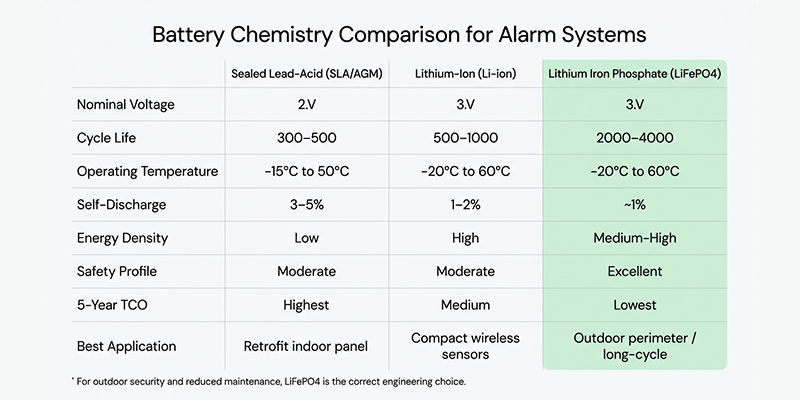
Not all battery chemistries are equal for alarm applications. Here’s how the three main technologies compare across the criteria that matter most for security deployments.
| Parameter | Sealed Lead-Acid (SLA/AGM) | Lithium-Ion (Li-ion) | Lithium Iron Phosphate (LiFePO4) |
| Nominal Voltage | 12V (6-cell) | 3.6–3.7V/cell | 3.2V/cell |
| Cycle Life | 300–500 cycles | 500–1,000 cycles | 2,000–4,000 cycles |
| Operating Temperature | -15°C to 50°C | -20°C to 60°C | -20°C to 60°C |
| Self-Discharge (per month) | 3–5% | 1–2% | ~1% |
| Energy Density | Low | High | Medium-High |
| Safety Profile | Moderate (sulfuric acid) | Moderate (thermal runaway risk) | Excellent (stable chemistry) |
| Maintenance | Low (VRLA) | None | None |
| Cost (initial) | Lowest | Medium | Medium-High |
| 5-Year TCO | Highest (replacements) | Medium | Lowest |
| Best Application | Retrofit, low-cost indoor panel | Compact wireless sensors | Outdoor perimeter, long-cycle deployments |
For control panel backup power in indoor environments with a tight budget and existing SLA infrastructure, a quality AGM battery remains a practical choice. For wireless infrared intrusion sensors deployed outdoors, for high-cycle managed security service equipment, or for any application where reducing field maintenance is a priority, LiFePO4 is the correct engineering decision.
Key Technical Specifications: What B2B Buyers Must Evaluate
When issuing an RFQ or evaluating a battery supplier for alarm system applications, these are the parameters that matter. Your supplier should answer them precisely.
Voltage and Capacity
The most common specifications for alarm system batteries:
-
3.6V / 1,200–3,600 mAh — Wireless door/window sensors, PIR detectors (primary lithium LS14500 format)
-
3.7V / 1,000–3,000 mAh — Compact wireless intrusion sensors (Li-ion/LiPo custom packs)
-
12V / 7Ah–17Ah — Control panel backup (SLA or LiFePO4 pack)
Capacity must be validated at the actual discharge rate of the application, not just at the standard 0.2C rate used in most datasheets. For example, a battery rated at 7Ah at 0.2C may deliver only 6.2Ah at the continuous current draw of a loaded alarm panel.
Standby Current (Self-Discharge)
For wireless sensors expected to operate for 2–5 years without replacement, self-discharge is as important as rated capacity. LiFePO4 cells with monthly self-discharge rates below 1% are essential for long-deployment sensors. Therefore, insist on measured self-discharge data, not just chemistry-class averages.
Low-Temperature Discharge Performance
Request discharge curves at -10°C and -20°C specifically. For a battery for home alarm system used outdoors or in an unheated enclosure, a 20°C room-temperature curve tells you very little about real-world performance.
BMS Functions and Communication
For any rechargeable pack, the BMS must provide:
-
Overcharge protection
-
Over-discharge cutoff
-
Short-circuit protection
-
Over-temperature shutdown
-
Cell balancing (for multi-cell packs)
For OEM integration, confirm whether the BMS supports your system’s communication protocol for state-of-charge reporting. A BMS-less pack in a managed system is a liability.
Certifications
Depending on your target market:
-
UN38.3 — Mandatory for air shipment of lithium batteries
-
IEC 62133 — Consumer and portable battery safety standard (required for most EU products)
-
UL 1642 / UL 2054 — Required for US market lithium batteries and packs
-
CE — Required for EU market
-
EN 50131 — European alarm system performance standard; your battery supplier should understand its power supply requirements
The Case for Custom Battery Packs in OEM Security Products
If you’re manufacturing alarm systems or intrusion detection equipment, there comes a point where a standard off-the-shelf battery format stops serving you — and your customers — well.
Here’s what a custom battery pack development engagement actually looks like, and why it delivers measurable value.
Form Factor Optimization
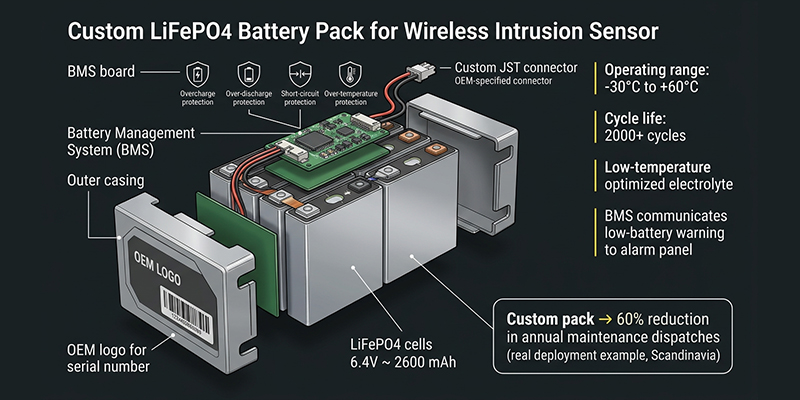
Standard battery formats like 18650 cells or SLA bricks are designed for the broadest possible market. Your product housing, PCB layout, and weight distribution have specific requirements. A custom pack is designed around your enclosure geometry. It optimizes cell arrangement, connector placement, and overall dimensions. As a result, you can reduce product size, improve thermal management, or enable a design feature that a standard format would block.
Voltage and Capacity Tuning
Your device’s microcontroller and RF module have a defined operating voltage range. A custom pack can be tuned to deliver precisely the voltage curve that keeps your electronics in their optimal operating window for the longest possible time. As a result, this avoids the voltage sag that causes premature shutdowns in standard packs as they approach depletion.
Connector and Interface Standardization
For high-volume production, connector standardization across your product line reduces assembly error. It also simplifies field replacement. Your service teams can work with a single part number. Custom packs are built to your connector specification from day one.
OEM Labeling and Traceability
For managed security service providers deploying thousands of units, battery traceability matters for warranty claims, maintenance scheduling, and regulatory documentation. Custom packs can be built with your branding, serial number labeling, and lot-level traceability built into the supply chain.
A Real Deployment Example
A European security system integrator came to us with a specific challenge. Their wireless PIR sensors and outdoor infrared intrusion sensors were being deployed in remote agricultural perimeters in Scandinavia and Eastern Europe. Standard primary lithium cells were failing within 18 months in cold conditions. The logistics of field replacement across widely distributed rural installations was becoming unsustainable.
We developed a custom LiFePO4 pack for their sensor line: 3.2V nominal, 2,600 mAh, with a low-temperature optimized electrolyte and a miniaturized BMS configured to their panel’s low-battery communication protocol. Operating range: -30°C to +60°C. The result was sensor battery life exceeding 4 years in field conditions, and a 60% reduction in annual maintenance dispatch events. Their field service cost per site dropped significantly in the first full year of deployment.
B2B Procurement Decision Checklist
Before reaching out to a battery supplier for an alarm system project, work through these questions. Your answers will determine the right specification and help you evaluate supplier capability quickly.
Application Layer
- Am I powering a control panel (backup), a wireless sensor, or both?
- Is this a new design or a retrofit/replacement procurement?
Environmental Requirements
- What is the minimum operating temperature in the field?
- Is the battery installed indoors (panel cabinet) or outdoors (perimeter sensor enclosure)?
- What IP rating does the enclosure achieve? Does the battery need to match?
Performance Requirements
- What is the required backup duration (hours) at rated load current?
- What battery life (years) is promised to the end customer?
- Does the system platform communicate battery health data back to a management interface?
Volume and Supply Chain
- What is your annual unit volume? (Determines MOQ feasibility for custom packs)
- Do you require OEM labeling, serial number traceability, or custom connectors?
- What certification marks are required for your target market?
Total Cost of Ownership
- Have you calculated the total field replacement cost over a 5-year deployment life for standard batteries versus a custom long-cycle solution?
- What is the cost of a single technician dispatch to your average field site?
If you find yourself uncertain about several of these questions, that’s normal — and it’s exactly what a battery engineering consultation is designed to resolve before you commit to a specification.
How Himax Electronics Supports Security System Manufacturers
At Himax Electronics, we have built our battery engineering capability specifically around the requirements of industrial and commercial OEM clients — not consumer retail. Our perimeter security and intrusion sensor battery solutions are developed through a structured engineering engagement, not a catalog lookup.
Our process begins with a technical review of your device’s power architecture, load profile, and environmental operating conditions. From there, our pack development team designs the cell configuration, BMS parameters, and form factor to match your specification. Samples are validated against your system before any production commitment.
For alarm system applications specifically, we offer:
-
LiFePO4 and Li-ion custom packs for wireless intrusion sensors, PIR detectors, and perimeter beam sensors
-
12V backup battery solutions for control panels, with AGM and LiFePO4 options depending on cycle life and temperature requirements
-
BMS-integrated packs with configurable low-battery thresholds and communication interfaces
-
Operating range -20°C to 60°C as standard, with extended low-temperature electrolyte options for extreme environments
-
9-tier safety testing protocol covering overcharge, over-discharge, short circuit, crush, thermal abuse, and vibration
-
Full certification support: UN38.3, IEC 62133, CE, UL — coordinated through our in-house compliance team
-
OEM labeling, custom connectors, and lot traceability for managed service deployments
Our intelligent BMS design extends effective battery life by up to 30% compared to standard pack configurations in the same form factor. That is a measurable difference in field maintenance frequency and total deployment cost.
We work with security hardware manufacturers, alarm panel OEMs, and large-scale integrators across Europe, North America, and Southeast Asia. If your organization is evaluating battery options for a new product line, a retrofit procurement, or a custom development project, we are set up to support that engagement from initial specification through to volume production.
Final Thoughts: Power Is Not a Secondary Specification
The performance of your alarm system — in the field, over years of deployment — is ultimately constrained by the reliability of its power source. A sensor that goes dark because of a failed battery is indistinguishable from a sensor that was never installed. The security gap is the same.
For B2B buyers and OEM manufacturers, the question is not simply “which battery fits the slot?” It is: What power solution, designed for our specific application environment and deployment scale, will minimize maintenance costs, meet certification requirements, and protect the reliability promise we have made to our customers?
If you have read this far, you are asking the right questions. The next step is a direct conversation with an engineer who can map your requirements to a validated solution.
Ready to discuss a custom battery solution for your alarm system product line?
Contact our engineering team at Himax Electronics to request a technical consultation and sample evaluation. We respond to all OEM inquiries within 24 hours.
Related resource: Perimeter Security & Intrusion Sensors Battery Solutions — Himax Electronics