NiMH Battery Discharge Performance at Different Temperatures
A Technical Case Study from Himax Battery
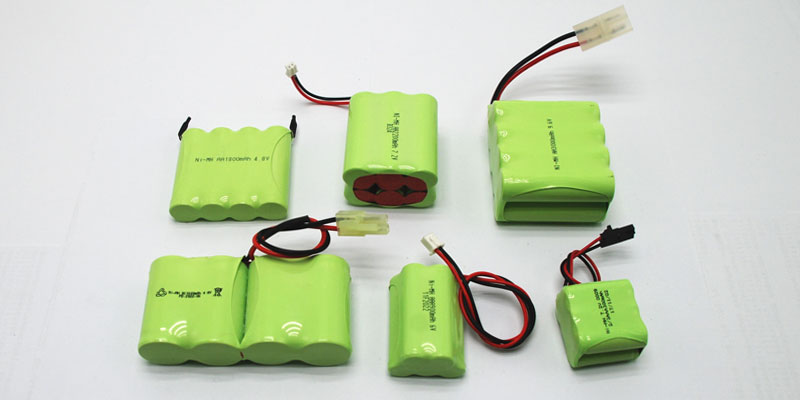
Nickel-Metal Hydride (NiMH) batteries remain a reliable power solution for backup systems, medical equipment, emergency lighting, industrial devices, and consumer electronics due to their safety, durability, and stable performance.
However, temperature has a significant impact on NiMH battery discharge behavior, and misunderstanding this relationship can lead to incorrect technical conclusions.
At Himax Battery, we believe that providing accurate battery data and professional technical guidance is just as important as manufacturing high-quality batteries.
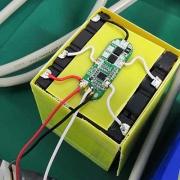
In this case study, our engineers analyzed the discharge performance of a NiMH 12V 2200mAh battery pack under different temperature conditions and corrected a commonly misunderstood discharge curve.
Test Conditions for the NiMH Battery Case Study
Battery model tested:
NiMH 12V 2200mAh battery pack
Test parameters:
| Parameter | Condition |
| Charge method | 0.2C × 6.5h |
| Discharge rate | 0.2C |
| Cut-off voltage | 1.0V per cell |
| Test temperatures | −10°C / 0°C / 20°C / 45°C |
| Ambient temperature | 20 ±5°C |
These parameters reflect typical testing conditions used by battery manufacturers and engineering laboratories.
Common Misinterpretation of NiMH Discharge Curves
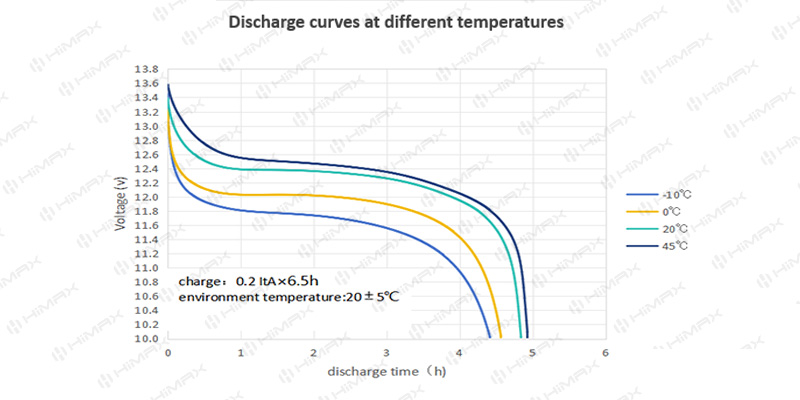
Some battery suppliers publish discharge curves similar to Figure 1, where the 45°C curve appears to deliver the highest capacity.
Figure 1 – Incorrect Interpretation of NiMH Temperature Performance
Figure 1: Incorrect interpretation of NiMH battery discharge curves at different temperatures. The graph suggests that higher temperatures always improve capacity, which does not reflect the real electrochemical behavior of NiMH batteries.
Technical Note
The curve shown above suggests the following relationship:
45°C > 20°C > 0°C > −10°C
This assumption is often based on the idea that higher temperature reduces internal resistance, which can increase voltage output.
However, this interpretation does not accurately reflect NiMH battery electrochemistry.
NiMH batteries are sensitive to elevated temperatures, which can accelerate internal side reactions such as:
- Oxygen recombination reactions
- Electrolyte degradation
- Increased self-discharge
- Parasitic chemical reactions
As a result, excessive temperature does not necessarily increase usable discharge capacity.
Correct NiMH Temperature Behavior Verified by Himax Battery
After carefully reviewing the experimental data, Himax Battery engineers reconstructed the discharge curves, shown in Figure 2.
Figure 2 – Correct NiMH Battery Discharge Curves at Different Temperatures
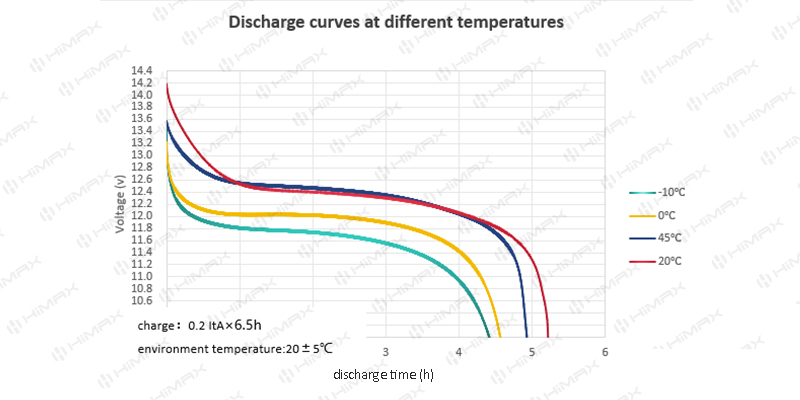
Figure 2: Corrected NiMH battery discharge curves verified by Himax Battery engineers. The results show optimal performance near 20°C, with reduced capacity at both low and high temperatures.
Technical Interpretation
The correct relationship between temperature and discharge capacity is:
20°C > 45°C > 0°C > −10°C
This pattern reflects the typical electrochemical behavior of NiMH batteries.
| Temperature | Discharge Performance | Reason |
| −10°C | Lowest capacity | High internal resistance and slow hydrogen diffusion |
| 0°C | Moderate performance | Reduced electrochemical activity |
| 20°C | Optimal capacity | Balanced reaction kinetics and minimal side reactions |
| 45°C | Slightly reduced capacity | Increased self-discharge and parasitic reactions |
This confirms that NiMH batteries perform best near room temperature (around 20°C).
Why Accurate Battery Data Matters
Incorrect battery performance curves can lead to:
- Improper system design
- Overestimated battery capacity
- Reduced product reliability
- Poor user experience
At Himax Battery, every battery model undergoes rigorous engineering verification, including:
✔ charge-discharge performance testing
✔ temperature performance validation
✔ internal resistance measurement
✔ long-term cycle life testing
Our engineers review and verify all data to ensure that customers receive reliable and realistic battery specifications.
Himax Battery Commitment to Quality and Engineering Accuracy
As a professional NiMH battery manufacturer, Himax Battery focuses on:
- advanced battery design
- strict manufacturing quality control
- accurate performance data
- transparent technical documentation
This commitment allows us to deliver reliable power solutions trusted by global OEM customers.
Whether used in medical equipment, industrial systems, or backup applications, Himax NiMH batteries are designed to perform reliably under real operating conditions.
Conclusion
Temperature significantly influences NiMH battery discharge performance.
Through this NiMH 12V 2200mAh case study, Himax Battery demonstrates that the correct temperature relationship is:
20°C > 45°C > 0°C > −10°C
By correcting inaccurate interpretations and sharing professional battery knowledge, Himax Battery helps customers better understand battery behavior and select the right power solution.