
Engineering Insights from Himax Battery Engineer Joan
Drone batteries must deliver extremely high current, stable voltage output, and reliable performance under demanding flight conditions.
At Himax Battery, our engineering team frequently works with UAV manufacturers that require high-discharge lithium polymer batteries capable of powering motors, ESC systems, and flight controllers simultaneously.
In this article, I will explain the design considerations behind a typical 22.2V 5000mAh 35C LiPo drone battery, based on the Himax battery specification for model 8843125 6S1P.
As a battery engineer, I will also address a common question:
Why do most drone batteries not include a protection board (PCM/BMS)?
Overview of the 22.2V 5000mAh LiPo Drone Battery
The battery pack analyzed in this case study uses a 6S1P lithium-polymer configuration, meaning six LiPo cells connected in series.
Key specifications include:
| Parameter | Specification |
| Battery Type | Lithium Polymer |
| Configuration | 6S1P |
| Nominal Voltage | 22.2V |
| Capacity | 5000mAh |
| Energy | 111Wh |
| Charge Voltage | 25.2V |
| Discharge Cut-off Voltage | 18.0V |
| Max Continuous Discharge | 87.5A |
| Cycle Life | ≥500 cycles |
| Working Temperature | −10°C to 60°C |
These parameters make the battery suitable for medium-to-large UAV platforms, aerial photography drones, and industrial drones.
What Does 35C Discharge Mean for a Drone Battery?
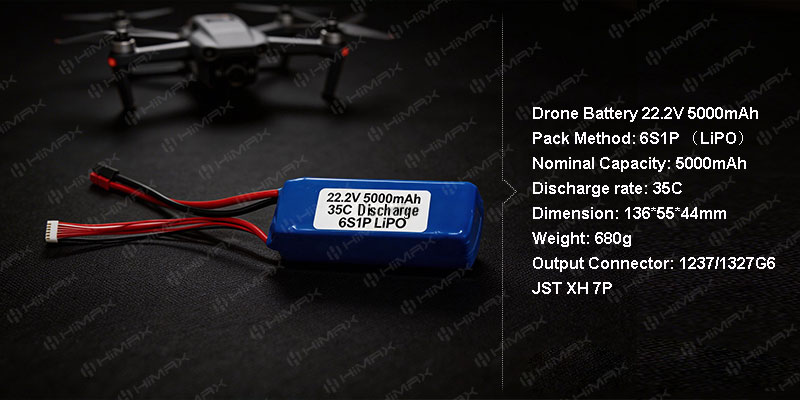
One of the most important parameters for drone batteries is the C-rate, which indicates how quickly the battery can discharge relative to its capacity.
For this battery:
Capacity = 5000mAh (5Ah)
Discharge rate = 35C
Maximum discharge current:
5Ah × 35C = 175A peak capability
However, in practical pack design, the continuous current rating is limited to 87.5A to ensure thermal stability and cycle life.
High-discharge capability is critical because drone propulsion systems demand rapid bursts of current, especially during:
- takeoff
- aggressive maneuvering
- payload lifting
- wind resistance compensation
Without a high-rate LiPo battery, drones would experience voltage sag and unstable flight performance.
Why Drone LiPo Batteries Usually Do NOT Use Protection Boards
One question we often receive from customers is:
Why do drone LiPo batteries typically operate without a protection circuit board (PCM)?
The answer is mainly related to current capability and response speed.
Protection circuits introduce several limitations:
1. Current Limitation
Most PCM/BMS solutions cannot handle extreme burst currents required by UAV motors.
For example:
Typical drone burst current:
100A – 200A
Most protection IC systems are designed for:
10A – 30A
Therefore, including a PCM would restrict the performance of the drone power system.
2. Response Speed
Drone motors controlled by ESC (Electronic Speed Controllers) require very fast current response.
Protection circuits may introduce:
- voltage drop
- current throttling
- slower response times
This could lead to unstable motor output or reduced thrust.
3. Weight and Space Constraints
Every gram matters in UAV design.
Adding a protection board increases:
- weight
- wiring complexity
- internal resistance
For high-performance drones, these trade-offs are often unacceptable.
How Drone Batteries Stay Safe Without Protection Boards
Even though drone batteries usually do not include PCM protection, safety is maintained through other design mechanisms.
1. Intelligent Drone Flight Controllers
Most UAV systems monitor:
- pack voltage
- individual cell voltage
- battery temperature
- remaining capacity
If abnormal conditions occur, the drone will automatically trigger a return-to-home or landing sequence.
2. External Smart Chargers
LiPo drone batteries rely on balanced charging systems, which manage:
- cell balancing
- charge voltage limits
- charge current control
For the Himax battery:
Maximum charge voltage:
25.2V
Charging follows the CC/CV method.
3. Strict Manufacturing Quality Control
At Himax Battery, every LiPo pack undergoes multiple quality tests including:
- internal impedance measurement
- vibration testing
- crush testing
- short-circuit testing
- cycle life verification
These tests ensure the battery can withstand real drone operating conditions.
Temperature Performance of Drone LiPo Batteries
Drone batteries must operate across a wide range of environments.
For the 22.2V 5000mAh pack:
| Condition | Temperature |
| Charging | 10°C – 45°C |
| Discharging | −10°C – 60°C |
| Storage | −10°C – 30°C |
Operating outside these ranges may cause:
- capacity degradation
- internal resistance increase
- potential safety risks.
Safety Considerations for High-Discharge LiPo Batteries
Due to the high energy density of lithium-polymer cells, users must follow several important precautions.
Key recommendations include:
- Use dedicated LiPo chargers
- Avoid over-discharge below 18.0V
- Do not short-circuit battery terminals
- Avoid exposure to temperatures above 70°C
- Store batteries at partial charge (30–50%)
Following these guidelines significantly extends battery life and operational safety.
Conclusion
High-performance drones require high-discharge lithium polymer batteries capable of delivering stable current under demanding flight conditions.
The Himax 22.2V 5000mAh 35C LiPo battery demonstrates how careful engineering design enables:
- high current capability
- stable voltage output
- reliable cycle life
- safe operation without a protection board
Understanding these engineering principles helps UAV manufacturers and drone enthusiasts choose the right power solution for demanding aerial applications.
At Himax Battery, our engineering team continues to develop high-performance LiPo batteries optimized for UAV platforms and industrial drone systems worldwide.