Why Lithium-Ion Batteries Must Be Charged Using the CC/CV Method

Lithium-ion batteries have become ubiquitous in modern electronics due to their high energy density and long cycle life. However, their unique chemical characteristics make proper charging crucial for both safety and longevity. Among all charging methods, the CC/CV (Constant Current / Constant Voltage) method is universally recommended.
1. Chemical Characteristics of Lithium Batteries
Lithium batteries store energy by lithium ions intercalating/de-intercalating between the anode and cathode. Key characteristics:
Nonlinear voltage-SOC relationship: At the beginning and end of discharge, voltage changes quickly, while in the middle it’s relatively flat.
Sensitive to overvoltage: Exceeding 4.2V/cell (for typical LiCoO₂ batteries) can cause electrolyte decomposition, gas generation, or even thermal runaway.
Sensitive to overcurrent: High current accelerates electrode degradation and may even trigger internal short circuits.
Hence, charging must control both current and voltage.

2. CC/CV Charging Process
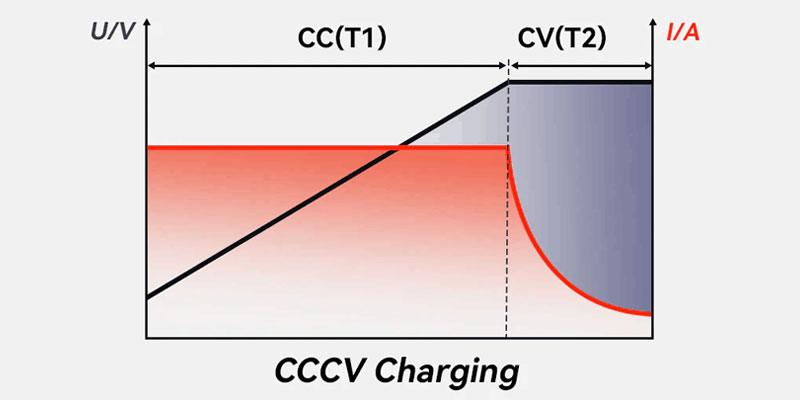
CC/CV charging splits the process into two stages:
① Constant Current (CC) Stage
Initial stage: battery voltage is low.
Charger provides a fixed current (e.g., 1C).
Battery voltage gradually rises to the target voltage (usually 4.2V/cell).
Purpose: Quickly charge the battery to ~70–80% capacity while keeping current safe to prevent overheating.
② Constant Voltage (CV) Stage
When battery voltage reaches 4.2V/cell (or rated voltage),
Charger maintains constant voltage, and the current gradually decreases.
Charging ends when current drops to a small value (e.g., 0.02C).
Purpose: Safely top off the battery and prevent overcharging.
3. Why You Can’t Use Only CC or CV
| Charging Method | Drawback |
| Constant Current only | When battery voltage is near full, current doesn’t decrease → overcharge → electrolyte decomposition, gas, swelling, lifespan loss, or even fire. |
| Constant Voltage only | When battery voltage is low, current is too high → overheating → battery damage, slow and unstable charging. |
Therefore, CC/CV is the standard and safe charging method for lithium batteries: fast in CC stage, safe in CV stage.
4. Additional Notes
Charging current is usually 0.5C–1C; too high can damage the battery.
Charging at high or low temperatures affects efficiency and safety.
Using a smart BMS (Battery Management System) prevents overcharge or over-discharge.
CC/CV charging perfectly matches lithium battery chemistry: constant current charges fast, constant voltage finishes safely, ensuring safety, efficiency, and long life. It is the only recommended charging method for lithium batteries.
In conclusion, the CC/CV charging method is not arbitrary—it aligns perfectly with the chemistry of lithium-ion batteries. By charging with constant current initially and switching to constant voltage for finishing, it ensures that batteries are charged quickly, safely, and with minimal wear, making it the only recommended method for lithium-ion battery charging.