
By Alden | Battery Engineer – Manufacturing & Quality Control, Himax Electronics
Every week, IoT product teams ship devices that work perfectly in the lab — and fail in the field within months. The sensors drop offline. The data stops flowing. The maintenance calls start piling up.
In most cases, the root cause isn’t the firmware. It isn’t the antenna. It isn’t the enclosure.
It’s the battery.
After years of hands-on work in battery pack manufacturing, aging tests, and OEM quality control at Himax Electronics, I’ve seen this pattern repeat across industries — from smart agriculture and building automation to industrial monitoring and smart home systems. Choosing the wrong battery isn’t just an engineering oversight; at scale, it becomes a supply chain and customer service crisis.
This guide breaks down the real battery challenges IoT product teams face, explains how to think through battery selection systematically, and shows how the right LiPo pack — like our 7.4V 2500mAh solution — can eliminate the most common failure modes before they reach your customers.
The 4 Battery Problems IoT Product Teams Keep Running Into
These aren’t theoretical edge cases. These are the situations I see repeatedly from B2B customers at the prototyping stage, during mass production ramp-up, and in post-deployment field reviews.
1. Battery Life Is Far Shorter Than Expected
The spec sheet said the device should run for 12 months. In deployment, it’s dying in 6 weeks.
This happens because most engineers calculate battery life using average current draw — but IoT sensors don’t consume power in a steady, average way. They sit in deep sleep mode drawing microamps, then wake up to transmit data and briefly pull 50 to 200 mA before going back to sleep. That transmission burst is short, but it’s repeated thousands of times over the product’s life.
If the battery can’t efficiently deliver high pulse currents — or if the battery chemistry chosen has high internal resistance — the energy wasted during each transmission is significant. Multiply that across a large deployment and you’re looking at dramatically reduced real-world battery life compared to datasheet projections.
The lesson: capacity (mAh) alone doesn’t determine runtime. The battery’s ability to handle your device’s specific power profile does.
2. Voltage Drops Cause Devices to Reset or Go Offline
A common failure mode that’s frustrating to diagnose: the device appears to work, but intermittently resets, drops from the network, or sends corrupt data.
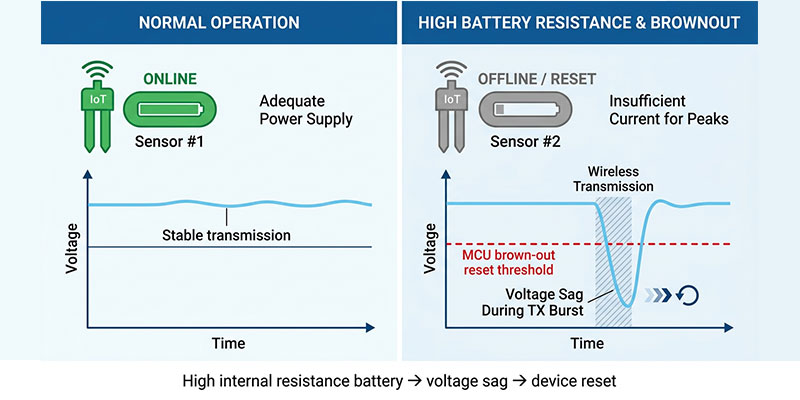
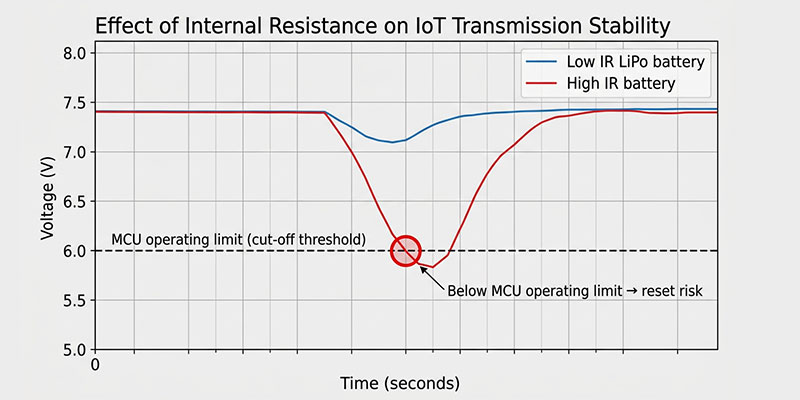
The cause is often a voltage collapse during transmission. When a wireless module fires — whether Zigbee, Wi-Fi, LoRa, or BLE — it demands a short but intense burst of current. A battery with high internal resistance will experience a sharp voltage drop during this burst. If the voltage dips below the microcontroller’s brown-out detection threshold, the MCU resets. The device reboots, reconnects, transmits again, collapses again — and rapidly drains itself in a cycle of failed reboots.
This is particularly common with coin cell batteries (CR2032) used in compact sensor designs. What looks like a software issue or a connectivity problem is actually a power delivery problem at the battery level.
3. No Clear Framework for Choosing Battery Chemistry
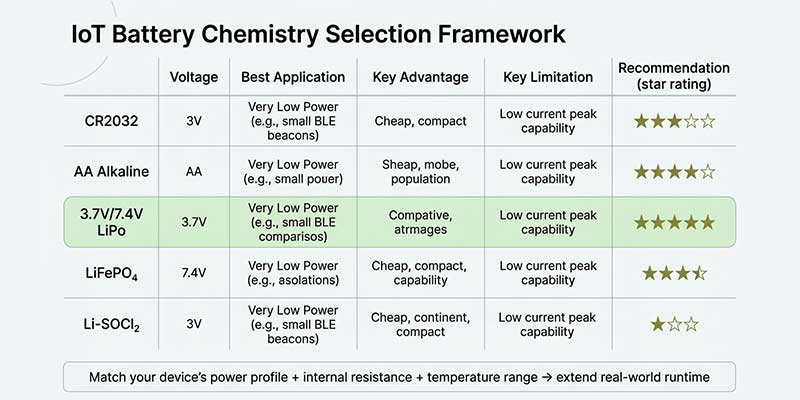
Ask five engineers which battery to use for an IoT sensor, and you’ll get five different answers — CR2032, AA alkaline, 3.7V LiPo, 7.4V Li-ion, Li-SOCl₂. Each has valid use cases, but selecting the wrong one for your application’s specific requirements leads to either premature failure or unnecessary cost.
The confusion is understandable. Battery selection involves balancing voltage, capacity, discharge curve, internal resistance, temperature range, cycle life, form factor, and regulatory certification. Without a structured framework, most teams default to what they’ve used before — which may not be the right fit for the new application.
4. Inconsistent Performance Between Prototype and Mass Production
Perhaps the most commercially painful problem: a battery that works well in prototype validation fails to deliver consistent performance at volume.
This happens when teams source prototype batteries from one supplier or batch, then switch to a different source for production. Cell grading, internal resistance variation, and quality control standards differ significantly between battery manufacturers. An OEM customer who has validated a design with Grade-A cells and then receives Grade-B cells in production will see a measurable reduction in cycle life and runtime — often without any change in the spec sheet numbers.
This is why supplier consistency and QC documentation matter as much as the battery’s specifications.
How to Select the Right Battery for IoT Devices: A Practical Framework
Understanding the problems is half the work. Here’s how to approach battery selection systematically.
Step 1: Define Your Power Profile Before You Choose a Battery
Before evaluating any battery, you need to know your device’s actual energy consumption pattern. The basic calculation looks like this:
Daily energy consumption (mAh) = (Sleep current × Sleep time) + (Active/Tx current × Active time)
For example, a soil moisture sensor that wakes every 15 minutes, transmits for 200ms at 80mA, and sleeps at 20µA for the rest of the time consumes roughly:
- Sleep: 20µA × 23.87 hours = 0.48 mAh/day
- Active: 80mA × (96 transmissions × 200ms) = 0.43 mAh/day
- Total: approximately 0.91 mAh/day
A 2500mAh battery in this scenario — assuming 80% usable capacity — would theoretically last over two years. But that figure only holds if the battery can deliver the 80mA transmission bursts without significant voltage sag. This is where chemistry and internal resistance enter the equation.
Step 2: Match Battery Chemistry to Your Application
Different battery chemistries serve different IoT use cases. Here’s a practical comparison:
| Chemistry | Nominal Voltage | Best For | Key Advantage | Key Limitation |
| CR2032 (Primary Li) | 3V | Ultra-low power, compact sensors | Small size, long shelf life | High internal resistance, not rechargeable |
| AA Alkaline | 1.5V | Low-cost prototypes, low-power nodes | Low cost, widely available | Poor performance in cold, not rechargeable |
| LiPo / Li-ion 3.7V / 7.4V | 3.7V / 7.4V | IoT gateways, multi-sensor hubs, industrial nodes | High energy density, rechargeable, thin/flexible form factor | Requires PCM protection circuit, charge temp ≥10°C |
| LiFePO₄ | 3.2V | Industrial, extreme temperature environments | Longest cycle life (2000+), safest chemistry | Larger form factor, lower energy density |
| Li-SOCl₂ (Primary) | 3.6V | Remote sensors, 10+ year deployments | Extremely long shelf life, wide temp range | Not rechargeable, specialized sourcing |
For most IoT devices that require rechargeable power — gateways, hub nodes, outdoor monitoring stations, and multi-sensor systems — Li-ion at 3.7V or 7.4V is the practical standard. It balances energy density, cycle life, and cost in a way no other chemistry currently matches.
Step 3: Evaluate Internal Resistance and Peak Current Capability
This is the specification most procurement teams overlook, and it’s the one that most directly determines whether your device will work reliably in the field.
Internal resistance determines how well the battery can maintain output voltage under load. A battery with low internal resistance will deliver clean, stable voltage even during high-current transmission events. A battery with high internal resistance will show significant voltage sag during the same events — potentially causing the device failures described earlier.
When evaluating batteries for wireless IoT devices, always request internal resistance data from the supplier and validate it with your device’s peak current profile. For Li-ion packs used in IoT applications, internal resistance below 100mΩ is generally a practical target for devices with active radio modules.
Step 4: Consider Temperature Range for Your Deployment Environment
Battery capacity and performance degrade at temperature extremes. A battery rated at 2500mAh at 25°C may deliver only 70–80% of that capacity at 0°C, and even less at -10°C.
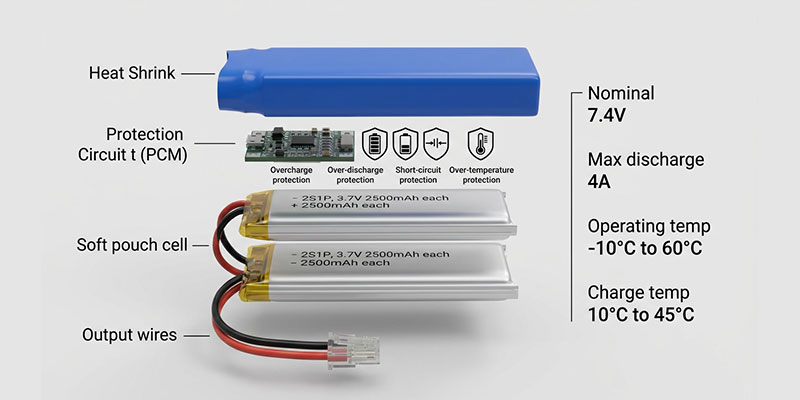
For outdoor deployments, cold storage monitoring, agricultural applications, or industrial environments, your battery chemistry must match the operating temperature range. The 635060-2S1P LiPo pack, for instance, supports discharge from -10°C to 60°C, but requires ambient temperatures of 10°C to 45°C for charging — a constraint that matters for devices deployed in cold climates where in-field recharging is part of the service model.
Step 5: Calculate Total Cost of Ownership, Not Just Unit Price
For B2B buyers deploying IoT devices at scale, the battery’s unit cost is rarely the largest cost factor. Consider:
- Labor cost of battery replacement: Replacing batteries across hundreds or thousands of deployed sensors involves logistics, technician time, and potential service downtime.
- Warranty and returns: Short battery life generates customer complaints and return merchandise authorizations.
- Supply chain continuity: A single-source battery with no backup supplier creates vulnerability.
A rechargeable LiPo battery with 300 charge cycles costs more per unit than a disposable alkaline, but across the lifetime of an IoT deployment, it typically delivers a significantly lower total cost of ownership — especially when devices are designed with accessible charging connectors or solar top-up capability.
A Ready-to-Deploy IoT Battery Solution: 7.4V 2500mAh LiPo Pack
At Himax Electronics, we’ve developed a 7.4V 2500mAh Lithium Polymer (LiPo) battery pack specifically suited for IoT applications that require stable, rechargeable power at a voltage level above single-cell 3.7V — including Zigbee gateways, multi-sensor controller nodes, outdoor monitoring stations, and smart agricultural systems.
Key Specifications
| Parameter | Specification |
| Model | 635060-2S1P |
| Cell Type | Lithium-ion Polymer (LiPo) |
| Nominal Voltage | 7.4V |
| Nominal Capacity | 2500mAh |
| Minimum Capacity | 2400mAh |
| Energy | 18.5Wh |
| Configuration | 2S1P (2 cells in series) |
| Charge Voltage | 8.4V (CC/CV method) |
| Standard Charge Current | 500mA |
| Max. Charge Current | 2500mA |
| Standard Discharge Current | 500mA |
| Max. Continuous Discharge Current | 4000mA |
| Discharge Cut-off Voltage | 6.0V |
| Internal Impedance (pack) | ≤220mΩ |
| Cycle Life | 300 cycles @ ≥80% capacity retention |
| Charge Retention (28 days) | ≥90% |
| Dimensions | Max 13 × 50.5 × 64mm |
| Weight | Approx. 102g |
| Output Wire | AWG22, 100±3mm |
| Output Connector | 5264-2P |
| Operating Temperature – Charge | 10°C to 45°C |
| Operating Temperature – Discharge | -10°C to 60°C |
| Storage Temperature | 0°C to 45°C |
| PCM Protection | Overcharge / over-discharge / overcurrent / short circuit |
| Reference Standards | GB/T18287-2013, UL1642, CE61580 |
Why 7.4V for IoT?
Many IoT gateway and controller designs — particularly those running higher-powered processors, multiple radio modules (Wi-Fi + Zigbee bridge, for example), or driving actuators alongside sensors — require a supply voltage above 3.7V to operate within efficient regulator ranges. A 7.4V (2S) pack allows the system’s step-down regulator to operate at higher efficiency, reducing thermal losses and extending overall runtime compared to a single 3.7V cell powering the same system through a boost converter.
The 2S configuration also distributes cell stress more evenly and gives the BMS more granular control over cell health, contributing to longer pack cycle life in real-world deployment conditions.
What the PCM Protection Means for Your Product
Our integrated PCM (Protection Circuit Module) isn’t an optional add-on — it’s an engineered safety layer that directly impacts your product’s reliability and regulatory compliance:
- Overcharge protectionprevents cell damage during charging, which is the primary cause of Li-ion degradation and thermal events.
- Over-discharge protectionprevents the cells from dropping below their minimum safe voltage, which irreversibly reduces capacity.
- Overcurrent and short-circuit protectionsafeguards against wiring faults or device-side component failures.
- Over-temperature protectionadds a last line of defense in environments where ambient temperatures exceed design parameters.
For OEM customers, a battery pack with integrated PCM means one fewer safety-critical component to design, source, and validate independently.
OEM Customization Options
The 7.4V 2500mAh pack is available as a standard configuration, but we routinely work with OEM customers to customize:
- Capacity (from 1000mAh to 5000mAh+ in the 7.4V 2S configuration)
- Connector type and cable length
- Physical dimensions and cell arrangement
- BMS parameters (charge cutoff voltage, protection thresholds)
- Label printing and brand marking
- Certification documentation for target markets (CE, UL, IEC 62133)
Need longer cycle life? The standard 635060-2S1P is rated at 300 cycles, which suits many IoT deployments. If your application requires 500+ cycles — for example, devices that recharge daily in industrial or agricultural settings — we can configure an alternative cell chemistry or cell grade to meet that target. LiFePO₄-based 7.4V packs, for instance, can achieve 1000–2000+ cycles at the same voltage level. Share your target cycle life and discharge profile, and our engineering team will recommend the most cost-effective solution.
Lead times from sample approval to mass production are typically 3–6 weeks depending on order volume and customization complexity.
Battery Procurement Checklist for IoT Product Teams
Before finalizing your battery supplier and specification, work through these six questions:
- What is your device’s operating voltage range?Ensure the battery’s discharge curve keeps the output within your regulator’s input range throughout the full discharge cycle — not just at full charge.
- What is your peak transmission current, and how frequently does it occur?This determines whether your chosen battery chemistry can handle the pulse load without voltage collapse. Request internal resistance data from your supplier and test under simulated load conditions.
- What temperatures will the battery experience in deployment?Account for the full range — not just nominal operating conditions, but worst-case winter outdoor temperatures or summer enclosure heat buildup.
- What is your target product lifetime, and does it require a rechargeable battery?If your product is expected to last 3–5 years in the field, a rechargeable LiPo battery rated for 300 cycles and an accessible charging mechanism is almost always more cost-effective than repeated primary battery replacement — particularly at deployment volumes above a few hundred units.
- What is your annual volume, and do you need a secondary supply source?Battery supply disruptions are a real risk. At Himax, we support customers with documented secondary cell source options and safety stock programs for high-volume OEM accounts.
- Which safety certifications are required in your target markets?UN 38.3 is the baseline for shipping. CE marking, UL, and IEC 62133 may be required depending on your product category and target geography. Confirm certification scope before locking in a battery specification.
Closing Thoughts
The battery is not a commodity component you finalize at the end of the design process. For wireless IoT devices, it is a foundational engineering decision that determines whether your product succeeds or fails in the field — and whether your production ramp goes smoothly or generates a flood of warranty returns.
Getting it right requires understanding your device’s actual power profile, selecting a chemistry that matches both the electrical and environmental demands of your application, and partnering with a battery manufacturer who can deliver consistent quality from prototype through mass production.
If you’re currently specifying a battery for an IoT project — or troubleshooting a deployment where battery performance isn’t meeting expectations — we’re glad to help. Share your device’s power profile and application requirements, and our engineering team will recommend the right battery configuration and send you a sample to validate.
Ready to solve your IoT battery challenge?
Contact Himax Electronics for a Free Technical Consultation →
Alden is a Battery Engineer in Manufacturing & Quality Control at Shenzhen Himax Electronics Co., Ltd. With hands-on experience across battery pack manufacturing, aging tests, and quality inspections, he works directly with OEM customers to ensure consistent performance, low defect rates, and stable supply from prototype to mass production.
Himax Electronics specializes in custom LiPo, Li-ion, LiFePO₄, and Ni-MH battery packs for IoT, industrial, medical, and consumer electronics applications. Learn more at himaxelectronics.com